
Neda’s By* family of Libre Services
A Vision and a Coperative Execution Plan
Document # PLPC-110004
Version 1.1
March 27, 2008
Available on-line at:
http://www.neda.com/PLPC/110004
Neda Communications, Inc.
3610 164th Place SE
Bellevue, WA 98008
Phone: (425) 644-8026
Fax: (425) 644-2886
E-mail: http://www.neda.com/ContactUs
Web: http://www.neda.com
Copyright © 2007,2008 Neda Communications, Inc.
Permission is granted to make and distribute complete (not partial)
verbatim copies of this document provided that the copyright notice
and this permission notice are preserved on all copies.
Contents
1.1 Document Organization
1.2 Document Formats
1.3 Who We Are
I Communal and Societal Dimmensions of Libre Services
2 Libre Services: Concept and Model
2.1 Introduction
2.1.1 The software development process
2.1.2 The free software movement
2.1.3 Our philosophy
2.2 The Subscriber Services industry
2.2.1 The industry today
2.2.2 Domination of the proprietary model
2.2.3 The problem: Governance by commercial interests
2.2.4 The solution: Free software presence in the services domain
2.3 The Libre Services model
2.3.1 Technological context
2.3.2 Benefits to society
2.3.3 Benefits to service providers
2.3.4 Our goal: Creation of the Libre Services industry
2.3.5 The need for a movement
2.3.6 The time is now
2.4 Libre Services: From concept to reality
2.4.1 Transformation of software into services
2.4.2 Freedom in principle vs. freedom in practice
2.4.3 Local software vs. network service
2.5 Separation of responsibility: FPF and Neda
2.5.1 Areas of responsibility
2.5.2 Complementary roles of FPF and Neda
2.5.3 Conflict of interest
2.6 Libre Services: Bootstrapping an industry
2.6.1 A project-based model for participation
2.6.2 Deployment and delivery
2.6.3 An invitation to participate
2.7 Starting point for bootstrapping
2.7.1 Engineering development
2.7.2 Deployment and delivery
3 Libre Services: Projects for Bootstrapping
3.1 Introduction
3.1.1 A project-based model for participation
3.1.2 Immediate mission-critical projects
3.1.3 Next stage projects
3.2 Libre Services Manifesto
3.2.1 Project description
3.2.2 Priority and schedule
3.2.3 Project sponsor and manager
3.2.4 Project status
3.3 Libre Services Forum
3.3.1 Project description
3.3.2 Priority and schedule
3.3.3 Project sponsor and manager
3.3.4 Project status
3.4 First-generation Libre Service Engines
3.4.1 Project description
3.4.2 Priority and schedule
3.4.3 Project sponsor and manager
3.4.4 Project status
3.5 Emacs Office Environment (EOE)
3.5.1 Project description
3.5.2 Priority and schedule
3.5.3 Project sponsor and manager
3.5.4 Project status
3.6 Libre Mobile Messaging (Operation WhiteBerry)
3.6.1 Project description
3.6.2 Priority and schedule
3.6.3 Project sponsor and manager
3.6.4 Project status
3.7 Libre Wireless Collaborative Networks (LWCN)
3.7.1 Project description
3.7.2 Project Notes
3.7.3 Priority and schedule
3.7.4 Project sponsor and manager
3.7.5 Project status
3.8 Libre School (Operation WhiteBoard)
3.8.1 Project description
3.8.2 Priority and schedule
3.8.3 Project sponsor and manager
3.8.4 Project status
3.9 LSIP software development & documentation
3.9.1 Project description
3.9.2 Priority and schedule
3.9.3 Project sponsor and manager
3.9.4 Project status
3.10 Foreign language translations of the Libre Service Manifesto
3.10.1 Project description
3.10.2 Priority and schedule
3.10.3 Project sponsor and manager
3.10.4 Project status
II Business and Commercial Dimmensions of Libre Services
4 The By* Concept: A Unified Model for Internet Services
4.1 Introduction
4.1.1 About this document
4.2 The By* Concept
4.2.1 The By* family of services
4.2.2 By* Libre Engines
4.2.3 Naming principles
4.2.4 User environments
4.2.5 Value propositions
4.3 Growth Dynamics and Models
4.3.1 Features and functionality
4.3.2 ByName service deployment: business motivations
4.3.3 Service usage
4.4 Development Roadmap
4.4.1 By* features and capabilities
4.5 Comparison to Existing Approaches
5 Neda Open Business Plan
5.1 Executive Summary
5.1.1 Setting the stage
5.1.2 The transformation of software into services
5.1.3 Free and proprietary software: cultural incompatibility
5.1.4 The Libre Services model
5.1.5 The By* model
5.1.6 Our strategic vision
5.1.7 This is all real
5.1.8 Key execution strategies
5.1.9 The Spearhead: By* Libre Texting
5.1.10 Where we are today
5.1.11 Moving forward
5.1.12 The need for broad participation
5.1.13 Conceptual foundations
5.1.14 Summary of references and pointers
5.2 A New Model for Internet Services
5.2.1 Libre Services
5.2.2 The By* concept
5.2.3 Growth dynamics
5.3 About this Initiative
5.3.1 Scope and scale
5.3.2 An engineering construct
5.3.3 Open and collaborative
5.4 About this Business Plan
5.4.1 An open Business Plan
5.5 Framework for Participation
5.5.1 Separation of responsibility: Neda and FPF
5.5.2 Libre Services participation
5.5.3 By* participation
5.6 Revenue Models
5.6.1 Hosting and subscriber services
5.6.2 Advertising
5.6.3 Transaction fees
5.6.4 Franchising
5.6.5 Website development and customization
5.6.6 Deployment and software consulting
5.6.7 Registration processing fees
5.6.8 Colocation
5.6.9 Consulting
5.6.10 Non-revenue
5.7 Execution
5.7.1 By* deployment schedule
5.7.2 Phase I: Near-term deployment
5.7.3 Phase II: Long-term direction statement
5.7.4 Adaptability to financing
5.7.5 Engineering and operations
5.7.6 Promotion
5.7.7 Recruiting
5.8 Status and Assets
5.8.1 Conceptual definition
5.8.2 By* services
5.8.3 Software distribution centers
5.8.4 Business infrastructure
5.8.5 Execution and revenue status
5.9 The Wireless Component
5.9.1 WhiteBerry mobile messaging
5.9.2 Libre Community WiFi
5.10 Competitive Advantages
5.11 Risks and Competition
5.11.1 Non-risk: engineering execution
5.11.2 Major risk: business execution
5.11.3 Competing Internet services
5.11.4 Timing
5.12 The Company
5.12.1 The people
5.13 Financing
5.13.1 An open investment model
5.13.2 Use of proceeds
5.13.3 Financial projections
5.13.4 ROI and exit
5.14 An Invitation to Participate
6 By* for Network Service Providers – A Proposal
6.1 Executive Summary
6.1.1 Part of a bigger picture
6.1.2 If not now, then prepare
6.2 Background
6.2.1 Libre Services: A non-proprietary services model
6.2.2 By*: A unified services model
6.2.3 The By* family of services
6.2.4 The By* development model
6.2.5 Development status and roadmap
6.3 The Opportunity for Network Service Providers
6.3.1 Business models
6.3.2 Corporate financing
6.4 About Neda
6.5 Project Outline
6.5.1 Scope of work and deliverables
6.5.2 Schedule
6.5.3 Commercial terms
6.5.4 Project management
6.6 Next Steps
III Engineering and Developmental Dimmensions of Libre Services
7 Overview of Engineering Dimmensions of Libre Services
7.1 Introduction
7.1.1 Audience
7.2 FPF Development Resources
7.2.1 Libre Services Projects
7.3 Neda Development Resources
7.3.1 Libre Services Integration Platform (LSIP)
7.3.2 BySource.org
7.3.3 ByBinary.org
8 By* Libre Engines Release Notes
8.1 Introduction
8.2 About the By* Libre Engines
8.3 Platform Assumptions
8.4 Obtaining the Software
8.5 Libre Platform Genesis Process
8.6 Site Name Assignment
8.7 Server Configuration and Domain Bindings
IV Deployment and Operational Dimmensions of Libre Services
9 Overview of Operational Dimmensions of Libre Services
9.1 Introduction
9.2 Libre Services Social Contract
9.3 General Libre Services SLA
9.4 General Libre Services AUP
Index
List of Figures
2.2 Context for Libre Services
2.3 From concept to reality
2.4 Transformation of free software into Libre Services
5.1 Free and Proprietary Software Domains
5.2 By* Libre Texting Layers
5.3 Conceptual Foundations
List of Tables
4.2 By* Instance Examples
5.1 Engineering vs. Business Polarization
5.2 The By* Family of Services
5.3 By* Instance Examples
5.4 Revenue Streams
5.5 By* Services Status
Chapter 1
About This Document
Non-Material Capitalism is Capitalism which rejects Copyright and Patents. Neda’s By* Libre Services is an instance example of Non-Material Capitalism. By* Libre Services are copyleft and patent-free.
This document describes the long-term strategic vision for Neda’s By* family of Libre Services. Additionally it creates a framework for cooperative execution of that vision. If the concepts, services and business models that we present in this document prove to be correct and successful, then the so called Intellectual Property Regime is demonstrated as a failed experiment.
We are a group of engineers with a vision for the future of the global Internet. The basic underlying principles of our vision are these:
- The correct model for software is the Free Software model
- The correct model for Internet Services is the Libre Services model
- The correct model for a coherent set of Libre Services is the By* unified model
By “correct” we mean that these models bring far greater benefits than their proprietary counterparts. The benefits we speak of are not a set of abstract idealizations, conceived without reference to the practical realities of the world. The Free and Libre models bring real and practical benefits to all relevant constituencies, including societal, engineering, and business.
The Free Software model is now well established as a viable reality, and is being energetically moved forward by others. Our strategic vision concerns the second underlying principle: the Libre Services model. Our goal is to establish Libre Services as a viable model for delivery of Internet Services, and eventually as the dominant model, worldwide.
The realization of this ambition has two major dimensions: public, and private.
- The public dimension. In contrast to the proprietary services model, Libre Services are a commnunal public resource, not owned by anyone, freely available for use by society at large. Development and promotion of the general Libre Services model must therefore take place in a non-commercial, public context. The general Libre Services movement is being led by the Free Protocols Foundation (FPF), a non-profit organization dedicated to the maintenance of patent-free protocols and software. For more information visit the FPF website at: http://www.freeprotocols.org/
-
The
private
dimension.
If
Libre
Services
are
to
come
into
widespread
usage
they
must
be
operated,
delivered
and
supported
for
end
users.
In
practical
terms,
this
is
something
that
must
be
done
by
service
providers
in
a
private,
commercial
context.
Somewhere
in
all
this
there
must
be
a
business
model
that
supports
delivery
of
Libre
Services
to
individual
users.
Neda Communications, Inc. is exercising leadership in the commercial arena. We have formulated an appropriate business model, and we are the first company to deploy and operate Libre Services in a commercial context. For more information visit the Neda website at: http://www.neda.com/
The public dimension of this initiative is fully described in a document called the Libre Services Manifesto, written and published by the FPF. This document is available at: http://www.libreservices.org/
The present document, titled Neda Strategic Direction Statement, provides a complete description of Neda’s long-term business direction and strategy. Our strategy is based fundamentally on the Libre Services model, and therefore a complete understanding of our strategy also requires a complete understanding of the Libre Services model. This document therefore includes the Libre Services Manifesto as a subset. This document also includes a description of the commercial constructs Neda has built on top of the Libre Services model. Our goal is to provide in a single document everthing required to understand what we are doing.
1.1 Document Organization
This document consists of a collection of articles. Each article is self-contained, and can be read and understood on its own. Together, these articles provide a complete description of Libre Services, the By* family of services, and Neda’s strategic vision. Since each article is written to be self-contained, some material may be duplicated in more than one article.
The Neda Strategic Direction Statement consists of the following articles:
Part I: The Libre Services Manifesto
-
Libre
Services:
A
non-proprietary
model
for
delivery
of
Internet
services.
Provides
a
complete
description
of
the
Libre
Services
model.
Document # LPD-200
Available on-line at:
http://www.libreservices.org/libreManifesto/conceptAndBootstrapping
-
Libre
Services:
Projects
for
Bootstrapping.
A
description
of
the
project-based
model
for
collaborative
participation
in
Libre
Services.
Document # LPD-201
Available on-line at:
http://www.libreservices.org/libreManifesto/projectsForBootstrapping/
Part II: The Business Dimension
-
The
By*
Concept:
A
Unified
Model
for
Internet
Services.
Provides
a
complete
description
of
the
By*
unified
services
model.
Document # LPD-600
Available on-line at:
-
The
By*
Family
of
Libre
Services:
The
future
of
the
Internet
Services
industry.
Provides
a
complete
description
of
Neda’s
business
model
and
execution
strategy.
Document # LPD-601
Available on-line at:
-
The
By*
Services
for
Network
Service
Providers:
A
strategy
for
rapid
entry
into
the
Internet
Application
Services
market.
An
analysis
and
proposal
for
rapid
entry
by
Network
Services
Providers
into
the
Internet
Application
Services
market.
Document # LPD-602
Available on-line at:
http://www.libreservices.org/libreManifesto/byStarGenericProposal
Part III: The Engineering Dimension
- Libre Services: Engineering and development models. A description of the engineering and developmental models for Libre Services.
- By* Libre Engines Release Notes. Provides the engineering release notes necessary to recreate By*-equivalent services based on the By* Libre Engines.
Part IV: Deployment and Operation
- Libre Services: Operational requirements. A description of the general operational requirements for deployed Libre Services.
1.2 Document Formats
The Neda Strategic Direction Statement and each of its constituent articles is available in multiple formats, including HTML, PDF, PostScript, and text-only. You can view or download documents in any of these formats from the Neda website at http://www.neda.com
1.3 Who We Are
Throughout this document we frequently refer to ourselves in the first person. The question may be asked, who are “we”? The following is a description of the persons and organizations involved in this initative.
- Mohsen Banan.
- Mr. Banan is the founder and president of Neda Communications, Inc. He is the intellectual originator and visionary behind the Libre Services and By* concepts. Mr. Banan is also the president and a board member of the Free Protocols Foundation. His professional biography is available at his public website at:
- Andrew Hammoude.
- Dr. Hammoude represents the written word of both Neda Communications, Inc. and the Free Protocols Foundation. All mission-critical exposition of the Libre Services and By* concepts has been created by him. In particular, he is the author of all constituent articles in the Neda Strategic Direction Statement. He has been with Neda since 1999, and also plays an active role in the Free Protocols Foundation activities. His professional biography is available at his public website at:
- Free Protocols Foundation (FPF).
- The FPF is a non-profit organization dedicated to the promotion and support of patent-free protocols, software and services. The FPF is responsible for the public side of the Libre Services initiative. Among other things this includes responsibility for establishing the conceptual definition, creating written materials to articulate and promote the concept, and establishing a framework for collaborative engineering development of Libre Services software. FPF board members include Mohsen Banan and Richard Stallman. For more information see the FPF website at http://www.FreeProtocols.org.
- Neda Communications, Inc.
- Neda Communications is an Internet Applications Services company, providing Internet services to small-to-medium businesses and to individuals. Neda is the creator and owner of By*, the private side of this initiative. Neda is exercising leadership in the business arena by deploying and operating By* as the first-generation family of Libre Services. For more information see the Neda website at http://www.neda.com.
Part I
Communal and Societal Dimmensions of Libre Services
Chapter 2
Libre Services: Concept and Model
Libre Services:
A non-proprietary model for delivery of Internet services
General Version
Document # LPD-200
Version 1.0
March 26, 2006
Available on-line at:
http://www.libreservices.org/libreManifesto/conceptAndBootstrapping
Mohsen Banan
http://mohsen.banan.1.byname.net/ContactMe
Andrew Hammoude
http://andrew.hammoude.1.byname.net/ContactMe
Free Protocols Foundation
3610 164th Place SE
Bellevue, WA 98008-5807
Phone: (425) 644-8026
Web: http://www.freeprotocols.org
Executive Summary
The Internet has created an enormous new offshoot of the software industry: the Internet services industry. This industry has become a key medium, not just for day-to-day communications and productivity, but also for the expression of information and ideas.
However, this vitally important new industry exists entirely in the form of the traditional proprietary software model. Within the general software arena, the free software movement is well established as an alternative to proprietary software. But as yet, the free software movement has no formal presence within the Internet services domain.
We are a group of engineers with a vision for the future of Internet services. We believe that the free software movement as we see it today is just the beginning, and the next major evolutionary phase of free software is its strong emergence into the Internet services arena.
We believe that the intellectual property ownership mechanisms of patents, copyright and trade secrecy, as they exist today, have almost no legitimacy at all within this arena. At bottom these ownership mechanisms are business constructs, intended to provide competitive advantage in a commercial context. That they do. But they do so at great cost to the broader society. Some of the societal costs are obvious; others are more subtle and indirect. But the costs are real, and very far-reaching. They include:
- A crippling of the software engineering profession. These ownership mechanisms cut directly across the engineering freedom of action that is the foundation of the software development process.
- The loss to the public of the technical benefits of unrestricted engineering development.
- In the case of Internet services based on commercial providers, the compromising of a number of important civil liberties, including personal privacy, freedom of information, and freedom of speech.
- A severe distortion of the competitive business environment.
- Eventual loss of governance of the Internet to purely commercial interests.
Instead of the proprietary software model, we are advocates of the free software movement, in which software is treated as a communal resource, freely available for reuse by anyone. Our ultimate vision is a completely open software industry, in which all computing and communications is based entirely on free software.
We are proposing a radically new, completely non-proprietary model for the delivery of Internet services. We call this the Libre Services model.
Libre Services are an extension of the principles of free software into the Internet services domain. They are Internet services that may be freely copied and reused by anyone. They are a communal resource, not owned by anyone, freely available for use by society at large. Any company, organization or individual can reproduce and host any Libre Service, either for their own use, or for commercial or non-commercial delivery to others. The Libre Services model exists in relationship to the proprietary Internet services model of AOL, MSN and Yahoo, in an analogous way to how GNU/Linux exists in relation to Microsoft Windows.
This is a radical departure from the existing commercial model, with societal benefits that are equally radical and far-reaching. The Libre Services model provides a range of critical freedoms that are entirely absent from the proprietary model:
- The freedom of the engineering community to engage in unrestricted creative development, building new and better Internet services for the benefit of the public.
- The freedom of any group or community to operate their own Libre Services, according to whatever principles they see fit. Since they are no longer subject to the actions of a commercial service provider, this guarantees a range of critical civil liberties: privacy, protection against government monitoring, freedom of information, freedom of ideas, freedom of speech.
- The freedom of the business community to participate in the Internet services industry, without any intellectual property barriers standing in the way. Libre Services transform the closed industry of today into a truly open industry, creating major new business opportunities and industry growth.
Libre Services are the right way to deliver Internet services to the user. Our goal is to establish Libre Services as a non-proprietary alternative to the existing proprietary services industry.
In this article we describe the Libre Services concept, and how we intend to turn it into a reality. A key component of our bootstrapping strategy is a project-based model for collaborative participation. We have defined a set of independent, self-contained projects required to move this initiative forward. This allows efficient, coordinated collaboration on multiple bootstrapping tasks in parallel.
2.1 Introduction
2.1.1 The software development process
Software development is an inherently cumulative and collaborative process. It is cumulative in the sense that new software is created by assembling existing software constructs into ever more complex and powerful constructs. And it is collaborative in the sense that it is readily amenable to joint, collective development by large numbers of organizations and individuals.
For this reason software has a unique capability to undergo rapid and complex evolutionary growth. This is nowhere better demonstrated than by the extraordinary growth and vitality of the Internet itself.
However, this evolutionary capability depends critically on freedom of action. It depends on the freedom of the software engineering community to reuse existing software constructs, and engage in collaborative development, without restriction. Any restrictions placed on this freedom inhibit the growth potential of the software and Internet industries.
By contrast, the conventional business model is based on asset ownership, and denial of that ownership to competing companies. In the case of the software industry, asset ownership is effected by means of a proprietary software model, in which software ownership is maintained by means of patents, copyright, and trade secrecy.
However, these ownership mechanisms cut directly across the essential freedom of action that gives software its unique evolutionary capabilities. All three mechanisms explicitly deny access to existing software constructs. They prevent software reuse and collaborative development, and therefore inhibit the natural software development process.
The proprietary software model is in fundamental conflict with the nature of software itself.
2.1.2 The free software movement
Twenty years ago Richard Stallman understood this very well, and he and others formulated the principles of free software, a completely non-proprietary software model [?]. Under this model software is a communal resource, freely available to the entire software development community without any restrictive ownership mechanisms.1
In 1985 Stallman and others founded the Free Software Foundation [?], an organization dedicated to the promotion of free software. They did the necessary intellectual work to formalize the principles of free software, created written materials to define and promote the free software concept, and established a framework for collaborative development of free software projects.
This early work led eventually to the creation of GNU/Linux, the foundational software for the entire free software movement [?].
Twenty years later, this movement is mature and robust. It is fully proven as a viable development model that can equal or exceed the capabilities of the proprietary model.
2.1.3 Our philosophy
We believe that the intellectual property ownership mechanisms of patents, copyright and trade secrecy, as they exist today, have virtually no legitimacy at all within the digital domain.
Many of our laws and practices serve to balance rights between potentially conflicting constituencies. As originally conceived, and as practiced within the material domain, these intellectual property mechanisms may well serve this purpose. But within the digital domain, they do not.
These ownership mechanisms confer unquestionable competitive advantage on their owner. But they do so at unacceptable cost to society at large. Patents, copyright and trade secrecy explicitly prevent the cumulative and collaborative development processes that give software its unique potential. As a result society is denied the full realization of this potential.
We believe that the proprietary model is the wrong basis for the software industry. Instead, we are advocates of the free software model, in which software is treated as a communal resource, subject to complete freedom of action by anyone.
The new conventions of non-material capitalism
We further believe that the free software movement as we see it today is only the beginning. It is the first manifestation of a much bigger cultural shift: a shedding of the traditional conventions of material capitalism, and the adoption of a new set of conventions based on non-material capitalism. Western capitalistic societies are rooted in the historical conventions and institutions of material products and materially-based services. In the digital domain these conventions appear in the form of the proprietary software model.
But in the non-material world, there is a better way of doing things. The power of free software derives from a relinquishing of the traditional intellectual property conventions. Instead, free software is based on a set of principles that allow powerful generative forces to come into play. Thus traditional copyright is rewritten in the form of copyleft; ownership of software via patents is relinquished in favor of patent-free protocols and software; self-interested software hoarding via trade secrecy is relinquished in favor of a convention of openness and sharing.
The result is a culture of creative freedom and collaboration, based on collective pooling of resources. Twenty years after the fact the premise appears very simple: in the digital domain there is more to be gained by collective pooling than by individual ownership.
We believe that these principles apply, not just in the digital domain, but throughout the non-material domain in general. We believe that these principles have equivalent power and can bring equivalent benefits in many fields throughout the sciences and humanities. We invite other professions to look critically at the free software movement, and consider applying its principles to their own field of endeavor.
But one thing at a time. The next natural extension of free software is its extension into the domain of Internet services.
2.2 The Subscriber Services industry
The Internet has created an enormous new offshoot of the software industry: the Internet services industry2 . By Internet services, or Subscriber Services, we mean any service that is provided to a user via the Internet. Some examples are:
- Communications. E-mail, mobile messaging, instant messaging, discussion groups, fax delivery, phone service (VOIP), voice messaging, web-based address book, web-based calendar, etc.
- Web presence. Personal website, blog, photo gallery, video gallery, etc.
- Information delivery. News, weather, stock reports, traffic reports, maps, directions, images, directories, catalogs, etc.
- Search. Google, AltaVista, Ask Jeeves, etc.
- Transactions. Services in which third parties are matched up for some type of transaction. Job listings, housing listings, buying/selling, auctions, personal ads, rideshareing, etc.
- Business services. Services provided over the Internet to businesses, such as those provided by Salesforce.com etc.
And many other types of service. The above list is far from complete, nor is our simple categorization of services in any way definitive. Subscriber Services is a new industry, not yet 20 years old, and still undergoing a process of disorganized self-definition. Thus far evolution of the industry has been driven by a multitude of ad hoc commercial initiatives, and it remains in a state of cheerful chaos.
Nevertheless, the scope of what we are describing is extremely large. In effect, it is the entire global Internet itself.
2.2.1 The industry today
Though still undergoing chaotic evolution, the Subscriber Services industry is well established. In 2006, generalized Internet services are provided by several large providers such as AOL, MSN and Yahoo. These major providers deliver a broad range of services to their subscribers, including most of the examples given above. Google is also aggressively moving into the generalized services arena, rapidly augmenting its core search service with a variety of additional services.
In addition to the major providers of generalized services, there is a wide variety of providers of specialized services, such as classified advertising (Craigslist), auctions (Ebay), airfare and vacation booking (Expedia), job listings (Monster.com), dating (Match.com), car trading (AutoTrader.com), and numerous others. We can expect that over time the large general service providers will provide many of these specialized services too, so that the industry will consolidate into a small number of dominant providers.
In addition to the variety of new services that the Internet has enabled, a fundamental change is occurring in the way traditional software applications are being provided to the user. Before the appearance of the Internet services industry, software applications were either run locally, on the user’s own PC, or perhaps on a remote server on a local area network.
But now traditional software applications are migrating towards a service-based implementation. Many user applications that hitherto have been implemented as local stand-alone applications, are now being implemented as Internet services, in which the user is provided with the same or similar functionality via the Internet.
This represents a fundamental shift in the focus of the software industry. The focus is moving away from software as a product, and towards functionality as a service. This trend is just now becoming widely recognized within the industry, and there remains confusion about its exact nature and implications. This general confusion is reflected in the multiplicity of terms used to refer to this trend, such as “software as a service,” “information technology as a service,” and “transformation of software into services.”
2.2.2 Domination of the proprietary model
All these developments—both the evolution of the Internet services industry, and the migration of traditional software into a service-based implementation—are taking place almost entirely in a proprietary context. Even Google, despite any pretensions it may have to the moral high ground, is based on proprietary software, heavily defended by patents, copyright and trade secrecy.
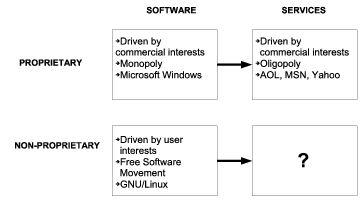
Figure 2.1 shows the presence of the proprietary and non-proprietary models in both the software and services arenas. Within the general software arena, the non-proprietary model has been fully formalized in the form of the free software movement. The principles of free software have been clearly articulated, and formally codified in the form of the GPL and other open-source licenses.
In addition, the Free Software Foundation and other organizations exist to provide leadership and advocacy, and to serve as rallying points for participation. As a result of all this, the free software movement exists as a viable alternative to the proprietary model.
However, a corresponding set of non-proprietary formalizations does not exist within the services domain. Today, virtually all Internet services are provided under the traditional proprietary software model, and as yet the free software movement has no formal presence in this domain. A set of defining principles has not been established, nor is there any leadership or rallying point for participation in the services domain, corresponding to the leadership of the Free Software Foundation in the software domain.
As a result of this there does not exist a non-proprietary alternative to the proprietary services model.
2.2.3 The problem: Governance by commercial interests
Meanwhile the proprietary services industry continues to grow rapidly.
It also continues to undergo a process of consolidation. In the services arena, as in the general software arena, there are strong forces of convergence towards a small number of dominant providers, and eventually a monopoly. In the more mature software industry this has resulted in the Microsoft Windows monopoly, now with no proprietary competition at all.
The services industry is already undergoing a similar process of convergence, and this may continue until there is a monopoly in this arena too. Microsoft is a particular concern in this regard. With its dominant position in both user environments (in the form of Windows), and services (in the form of MSN.com), Microsoft can create a level of integration between its own proprietary user environment and its own proprietary service that cannot be matched by any of the other major players. Based on its operating system monopoly it can exercise dominance of the services arena in a way that the other providers cannot, and can eventually achieve a monopoly position there too.
This trend towards a commercial oligopoly or monopoly presents some societal concerns.
The Internet is a global public resource, and as such requires representation and advocacy for the public interest. Such representation includes maintaining technical standards and protocols, protecting civil liberties, and preventing unfair business practices.
Standards and protocols
In the technical arena of standards and protocols, public representation has historically been provided by standards organizations within the Internet industry, such as the Internet Engineering Task Force (IETF). But service providers are under no obligation to use public protocols, and are free to deliver services using their own proprietary protocols. And if a commercial provider is large enough, in terms of number of subscribers, it becomes a de facto authority within the industry, able to establish its own protocols as an industry standard.
The history of Instant Messaging is a good example. Clearly the right answer for Instant Messaging is a set of non-proprietary public protocols, allowing global interoperability and open participation by all service providers.
But this is not what happened. Even though IRC (Internet Relay Chat) already existed as an open protocol for Instant Messaging, the major providers disregarded this entirely. Instead, each defined its own set of proprietary protocols, in an attempt to take complete ownership of Instant Messaging functionality and deny this functionality to competing providers. The result was that each provider created its own island of subscribers, unable to communicate with the subscribers on the competing islands.
Only when the resulting dysfunctionality became unacceptable to their subscribers did the major providers address the issue. But not by adopting an open protocol—rather, by implementing interoperability gateways amongst one another. The major providers now have cross connectivity for Instant Messaging, but the underlying protocols remain proprietary, and smaller providers are marginalized and at a competitive disadvantage. In effect the major providers have created a cartel to take complete ownership of Instant Messaging.
The presence of the free software movement in Instant Messaging remains limited to a small island of IRC users, who are able to communicate with the proprietary subscribers via interoperability gateways provided by the proprietary service providers. The major providers thus continue to control the Instant Messaging arena, with the free software community provided for as a courtesy.
Thus in the technical arena such public representation as exists is ineffective. The large commercial providers are able to establish their own standards and protocols, and engineering standards organizations such as the IETF have become largely irrelevant.
Civil liberties
In the area of civil liberties there is no formal public representation at all, and protection of civil liberties remains entirely in the hands of the commercial service providers.
If the commercial providers could be relied upon to act in the public interest, this would be of no great concern. But such is not the case. The commercial providers are under no obligation to protect the public welfare. Their sole mandate is to pursue their own commercial interests, and these may be highly detrimental to the broader interests of society.
Two recent events demonstrate this very well. In the first event, Microsoft recently shut down the Internet journal of a Chinese dissident, who had been expressing political views that his government found objectionable. In the second event, Google recently agreed to censor its search results in China, expunging web content that the government considers objectionable. Google will base its censorship decisions on guidance provided by Chinese government officials. So much for the moral high ground.
Both of these actions were taken at the request of the Chinese government, and both companies complied because this was in their commercial interests: they did so in return for access to the Chinese market. This was a quid pro quo arrangement, in which a political favor was exchanged for a commercial one.
Despite the simplistic justifications offered by their respective public relations departments, the fact is that Microsoft is silencing freedom of speech, and Google is degrading freedom of information. These are clear trespasses against basic civil liberties.
These are stark illustrations of how commercial interests can be highly injurious to the human condition. Any doubt we may have about the hazards of entrusting Internet governance to the commercial providers is surely dispelled by these examples.
2.2.4 The solution: Free software presence in the services domain
In the general software arena, the free software movement and GNU/Linux play an essential role in providing a non-proprietary alternative to the Windows monopoly. It is imperative that a similar non-proprietary alternative be established for the services industry. Without such an alternative, Internet governance will remain largely in the hands of commercial interests.
All the basic principles of the free software movement carry over into the services domain. In particular, Internet services are amenable to similar cumulative and collaborative development mechanisms to software. And as in the case of software, these mechanisms depend critically on the appropriate freedom of action.
But in order for these mechanisms to be replicated in the services arena, the proper formalization is required. This formalization must include: a coherent model for non-proprietary services, a definition of the concept and principles, creation of industry-wide awareness, a framework for collaborative development, leadership, and a rallying point for participation. In short, an equivalent movement to the free software movement is required in the Internet services arena.
2.3 The Libre Services model
We are proposing a radically new, completely non-proprietary model for the delivery of Internet services. We call this the Libre Services model.
Libre Services are an extension of the principles of free software into the domain of Internet services. Free software allows complete freedom of action: it may be copied and reused without restriction. Libre Services provide equivalent freedom of action: they are Internet services that may be copied, modified, reproduced, extended, and redistributed in their entirety. Libre Services are:
- Implemented entirely in free software
- Based entirely on patent-free protocols
- Reproducible as a complete service by anyone
They are a communal resource, not owned by anyone, freely available for use by society at large. Any company, organization or individual can reproduce and host any Libre Service, and deliver the service to others. Or any group of individuals can host the service for themselves, thus acting as their own service provider.
The Libre Services model exists in relationship to the proprietary Subscriber Services model of AOL, MSN, Yahoo and Google, in an analogous way to how GNU/Linux exists in relation to Microsoft Windows. Both Libre Services and GNU/Linux are open and free models, and both provide the essential freedom of action that is absent from the closed model.
2.3.1 Technological context
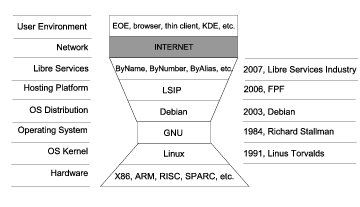
Figure 2.2 shows how Libre Services fit into the overall free software context. The left side of the figure shows the general technological requirements, and the center of the figure shows how these are realized today. It should be noted that this realization represents the general industry environment, and specific implementation choices we have made, at the time of writing in early 2006. This realization is open to future change and evolution.
The figure is not unlike the common “hourglass” representation of the OSI (Open Systems Interconnection) and Internet architectures, in which a high degree of heterogeneity at the upper and lower levels is bridged by a common set of protocols in the stem of the hourglass.
Figure 2.2 has a similar shape, but here we are showing how a high degree of heterogeneity among hardware platforms and user environments is bridged by a unifying set of software components. At the bottom of the figure is the hardware level, consisting of the large number of hardware platforms and architectures available for client side and server side computing.
GNU/Linux
In the open-source software world, the key enabling component is the GNU/Linux operating system, providing a complete environment for open-source software development. Linux, the operating system kernel, is the unifying interface for running GNU on a wide variety of hardware platforms.
(To place things in historical perspective, the GNU Project was founded in 1984. The earliest version of the Linux kernel was released in 1991.)
Debian
An important development in the evolution of the open-source software movement was the appearance of GNU/Linux distributions, or complete GNU/Linux software packages, assembled together for easy installation and use. The first of these appeared in 1992, soon after the first release of the Linux kernel.
Distributions play an essential role within the GNU/Linux framework. The integration of the various GNU/Linux components into a usable system is not a simple process. Distributions eliminate the need for a developer to locate, download, compile, install and integrate a large number of necessary components into a working GNU/Linux system. Instead, the complexities of system construction are handled transparently by the distribution software.
Our initial Libre Services implementations are based on the Debian distribution of GNU/Linux [?]. Debian was founded in 1993, and has emerged as the most practical and reliable distribution for software engineering development. Equally important, Debian fully conforms to the philosophy of the free software movement. The Debian project is guided by the Debian Social Contract [?], an explicit statement of the philosophy and guiding principles of Debian.
Libre Services Integration Platform
The Libre Services Integration Platform (LSIP) is a generalized framework for developing Libre Services. All our initial implementations are based on LSIP.
LSIP is a set of tools, policies and conventions for services development and deployment. It provides a uniform, disciplined environment for transformation of software into services, integration, and service aggregation. It allows efficient integration of free software components into coherent services.
LSIP is the key technological component of Libre Services. It is the component that makes generalized, large-scale services development practical and efficient.
User environments
Libre Services are implemented as server-side software entities, typically running on servers at the service provider’s premises, remote from the user. The user interacts with the service using his or her own computer, and may do so using any of a wide variety of user environments, such as EOE (Emacs Office Environment), a web browser, thin client, or KDE (K Desktop Environment). These are shown at the top level of Figure 2.2. The link between the user environment and the service is the Internet itself.
Since Libre Services are completely open, there are no proprietary restrictions on which user environment can be used to interact with the services. The Libre Services model allows any user environment to interact with any service using any hardware platform.
2.3.2 Benefits to society
Libre Services bring the cumulative and collaborative development characteristics of free software into the services arena. They are open to completely unrestricted, large-scale collaborative development, and therefore have an ability to undergo complex evolutionary growth that cannot be matched by the proprietary model. In terms of richness of functionality, they have the ability to surpass the proprietary model completely.
In addition to straightforward end-user functionality, Libre Services also provide a number broader societal benefits.
Engineered for the user, not for business
In both the free and proprietary models, software is created by engineers. But the motives driving the engineering effort are entirely different under the two models.
In the proprietary model, engineering acts at the behest of business. And the prime directive of business is to make profit. Though corporations like to proclaim that their number one concern is the customer, this is a fiction. The welfare of the customer is of concern to the corporation only insofar as it relates to profit; beyond that it is meaningless. Under the proprietary model, service providers can and frequently do act directly against the interests of the user.
But in the free software model, engineering does not take place within a business framework. Instead it is a collaborative effort, undertaken by many organizations and individuals in a variety of diverse environments. Therefore the dependence of engineering on business imperatives is severed. The engineering effort no longer takes place at the behest of business. Instead it is driven by fundamental, constructive engineering motives: the desire of the software engineering community to create applications of real value to the user.
The resultant software is therefore fully aligned with the usage, requirements and interests of the user. It is built to benefit the user, not to benefit business.
Civil liberties: Services operated by the user, for the user
In the proprietary services model, the service provider and the user are two separate and distinct entities. All policy decisions regarding operation of the service are made by the provider, with little input from the user.
In particular, the user is entirely subject to the provider’s actions regarding civil liberties issues such as privacy, censorship, and freedom of speech. The provider’s actions are taken based on commercial considerations, and these actions may constitute serious violations of the user’s civil liberties.
As we have noted, commercial providers can silence dissent and enforce censorship in order to gain access to foreign markets. As we will note in the next section, they can also cooperate in government intrusion into their users’ personal and private affairs. Commercial providers have also cooperated with enforcement of censorship and freedom of speech restrictions by monitoring web logs and bulletin boards, erasing banned content, and reporting offenders to government authorities.
Under the Libre Services model, however, any group or community of people can host the service cooperatively for themselves, and operate it according to whatever policies they see fit. The Libre Services model thus breaks the separation between the provider and the user—they can now be one and the same.
Libre Services can be operated by the user, for the user. The civil liberties of the user are thereby assured.
Privacy and security
In the proprietary services model, user activity can be monitored without the user’s knowledge or consent. There are two forms of monitoring that present societal concerns:
- Monitoring by commercial entities
- Monitoring by government agencies
In the case of commercial monitoring, any aspect of a user’s activities can be recorded and reviewed by the service provider. This includes the content of incoming and outgoing e-mail, search queries, websites visited, products and services purchased—indeed, any service usage that is technologically available to the provider can be monitored, without the knowledge or consent of the user.
This form of monitoring is much less of an issue in the case of Libre Services because, as we have noted, the service is designed to benefit the user, not a commercial entity. Since the service is not created for commercial benefit, there is no great incentive to include commercial monitoring capability within the service.
But to the extent that commercial monitoring remains a concern, the Libre Services model can provide complete guarantees of privacy. In the case of proprietary services, based on closed software, monitoring can take place because the community of users has no way of knowing what the software is actually doing. But in the case of Libre Services, the complete openness of the software permits verification and authentication that the service is completely free from all monitoring activity. The community of users is able to know exactly what the software is doing, and that it is doing no more and no less than they wish it to do.
Much more worrisome than commercial monitoring is monitoring by the government. National governments may have very broad powers to monitor their citizens’ usage of Internet services. In the USA, an agency with sufficient authorization can compel a service provider to disclose all available information about a user, and cooperate in monitoring all communications and other service usage, without the user’s knowledge or consent. The FBI’s controversial Carnivore system, for example, is designed to capture all e-mail traffic for a particular targeted individual. Post-9/11, the necessary authorization can be provided simply by association, at several levels of remove, with someone the government considers to be a person of interest for national security reasons.
In the proprietary services model, covert government monitoring is possible because the user has no way of knowing what the service provider is doing. In particular, the provider is under no obligation to disclose government monitoring to the user. But in the case of Libre Services, any individual or organization can prevent covert monitoring by running the service for themselves, rather than leaving it in the hands of a third-party provider.
In addition, by eliminating the separation between the provider and the user, the Libre Services model makes current monitoring practices impractical. Under the proprietary model, a government agency conducts monitoring activity by directing its compliance demands against a well-defined commercial service provider. But under the Libre Services model the oligopoly of commercial service providers has disappeared, to be replaced by numerous private self-providers.
The government can still come knocking and demand access to a user’s information. But it must now direct its compliance demands against a multiplicity of individual persons and organizations. And it can no longer do this without the user’s knowledge.
Service stability and continuity
In both the free and the proprietary worlds, software applications and services can be discontinued. The provider of the application or service can go out of business, or may decide to discontinue supporting the application. In either case the user may be left with an investment in an “orphaned” application. But the dynamics of how this occurs, and the effects on the user, are very different under the two models.
In the free software world, application extinction occurs because of migration of the community of users away from the application towards other, better applications. Extinction occurs because of a process of user-driven convergence, based on the genuine merits of alternative solutions.
In the proprietary world, applications are left orphaned not by the actions of the users, but by the actions of the provider. And these actions may be taken for reasons that have little to do with the actual merits of the application, but may be based on purely business considerations.
Because of these differing dynamics, application orphaning is a gradual and organic process in the free software world, whereas in the proprietary world it can occur suddenly and without warning.
Thus in the free software world, continuity of applications and services is much less of an issue than in the proprietary world. Applications persist based on their merits, and where they do not persist, this is to the ultimate betterment of the industry and the user.
But to the extent that service continuity is of concern to the user, the Libre Services model provides guarantees of continuity that are completely absent from the proprietary model. First, since the services are a communal resource, the user is not tied to any particular service provider. The effect of the Libre Services model is to decouple the service functionality from the service provider. If a provider goes out of business or discontinues providing the service, a user can simply go to an alternative provider, and be assured of receiving a functionally identical service.
The same consideration applies to the availability of technical support for the service. Again, since the service is a communal resource, the user is not tied to any particular vendor for technical support. Under the Libre Services model, technical support remains readily available for as long as the service itself remains available.
Finally, under the rather implausible scenario in which an entire Libre Service inexplicably disappears, but an organization remains fully committed to the orphaned service, the organization still has recourse. Since Libre Services are implemented entirely in free software, the organization has guaranteed perpetual access to the software. If necessary, the organization can reproduce and operate the entire service for itself.
Complex integration of user environments with services
As indicated in Figure 2.2, Internet services work by communication over the Internet between a client application running in the user environment, and a corresponding server application running within the service.
In the proprietary model, a particular service is tied to certain specific user environments. The service can be accessed only via one or two user environments, typically a web browser, and possibly also a dedicated client application provided by the service provider.
Under the Libre Services model, however, there are no proprietary limitations placed on integration between the User Environment layer and the Libre Services layer in Figure 2.2. Since the service is completely transparent, the dependence of the service on any particular user environment is severed. Thus any user environment can be integrated with any Libre Service.
Furthermore, a much more complex level of integration is possible. In particular, free user environments (i.e. user environments based on free software) can be integrated with Libre Services. And since both the client and server sides of the service are now completely transparent, this permits a highly complex level of integration between the two. This allows the development of Internet services with a power and versatility that far exceeds what exists today.
For these reasons we believe that the free software movement as we see it today is just the beginning. Today, free software exists at operating system and application level. The Libre Services model brings the power of free software to the Services level, the User Environment level, and the integration between these two levels. The result will be a complete transformation of the Internet services industry.
2.3.3 Benefits to service providers
The Libre Services model also brings important benefits to the providers of Internet services.
A truly open industry
Under the proprietary model the Internet services industry is dominated and controlled by a few large providers. These dominant players actively stifle competition by means of restrictive business practices, such as the use of proprietary protocols, highly aggressive patent assertion, and other practices based on ownership and control of intellectual assets.
Under the Libre Services model, however, there are no intellectual property barriers to business entry, and any company that wishes to host services can do so. This has major business consequences. The effect of the Libre Services model is to open the entire services industry to free market entry. This will result in unrestricted engineering collaboration and business competition, and will catalyze enormous industry growth. Libre Services will transform the closed industry of today into a truly open industry, in which all participants can compete on a level playing field.
Collaborative development
In the proprietary model, small service providers can also be marginalized on the basis of service quality and functionality. A small proprietary service provider cannot compete with the resources of the large providers in their ability to develop new and better functionality.
Libre Services, however, are based on the large-scale cumulative and collaborative development mechanisms of free software. Any development contribution made by any engineer, anywhere, becomes immediately available to the entire constituency of service providers. In effect, the Libre Services model permits global pooling of engineering development resources.
This provides a level of cooperative development capability that far exceeds the resources of even the largest proprietary provider. Eventually the Libre Services model can surpass the proprietary model entirely in terms of service quality and functionality.
Industry representation
As we saw in the case of Instant Messaging, small proprietary providers can also be marginalized in terms of representation in industry decision-making, for example in establishing technical standards and protocols. This is because a service provider’s voice in such decision-making is based ultimately on the provider’s size, in terms of number of subscribers. The major commercial providers are thus able to exert a dominating influence over industry standards and policies.
The Libre Services movement, however, provides a unified voice of advocacy for all its subscribers. In effect the Libre Services model permits global pooling of the entire community of Libre Service subscribers as a single constituency for industry representation.
2.3.4 Our goal: Creation of the Libre Services industry
Libre Services are the right way to deliver Internet services to the world. As well as providing a number of vitally important societal benefits, they are also the proper basis for a healthy, thriving and egalitarian services industry.
Our goal is nothing less than the creation of an entirely new industry: the Libre Services industry. Much as others established the free software movement twenty years ago, we are establishing the Libre Services movement today.
2.3.5 The need for a movement
Possibly the free software movement might have come into existence on its own, in some spontaneous organic way, even without the actions of the Free Software Foundation. We only get to experience one history, so we will never know. But at the very least the Free Software Foundation greatly expedited this process by explicitly formalizing the principles of free software. And quite possibly, without the Free Software Foundation or some other entity taking this initiative, the free software movement might never have come into existence as a coherent movement at all. In any event, 20 years later, the free software movement now exists as a viable alternative to proprietary software. Society is surely better off for having the choice.
Similar speculations can be made about the Libre Services movement. One could question whether there is any need for anything so grandiose as a “movement,” with a “blueprint” and a “manifesto.” Possibly it too might arise spontaneously, without requiring any explicit formalization. Possibly everything we are trying to achieve is destined to occur anyway, as a natural consequence of the already established free software movement. One could argue that services are just another form of software, and the existing free software movement is already sufficient to create its own non-proprietary presence in the services arena.
It is true that in a purely reductionist sense, services are just another form of software. But from a holistic viewpoint they are no more “just” an extension of software than biochemistry is “just” an extension of chemistry. Internet services have a richness and complexity beyond that of general software, and they have a set of dynamics that are not apparent within the general software arena.
Technical development challenges
The creation of a coherent service is a complex process, presenting its own set of technical challenges. This process involves the transformation of software components into a service-oriented implementation, integration of software components, and service aggregation.
The existing technical conventions of free software are not well adapted to these requirements. These requirements have been partially met by the appearance of hosting platforms, but these have been implemented on a specialized, ad hoc basis, and the integration of software into services remains inefficient and costly.
In the longer term a much more general framework is required. This framework must include a coherent set of tools, policies and conventions for efficient integration of free software components into services, and for consistent service aggregation. The Libre Services Integration Platform (LSIP) we have developed is one such framework.
Collaborative development challenges
In addition to these technical issues, managing collaborative development on services presents another set of challenges. For example, collaboration on services is much more vulnerable to software division (the tendency of open-source projects to split into rival projects) than collaboration on individual software components. For this and other reasons services require a set of collaborative policies and methodologies that are significantly different from the general free software model.
Motivation for development
Furthermore, the motivations driving development of free software and Libre Services are quite different. The initial “consumer” of free software was the engineering community itself—the community of software engineers who recognized the need for non-proprietary software tools such as editors, compilers, debuggers, etc. Free software was developed by engineers for engineers, and so the benefits of free software translated directly into the necessary action to create it.
By contrast, the “consumer” of services is the end-user, and a completely different set of motivations and dynamics must come into play to create Libre Services. Though the benefits of Libre Services are very real and very far-reaching, it is not clear that these benefits translate directly into forces and action to create them. Under these circumstances an explicit movement is required to provide the necessary motivation.
2.3.6 The time is now
In the end, the best anyone can say is that there is uncertainty about the future. One could be complacent, take no action, and accept whatever default history will hand us. But the stakes are very high. We believe it behooves us to take positive action to ensure the future, rather than complacently assume that history’s default will be the one we desire.
The time to do this is now. All the necessary requisites for Libre Services now exist. The key enabling components are the Linux kernel, the GNU operating system, and the Debian distribution. These components are now sufficiently complete and mature to make Libre Services a reality.
The window of opportunity for this is unknown. It is possible that the proprietary services may become so entrenched that they become impossible to dislodge. The number of proprietary subscribers may become so large and so tightly bound to their service provider, that a different services model can no longer gain credibility. In this case, the opportunity to establish Libre Services, if not acted upon quickly, may be lost.
We would like to ensure that, 10 years from now, society will have a non-proprietary alternative to the proprietary Internet services. As in the case of free software, society will surely be better off for having the choice.
2.4 Libre Services: From concept to reality
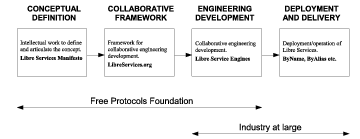
Figure 2.3 provides an overview of the major stages of development needed to establish Libre Services as a reality, and the principal deliverables needed at each stage. The major requirements are:
-
Conceptual
definition.
The
first
requirement
is
a
clear
definition
and
explication
of
the
concept.
The
necessary
intellectual
work
must
be
done
to
define
the
concept
fully,
and
written
materials
created
to
communicate
it
to
others.
The principal required deliverable is the Libre Services Manifesto, a comprehensive description of the Libre Services model.
-
Collaborative
framework.
The
next
requirement
is
a
framework
for
collaborative
engineering
development.
Open-source
software
development
does
not
take
place
in
a
vacuum—it
requires
a
proper
framework
to
proceed
effectively.
This
framework
must
include
a
central
software
repository,
and
automated
mechanisms
to
allow
developers
to
retrieve
software
components
from
the
repository,
then
resubmit
modified
software
back
into
the
repository.
The
framework
must
also
define
the
policies
and
procedures
to
be
followed
for
orderly
collaboration,
and
provide
various
other
resources
for
developers.
The required deliverable is LibreServices.org, a website and forum providing all the necessary resources and functionality.
-
Engineering
development.
Next
it
is
necessary
to
do
the
engineering
work
to
create
Libre
Services
software.
This
is
done
by
the
open-source
development
community
within
the
industry
at
large.
The required deliverables are a set of software components and Libre Service Engines.
-
Deployment
and
delivery.
Finally
it
is
necessary
to
deploy
and
deliver
services
to
individual
subscribers.
This
is
done
by
service
providers
within
the
industry
at
large.
The required deliverables are a set of deployed, usable, first-generation Libre Services.
2.4.1 Transformation of software into services
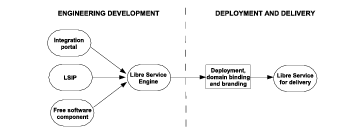
Figure 2.4 provides an overview of the technical processes required to transform free software components into a working service for delivery to users.
In addition to free software components, two other important elements are required to create a service: an integration portal, and LSIP. These three elements are integrated together to create a Libre Service Engine.
The Libre Service Engine is a key technological component of the Libre Services model. It is a complete, fully integrated package of service features and capabilities, ready for deployment and delivery by a service provider. It is part of the definition of a Libre Service that such an engine exist, ready for deployment without requiring any further software integration work.
It is the responsibility of a service provider to create a deployed service based on the service engine. This includes binding the service to a specific Internet domain, branding the service with the provider’s trade name, and providing the technical and business structures required to deliver the service and support users.
The vertical line in Figure 2.4 represents an important conceptual point of demarcation in the Libre Services model. It is the division between industry-general engineering activity, and provider-specific deployment activity. Engineering development is a collective activity, undertaken by the industry as a whole. The resulting assets are industry-generic, available for use by all industry participants. Deployment and delivery, on the other hand, is undertaken by a commercial or non-commercial service provider. The resulting deployed service is associated with and carries the brand name of a specific provider.
Thus LSIP and all service engines are industry-generic resources. ByName, a deployed service, is associated with a specific service provider, in this case Neda.
In the Libre Services model any engineering development, taking place at any point within the industry, becomes immediately available to the entire industry. This means that differentiation and competition among service providers no longer takes place on the basis of service functionality. Instead it must now take place purely on the basis of deployment and delivery characteristics such as service cost, reliability, and customer service.
2.4.2 Freedom in principle vs. freedom in practice
Both free software and Libre Services offer total transparency and freedom of action. In the case of free software, anyone can copy the software, run it on their own computer, modify it, and redistribute it to others. Libre Services provide an analogous set of freedoms. In the case of Libre Services, anyone can reproduce the entire service, operate the service on their own server, modify the service, and redistribute it to others.
These freedoms are real, and in principle can be exercised by anyone. In practice, however, exercising these freedoms requires specialized skills and expertise. For someone to modify a free software program they must first set up the necessary programming environment, including an editor, compiler, linker and various other tools. They must have the necessary technical skills to do this, and they must also have the necessary programming skills to do the software modifications.
Modifying a Libre Service requires even greater expertise. In addition to all the skills required for free software programming, someone wishing to do this must also have the necessary technical skills to set up and operate their own server. Exercising programming freedom in the context of Libre Services is therefore more technically demanding than for free software, and may not be practical for an individual programmer.
In practice therefore, the freedoms associated with free software and Libre Services can be exercised only by a minority of people with the necessary expertise. The majority of people within society at large have neither the know-how nor the inclination to do hands-on software programming, and so in practical terms cannot exercise these freedoms at all.
Nevertheless, all of society benefits from the existence of these freedoms, because the results are available to all. In the case of free software, a community of free software programmers exists, who do actual hands-on software programming. The result is new and better software applications, which can then be used by anyone. In addition, free software development is done in a open democratic manner, by members of society itself, rather than being under the control of a specific private party, as is the case for proprietary software.
Society benefits from Libre Services in much the same way, though there are some important differences. In the case of Libre Services there will also be a community of services developers, with the technical expertise to do actual services development.
But for Libre Services this development will more typically be undertaken as a group activity rather than an individual activity. Many free software programs are stand-alone applications, running on an individual’s own computer, and here software development is something that can reasonably and practically by done by the individual programmer. Libre Services, on the other hand, are normally operated by and provided to groups of people, rather than individuals. Thus in the Libre Services domain, the analogous thing to the individual user is the collective group of users, who wish to operate their own Libre Services and/or do services development.
But as with free software, the results of this development are then available to all of society. And as with free software, this development is done in a open democratic manner, rather than being under the control of a proprietary service provider.
Another difference between the free software and Libre Services models is how the end results are utilized by society at large. Among other things, free software frequently takes the form of a stand-alone application, suitable for use by an individual user. In this case the beneficiary is the individual user who can run the program.
But a Libre Service is not usually something that is run by an individual user. Instead, Libre Services are utilized by society at large via two different sets of beneficiaries. As a service, there is both a provider and a user of the service. In general these need not be the same entity, and both are beneficiaries of the Libre Services model. The results of Libre Services development are available for deployment by any service provider—commercial or non-commercial; public, corporate, or private. And the resulting deployed services are then available to the community of end users of the services.
Thus in the case of both free software and Libre Services, all of society benefits from a set of freedoms available in principle to all, but exercised in practice by few.
2.4.3 Local software vs. network service
As we noted in Section 2.1, there is a major trend towards providing functionality as a remote service, rather than as a local application. The commercial service providers are actively promoting this trend, since this directly increases consumption of their own services. As a result, network-based services are becoming a pervasive model for how people access computing resources and functionality. However it may not necessarily be in the user’s best interests to access functionality remotely, when equivalent functionality can be provided locally.
Some types of computing functionality are not practical for a user to run locally, and such functionality must be provided as a network service. An obvious example is an SMTP e-mail server. Technically one could run this as a local application, but it is far more convenient and cost effective to implement this functionality on a centralized server, shared by multiple users. Another example would be search—it is not feasible for an individual user to run an Internet search service locally. And many other examples. Certain types of functionality are inherently service-oriented, and in practical terms must be implemented in the form of a network service.
On the other hand there are some software components and functionality that must be run locally. At these two extremes there is no discussion to be had—inherently service-oriented functionality must be provided as a service, and inherently local functionality must be provided locally.
But intermediate between these two extremes there is a large class of software components that can reasonably be implemented either as a local program or a remote service, and here the merits of the two approaches are open to discussion.
Certainly, the network-based computing model provides a number of important advantages. These include:
- Reduced total cost of ownership
- Ease of access to specialized software
- Ease of maintenance
- Cost effectiveness of shared computing resources
However, there are also a number of major disadvantages to accessing computing resources remotely, when equivalent functionality can be provided locally. These are:
-
Privacy
and
confidentiality.
In
the
case
of
a
proprietary
software
application
versus
a
proprietary
service,
users’
privacy
is
far
better
protected
if
their
personal
information
(address
book,
calendar,
etc.)
is
maintained
locally
rather
than
remotely.
As
we
have
noted
elsewhere,
commercial
service
providers
are
under
no
obligation
to
protect
users’
privacy
and
civil
liberties,
and
have
already
shown
their
willingness
to
compromise
both
of
these.
This consideration is less of an issue in the case of local free software program versus a Libre Service, since the Libre Services model provides far greater protection of users’ privacy and civil liberties than the proprietary model.
- Integration. The greater practicality of deep integration between applications, when these are run locally.
- Control. Running software locally provides users with a greater degree of control over their computing environment. Users can set up and configure their local computing environment according to their own choices and preferences. For example users have choice over which specific software component they will use for a particular type of functionality, or what revision they will use. When the functionality is provided as a service, these choices must be left to the service provider.
-
Programming
freedom.
A
further
dimension
of
user
control
is
the
ability
to
make
hands-on
software
modifications—i.e.
exercise
the
programming
freedom
guaranteed
by
free
software
and
Libre
Services.
In
the
case
of
a
local
free
software
program,
it
is
possible
for
a
user
with
the
necessary
technical
skills
to
set
up
a
programming
environment
and
modify
the
software.
In the case of the same functionality running as a service, however, it may not be feasible for the user to modify the service. If the user is part of a group of people who are running and maintaining their own service, then the user can indeed modify the service, just as an individual user can modify a local program. But if the user is an individual subscriber to a service being run by a second-party service provider, the user cannot modify the service.
Therefore an additional advantage to running software locally rather than remotely, is that those with the necessary technical skills can modify the software.
But note that this consideration applies only to those with the skills and inclination to do hands-on software modifications. For the great majority of non-technical users, this difference between local programs and remote services does not apply.
There are thus a number of reasons to maintain computing functionality locally rather than remotely. In general, the partitioning of functionality between the local free software environment and the remote Libre Service should be based on consideration of all the relevant issues.
Other considerations
The above discussion focusses on providing functionality on a user’s desktop rather than as a network service. But a user may wish to access her services when she is away from her home desktop, for example at an Internet cafe. Under these circumstances the user may want to have a full suite of computing functionality provided entirely by the service.
It must also be borne in mind that the Libre Services model has a very significant business dimension. It fully supports a model in which services are provided in a commercial, for-profit context, and in this context commercial Libre Service providers must be responsive to their market.
Regardless of the merits of maintaining local functionality, users of the service may wish to access their computing resources remotely. If Libre Service providers are to compete against the proprietary service providers they must fully cater to the demands of their users in this respect.
2.5 Separation of responsibility: FPF and Neda
2.5.1 Areas of responsibility
As shown in Figure 2.3, the major requirements for establishing Libre Services fall under different areas of responsibility.
The resources to be created in the conceptual definition and collaborative framework arenas are general industry enablers, and are sufficiently bounded in scope to be created by a single organization. Therefore major responsibility for creation of these resources will be taken by the Free Protocols Foundation (FPF).
The scope of the required engineering and deployment work, on the other hand, is too large for any one company or organization acting alone, and must be undertaken by the industry at large.
Engineering development
The engineering development work is a communal activity, and can be undertaken by any individual or organization. In the free software model, software developed by any entity is released and licensed under the General Public License (GPL) or other open-source license [?], and so becomes immediately available to the entire open-source development community. In this collaborative environment it is not of any great significance who or which organization creates any particular component of the Libre Services software. The body of Libre Services software is not owned by anyone, in any restrictive sense.
At the outset the FPF is playing a major role in building the necessary engineering resources. We are actively developing LSIP and a set of starting-point service engines. As others begin to participate we expect that this work will evolve into a distributed industry-wide effort, with the FPF playing an appropriate coordination role.
Deployment and delivery
Deployment and delivery of Libre Services is an essential requirement for their adoption. If Libre Services are to come into widespread usage, they must be operated and supported for the end user. In practical terms, this is something that must be done by service providers in a commercial context. Somewhere along the line, there must be a business model that supports the delivery of Libre Services to individual users.
However, as a business activity, this falls outside the responsibility of the FPF. The necessary deployment work must therefore take place in an entirely separate context.
2.5.2 Complementary roles of FPF and Neda
We have established a separation of responsibility to address this issue. Responsibility for moving this initiative forward will be divided between two separate entities:
-
The
Free
Protocols
Foundation
is
responsible
for
creating
all
the
assets
required
in
the
conceptual
definition
and
collaborative
framework
arenas.
This
consists
of
the
work
to
articulate
the
concept
and
create
the
necessary
development
framework.
The FPF is also taking responsibility for creating momentum in the engineering development arena. We are doing the necessary work to create a set of starting-point engineering resources, and we are establishing a framework to enable collective participation by others.
- Neda Communications, Inc. is responsible for creating the necessary deliverables and demonstrating proof-of-concept in the deployment arena. This consists of the work to deploy and operate a set of usable, first-generation Libre Services.
The Free Protocols Foundation and Neda Communications thus play complementary roles in moving this initiative forward.
2.5.3 Conflict of interest
The relationship between the FPF and Neda is not unlike that between a professional association and a member of that profession; for example the American Bar Association and a particular law firm. The FPF is a voice of advocacy for the Libre Services industry as a whole. It has a moral authority, and its ultimate mandate is to serve the public interest.
Neda Communications, on the other hand, is merely one company that conducts engineering and business operations within this industry. At the outset it is playing a unique leadership role, but eventually we hope it will be just one of many companies delivering Libre Services to users.
But what is highly unusual about this, is that the Libre Services industry does not yet exist; and the enabling framework for the industry, and the first company within the industry, are both being established at the same time. Furthermore, these two structures are being established by the same persons. The authors of this paper are directors of the FPF, and also employees of Neda. Not only are we moving this initiative forward under the FPF, we are also doing the necessary deployment work under Neda.
This creates a conflict of interest issue. In the long run, it is not possible for the same persons to manage both the FPF, and a commercial entity within the Libre Services industry. At some point these responsibilities must be separated entirely.
But for the moment this conflict cannot be avoided, since we cannot divide ourselves in two, either as individuals or as a team.
In the short run, however, we believe that this conflict of interest is manageable. This is because in every capacity—we as individuals, the FPF as an organization, and Neda as an organization—we share the same unifying philosophy. In each capacity we are fully committed to the principles of the free software movement, and in each capacity we share the same ultimate vision: completely open software and Internet services industries, in which all computing and communications is based entirely on free software.
In particular, although Neda is a for-profit company, in all its engineering and business practices it fully conforms to the philosophy and principles of the FPF. All protocols developed by Neda are patent-free; all software developed by Neda is free software; all services developed by Neda are Libre Services. The potential conflict of interest is thus greatly mitigated.
It must also be emphasized that, since Libre Services are completely non-proprietary, there are no intellectual property barriers to participation in this industry. Neda enjoys no proprietary advantages whatsoever, and any company that wishes to participate is free to do so. What we are creating is a truly open industry, in which all participants must compete on a truly level playing field. And the ultimate beneficiary of this is society at large.
2.6 Libre Services: Bootstrapping an industry
We are proposing an entirely new model for delivery of Internet services. This is an ambitious initiative, and will require the participation of many others to turn into a reality.
So far what we have described has been largely theoretical. We have described a new concept, and outlined the major technical requirements to implement it. But to make all this real, a lot more than this is required. An explicit strategy is needed to bootstrap Libre Services into existence.
The goal of our bootstrapping strategy is to create deployed, usable, first-generation Libre Services. This means that all the requirements of Figure 2.3 must be fully addressed.
The FPF is taking primary responsibility for the first two requirements in Figure 2.3: the conceptual definition, and creation of the collaborative framework. We are creating the Libre Services Manifesto to articulate and promote the concept, and we are building the required development framework at LibreServices.org.
But the scope of the next two requirements—the necessary engineering and deployment work—is far too large to be undertaken by any single organization or group of people acting alone. The scope of work required to build a real Libre Services industry is enormous, and can only be accomplished as a collective enterprise by many organizations and individuals.
The key to enabling this collective effort is a coherent basis for participation.
2.6.1 A project-based model for participation
We have established a coherent basis and model for collaborative bootstrapping of the Libre Services industry. This consists of two major components:
- We have done the initial development work to create a set of starting-point, reference software components. These include LSIP, and a coordinated family of Libre Service Engines.
- We have established a project-based model for collaborative participation.
We have defined a set of projects, representing the next stages of work required to move this initiative forward. Each project is largely independent and self-contained, and ready to be undertaken by an interested group or organization immediately. This project-based model allows efficient, coordinated collaboration on multiple bootstrapping tasks in parallel.
Each project is defined in the form of a Project Document, providing a complete specification for the project. The complete list of projects and Project Documents is provided in a separate article. See the article titled Libre Services: Projects for bootstrapping.
In this project-based model the role of the FPF is largely one of coordination and support. We will take responsibility for defining projects, creating and maintaining the Project Documents, and seeking out project sponsors.
2.6.2 Deployment and delivery
As a commercial activity, deployment and delivery falls outside the scope of the FPF. We therefore rely on independent service providers to do the necessary deployment work. At the outset Neda will take responsibility for this. The primary role of Neda is to demonstrate engineering and business proof-of-concept by deploying usable first-generation services.
As the bootstrapping process gains momentum, we hope and expect that other service providers will also deploy the services.
2.6.3 An invitation to participate
We invite and encourage others to join us in this ambitious initiative. We invite active participation by all relevant constituencies:
- Engineering. To do the work to build usable, first-generation Libre Services.
- Business. To deploy and deliver first-generation services in a commercial context.
- Grantmaking foundations. To provide non-profit sponsorship and funding for Libre Services bootstrapping projects.
- The investment community. To finance commercial deployment of Libre Services.
- The academic community. To analyze and criticize the concept.
- The media. To publicize the concept and educate the public.
The Libre Services Forum at LibreServices.org provides a variety of resources to assist organizations and individuals who wish to participate.
The forum hosts a number of mailing lists to facilitate various forms of participation. These include a general interest mailing list, a mailing list oriented towards engineering development, and a mailing list oriented towards business development. These provide a means for organizations and individuals to announce their participation, seek out partners, and coordinate cooperative effort.
Immediate mission-critical tasks are the creation of the Libre Services Manifesto, and the engineering work to create usable first-generation services. Those who are interested in promoting the Libre Services model can assist us by contributing additional material to the Manifesto, revising existing material, and translating Manifesto articles into foreign languages.
Organizations and individual programmers who wish to participate in the engineering effort can do so through the software repository and development resources at LibreServices.org. All FPF-sponsored Libre Services software is available at LibreServices.org, licensed under the GNU General Public License (GPL).
2.7 Starting point for bootstrapping
Bootstrapping of Libre Services is not starting from zero. As part of our framework for collaboration we have created an initial set of starting-point engineering and deployment assets.
We have done substantial engineering development work to create a set of reference Libre Services software components. These are available for immediate use as the basis for collaborative engineering development.
Under Neda we have also done the initial work to demonstrate deployment proof-of-concept.
2.7.1 Engineering development
Libre Services Integration Platform
We have completed initial development of LSIP, the Libre Services Integration Platform. LSIP is the basis for efficient services development, and a key component of the Libre Services model. It consists of a uniform set of tools, policies and conventions for integration of software into services. LSIP is now sufficiently complete and mature for use as a general industry resource.
Libre Service Engines
We have done the intellectual work to define the requirements for a coordinated set of services, allowing highly generalized interactions among each other. We have identified the key abstractions that must be represented within such a set, including such things as individual persons, businesses, physical locations, and events. We have then designed a family of services to represent these abstractions, and to allow rich and complex interactions among them. The result is a coherent and powerful model for generalized Internet services.
Based on this general conceptual architecture we have created an initial set of starting-point Libre Service Engines. Thus far we have created service engines to provide the following functionality:
- A service for named individual persons.
- A service for individual persons referred to by a numerical ID, and allowing usage via numeric devices.
- A service for individual persons referred to by an alias.
- A service for preserving the memory of deceased individual persons.
We are in the process of creating service engines based on the other abstractions and usage models in our general conceptual architecture. These include services based on the generalized abstraction of business entities, physical locations, and events; services for publication of information; and services allowing complex interaction among the various types of abstracted entities.
Everything we have built—the LSIP development platform, and all the starting-point service engines—is available as free software licensed under the GPL. These are intended to be reference implementations, freely available for examination, evaluation and reuse by the software engineering community.
2.7.2 Deployment and delivery
Under Neda we have deployed an initial set of working Libre Services based on the starting-point service engines. The first of these is the ByName service. ByName provides a basic set of Internet services for the individual user, including a personal domain, personal website, e-mail, mobile messaging, integrated support for mobility, and a few other capabilities. It is the world’s first Libre Service!
Libre Services are thus not merely an abstract concept—they are a real construct that exists today.
Thus far we have deployed the following services:
-
ByName.
As
basic
set
of
services
for
the
individual
user.
http://www.ByName.com
-
ByNumber.
A
similar
set
of
services
to
ByName,
but
based
on
a
number
assigned
to
the
user
instead
of
the
user’s
name.
This
allows
access
to
the
services
using
numeric
devices
such
as
telephone
keypads.
http://www.ByNumber.com
-
ByAlias.
A
similar
set
of
services
to
ByName,
but
allowing
the
use
of
an
alias
instead
of
the
user’s
real
name.
http://www.ByAlias.com
-
ByMemory.
A
set
of
services
for
preserving
the
memory
of
deceased
persons.
These
include
features
for
creating
memorials
and
biographies,
and
for
creating
and
maintaining
shared
genealogies.
http://www.ByMemory.net
These initial services are in varying stages of development, in some cases providing only very basic capabilities. But they are sufficient to demonstrate end-to-end proof of the Libre Services concept. They show that it is possible to deliver real services to an end-user, using nothing but free software.
Acknowledgements
We would like to thank the following persons for their assistance in the preparation of this paper: Steven Caro, Richard Stallman.
Chapter 3
Libre Services: Projects for Bootstrapping
Libre Services:
Projects for Bootstrapping
Document # LPD-201
Version 1.0
April 10, 2006
Available on-line at:
http://www.libreservices.org/libreManifesto/projectsForBootstrapping/
Mohsen Banan
htmladdnormallinkhttp://mohsen.banan.1.byname.net/ContactMehttp://mohsen.banan.1.byname.net/ContactMe
Andrew Hammoude
htmladdnormallinkhttp://andrew.hammoude.1.byname.net/ContactMehttp://andrew.hammoude.1.byname.net/ContactMe
Free Protocols Foundation
3610 164th Place SE
Bellevue, WA 98008-5807
Phone: (425) 644-8026
Fax: (425) 644-2886
Web: http://www.freeprotocols.org
3.1 Introduction
In a previous article we have introduced the concept of Libre Services, a non-proprietary model for delivery of Internet services.
For a general description of Libre Services and how we propose to turn it from concept into reality, see the article titled Libre Services: A non-proprietary model for delivery of Internet services.
The scope of work required for this is far too large to be undertaken by any single organization acting alone, and can only be accomplished as a collective effort by many organizations and individuals.
The key to enabling this collective effort is a coherent framework for participation.
3.1.1 A project-based model for participation
As part of our strategy for bootstrapping the Libre Services industry into existence, we have established a project-based model for collaborative participation.
We have defined a set of projects representing the major stages of work required to move this initiative forward. Each project is largely independent and self-contained, and ready to be undertaken by an interested group or organization immediately. This project-based model allows efficient, coordinated collaboration on multiple bootstrapping tasks in parallel.
Each project is defined in the form of a Project Document. This provides complete details about the project, including:
- The project title.
- The project description. The project concept and a detailed project specification, including the required project deliverables.
- The project context. How the project fits into the overall Libre Services bootstrapping strategy.
- The project priority and proposed schedule
- The project sponsor. The organization or agency providing financing for the project.
- The project manager(s).
- The current project status.
This article lists the currently defined projects and provides a Project Document for each one. The list of projects and their status is a dynamic thing, changing over time as this initiative moves forward. We will update this article regularly to keep it current.
Note: The current (April 10, 2006) version of this article includes only preliminary descriptions of the first set of projects. We will provide more complete and detailed Project Documents in the next revision of this article, coming soon.
We invite and encourage participation by others in this ambitious initiative. If you are interested in taking responsibility for or working on any of these projects, please contact us directly at the Free Protocols Foundation.
3.1.2 Immediate mission-critical projects
The following are the three most important mission-critical projects. These tasks have the highest priority and must be accomplished as quickly as possible to move this initiative forward.
- The Libre Services Manifesto.
- Libre Services Forum (LibreService.org distribution center).
- First-generation Libre Service Engines.
3.1.3 Next stage projects
Other currently defined projects are the following. Though of lower priority, all these projects are ready for immediate implementation.
- Libre Emacs Office Environment (EOE)
- Libre Mobile Messaging (Operation WhiteBerry)
- Libre Community WiFi
- Libre School (Operation WhiteBoard)
- LSIP software development & documentation
- Foreign language translations of the Libre Service Manifesto
3.2 Libre Services Manifesto
3.2.1 Project description
The Libre Services Manifesto is the fundamental defining document for the Libre Services model, providing a comprehensive description of every aspect of the model. It will include the following major content:
- Conceptual definition. Underlying philosophy; historical background; technological context; benefits to society.
- Bootstrapping strategy. An explicit description of how Libre Services will be moved from concept to reality. Viability of Libre Services from both engineering and business perspectives; required resources; models for collaborative development and business deployment.
- Criteria for Libre Services branding. A definitive set of criteria for what constitutes a Libre Service. Just as the GPL defines free software, a precise definition is required for Libre Services. This allows providers to brand their service unequivocally as a genuine Libre Service, and prevents proprietary service providers from claiming this brand.
- The Libre Services Social Contract. Libre Services will be based on a written social contract. In the same spirit as the Debian Social Contract, this will consist of a set of ethical commitments made by Libre Services developers towards the free software community and the public.
- Libre Services reference model. Definitions of terminology; how Libre Services relates to existing technology and practices; general software architecture; definitions of usage models; definitions of the franchise and other delivery models.
It is anticipated that the Libre Services Manifesto will take the form of a series of articles, each of which stands on its own and can be read independently of the others.
The Libre Services Manifesto will be published electronically at the LibreServices.org website. In addition it will be published as a physical book with an ISBN number.
3.2.2 Priority and schedule
The Libre Services Manifesto is an essential requirement for communicating the concept to others. It is a highest-priority mission-critical project.
The manifesto is scheduled to be largely complete by March 2007.
3.2.3 Project sponsor and manager
Initial work on the Libre Services Manifesto has been started by the Free Protocols Foundation.
We are currently seeking sponsors to complete this work.
The current project manager is Andrew Hammoude.
3.2.4 Project status
The first article, Libre Services: A non-proprietary model for delivery of Internet services is complete.
The second article, Libre Services: Projects for bootstrapping (the present article) is in progress.
All other articles remain to be written.
3.3 Libre Services Forum
3.3.1 Project description
The Libre Services Forum at LibreService.org is the central framework and resource center for collaborative engineering development. It will provide various resources to assist organizations and individuals who wish to participate in the Libre Services movement. These will include:
- Information. The Libre Services Manifesto, links to related websites, project areas currently undergoing development, etc.
-
Software
repository
and
distribution
centers.
A
central
repository
and
distribution
point
for
Libre
Services
software.
The
software
repository
will
include
automated
mechanisms
to
allow
developers
to
access
and
retrieve
software
components
in
both
source
and
binary
form,
and
resubmit
modified
software
back
into
the
repository.
LibreServices.org will be the distribution center for all FPF-sponsored Libre Services software. Other developers may also use LibreServices.org as the distribution point for their software; alternatively they may use their own website for this, or they may use LibreServices.org as a mirror repository for their own website.
- Policies and procedures. Definitions of the policies and methodologies to be used for effective and orderly collaboration.
- Communications. Automated mailing lists, discussion forums, and other facilities for communication. These will include a general interest mailing list, a mailing list oriented towards engineering development, and a mailing list oriented towards business development. These will provide a means for organizations and individuals to announce their participation in Libre Services projects, seek out partners, and coordinate cooperative effort.
3.3.2 Priority and schedule
The Libre Services Forum is an essential requirement for the success of this initiative. It is a top-priority mission-critical project.
A schedule for this project has not yet been established.
3.3.3 Project sponsor and manager
We are currently seeking sponsorship for this project.
A project manager has not yet been assigned.
3.3.4 Project status
All the above capabilities remain to be implemented. We have established the LibreServices.org domain, and put in some descriptive placeholder text. But all the above structures and mechanisms remain to be built.
3.4 First-generation Libre Service Engines
3.4.1 Project description
Libre Service Engines are a key technological component of the Libre Services model. A service engine is a complete, fully integrated package of service features and capabilities, ready for deployment and delivery by a service provider. It is part of the definition of a Libre Service that such an engine exist, ready for deployment without requiring any further software integration work.
As described below, a starting-point set of reference service engines has been created. However these are far from being complete and mature enough for deployment as usable services.
The goal of this project is to create a complete and coherent set of service engines, ready for deployment as usable first-generation Libre Services.
3.4.2 Priority and schedule
First-generation Libre Service Engines are an essential requirement for the success of this initiative. This is a top-priority mission-critical project.
A schedule for this project has not yet been established.
3.4.3 Project sponsor and manager
This project is currently being financed by the Free Protocols Foundation.
The current project manager is Mohsen Banan.
3.4.4 Project status
Substantial architectural and engineering development work has already been invested in this project.
We have done the intellectual work to define the requirements for a coordinated set of services, allowing highly generalized interactions among each other. We have identified the key abstractions that must be represented within such a set, including such things as individual persons, businesses, physical locations, and events. We have then designed a family of services to represent these abstractions, and to allow rich and complex interactions among them. The result is a coherent and powerful model for generalized Internet services.
Based on this general conceptual architecture we have created an initial set of starting-point Libre Service Engines. These include service engines to provide the following functionality:
- A service for named individual persons.
- A service for individual persons referred to by a numerical ID, and allowing usage via numeric devices.
- A service for individual persons referred to by an alias.
- A service for preserving the memory of deceased individual persons.
These are reference implementations only, not yet ready for deployment as usable services. They are available for examination, evaluation and reuse by the software engineering community, and provide a starting-point for collaborative engineering development.
In addition to bringing these service engines to maturity, it will be necessary to create service engines based on the other abstractions and usage models in our general conceptual architecture. These include services based on the generalized abstraction of business entities, physical locations, and events; services for publication of information; and services allowing complex interaction among the various types of abstracted entities.
3.5 Emacs Office Environment (EOE)
3.5.1 Project description
About Emacs
Emacs is a highly sophisticated text editor, and much more besides.
Emacs contains an entire Lisp system inside it. It includes a Lisp interpreter, and most of its functionality is written in Lisp. For this reason Emacs is highly customizable and extensible—almost any part of its functionality can be modified, and additional functionality incorporated, by editing and/or writing Lisp code.
Though originally conceived as a program editor, Emacs has now evolved into something much bigger. It has been extended to provide many programming and general productivity features, such as facilities to run compilation subprocesses, and a complete integrated e-mail system.
The functionality of Emacs has been extended to the point that it now provides a very rich and complete environment for general purpose computing. In effect it has now become a complete user environment.
Many software professionals now do almost all their work inside Emacs. No longer just a program editor, it is now more accurate to refer to Emacs as an editor-based user environment.
Emacs as the user environment for Libre Services
Emacs remains largely the province of the sophisticated technical user. However it has the potential to become a much more widespread tool for sophisticated users everywhere.
As discussed in the article titled Libre Services: A non-proprietary model for delivery of Internet services, users interact with services via a user environment on their own computer. This is typically a web browser running under Windows.
The goal of this project is to establish Emacs as a complete user environment for interaction with Libre Services. We call this the Emacs Office Environment, or EOE.
All computer users require a basic set of office services and productivity tools. These office services includes such things as e-mail, time management tools, on-line dictionary, thesaurus, personal phone book, and corporate phone book. These are common requirements, independent of the user’s particular profession and work environment.
Using Emacs as a general-purpose environment for all of these services provides several important advantages:
- Uniformity of access to office services through a consistent user interface across many diverse hardware and software platforms.
- Hardware/software vendor independence.
- High degree of openness and extensibility
- Highly integrated and consistent.
- Portability.
- Conservation of skill sets.
Emacs runs on hundreds of hardware and software platforms, including almost all versions of UNIX.
Technical requirements
The standard distribution of Emacs must be augmented to a complete office environment.
What is needed to accomplish this is a set of cooperating software components that are available on various FTP sites on the Internet.
3.5.2 Priority and schedule
This is a medium-priority project.
A schedule for this project has not yet been established.
3.5.3 Project sponsor and manager
We are currently seeking sponsorship for this project.
The current project manager is Mohsen Banan.
3.5.4 Project status
Initial work on EOE has been started by the Free Protocols Foundation.
A starting point has been established. EOE now needs to be packaged and subjected to wider usage.
3.6 Libre Mobile Messaging (Operation WhiteBerry)
3.6.1 Project description
The mobile messaging landscape
The mobile messaging landscape of today is dominated by a number of closed and proprietary solutions, such as the well-known BlackBerry system.
The components of these competing systems do not interoperate, and they cannot build on each others assets. The result of this is the fragmentation of the mobile messaging market into a number of isolated islands of consumers, each limited to a particular closed solution.
All these closed solutions are heavily defended by patents, and competition among them often takes the form of aggressive patent litigation. We have already seen a number of highly public patent fights between RIM and various other litigants.
Operation WhiteBerry
These costly and embarrassing patent fiascos are an inevitable consequence of the existing closed and patented competitive environment. In the long run the existing situation is is untenable. Sooner or later the industry must abandon the closed competitive model, and instead adopt a single set of open protocols that guarantee industry-wide interoperability.
In a previous article we have described how equivalent mobile messaging functionality to the existing closed systems can be provided in the form of a completely open solution, based on existing protocols and technologies. For complete details see Operation WhiteBerry: Creation of a truly open mobile messaging solution, available at:
http://www.leapforum.org/operationWhiteberry/index.html
The key component of WhiteBerry is a set of open mobile messaging protocols. These exist already, are complete, fully satisfy all necessary technical requirements, are truly open and patent-free, and have been published as RFCs.
An open paradigm is the right model for the mobile messaging industry. An open industry model provides the greatest benefit to the end user and the industry at large, by allowing free market entry and competition at any point within the mobile messaging solution domain. This in turn results in greatly increased business opportunities, more and better solutions for the end user, and unrestricted industry growth.
Libre Mobile Messaging
The WhiteBerry solution requires implementation of the protocols in both end-user devices (the front end) and message centers (the back end). In particular an Internet service must be created to support WhiteBerry users.
The WhiteBerry service can be implemented using end-to-end free software. Thus the end-user device can run entirely on free software, and the message center service can be implemented entirely in free software—in other words it can be a Libre Service. We refer to such an implementation of WhiteBerry as Libre Mobile Messaging.
Scope of project
The purpose of this project is to create the WhiteBerry back-end service.
The evolution of PDA software is already moving towards a free software implementation, and we expect that eventually end-user devices will run on pure free software. The scope of this project is limited to the back end only.
As described below, the WhiteBerry solution has already been implemented in the form of message center software. The goal of this project is to turn the WhiteBerry message center software into a complete Libre Service.
3.6.2 Priority and schedule
This is a medium-priority project.
A schedule for this project has not yet been established.
3.6.3 Project sponsor and manager
We are currently seeking sponsorship for this project.
A project manager has not yet been assigned.
3.6.4 Project status
Open-source software implementations of the WhiteBerry solution are already available for all major device and message center platforms.
Reference Procotol Engines have been implemented in the form of portable code, which has been ported to a wide variety of platforms and end user devices. On the device side, software has been implemented for pagers and cell phones; for palmtop devices (Windows CE, Pocket PC, Palm OS, EPOC); for Windows 2000, Windows 98/95, and Windows NT; and for Pine (UNIX, Windows, DOS). On the message center side, software is available for Windows NT, Solaris, and Linux.
All this software is freely and publicly available at the MailMeAnywhere open-source software distribution center. The software is available as free software, subject to the General Public License (GPL). For complete details visit MailMeAnywhere at http://www.MailMeAnywhere.org.
3.7 Libre Wireless Collaborative Networks (LWCN)
3.7.1 Project description
With WiFi well established as the final-leg Internet connectivity mechanism, based on a Libre and collaborative model we wish to:
- increase availability of WiFi based internet access
- increase consistency of WiFi based internet access
- provide for consistent mobility
- accomodate incorporation of a wide range of next-to-last-leg networks (both broadband and narrowband)
- provide a foundation for applications such as Libre Texting
LWCN is a Libre Service.
The Libre Enging for LWCN can be used to provide Wireless Community Networks.
The Libre Secure Mobile Virtual Network (LSMVN) architecture can be added to LWCN to accomodate push applications.
We refer to this model as Libre Wireless Collaborative Networks.
3.7.2 Project Notes
Related work and topics include:
- Free Software: DD-WRT
- Free Software: NoCatAuth
- Free Software: Chilisport
- Free Software: CoovaAP
- Free Software: TCNG
- WiFi Publci Easements
- Wi-Fi Collaborative Mobile Overlay Networks
- Access Point Hardware: ASUS WL 500W
- Commercial Service: WorldSpot.net
- Proprietary Service: RovingIP
3.7.3 Priority and schedule
This is a medium-priority project.
A schedule for this project has not yet been established.
3.7.4 Project sponsor and manager
We are currently seeking sponsorship for this project.
A project manager has not yet been assigned.
3.7.5 Project status
The work on this project is captured in PLPC-100109.
3.8 Libre School (Operation WhiteBoard)
3.8.1 Project description
The Libre Services model has an important application in the context of learning environments.
Schools (primary, high school, colleges and universities) have a particular set of computing and communications requirements. As well as the usual productivity tools, students, faculty and staff in a school environment also need specialized services for posting class schedules and class notes, turning in homework, automated grading, posting grades, etc.
Thus far the provision of these services has largely been based on the traditional hardware/software model, consisting of multiple PCs running proprietary software. Typically each student, teacher or classroom is provided with his/her/its own fully equipped desktop client PC.
This traditional model results in very high cost of ownership for both hardware and software.
The high cost of hardware ownership can be addressed by the ultra-thin client model. In this model the fully equipped desktop PC is replaced by a very simple I/O station running only a remote client application. The I/O station consists of little more than a display, keyboard and mouse, plus sufficient computing power required to run the remote client. The client application connects to a host application running on a server PC, which runs all the computing and communications services.
This ultra-thin client model greatly reduces the hardware costs for large-scale distributed computing.
Adoption of this centralized computing model has been held up by the lack of a suitable software environment to deliver the necessary services. The Libre Services model is ideally suited to satisfy this need.
We call the development of a specialized Libre Service for the school environment as Libre School, or Operation WhiteBoard. This model consists of the combination of the ultra-thin client hardware model, together with the Libre Services software model, thereby greatly reducing both hardware and software costs of ownership.
As a first step in this project we propose the definition of an additional abstract entity to represent the generalized abstraction of a student. This will be an extension of the abstraction of an individual person, with specialized attributes to cater to the specific needs of students.
3.8.2 Priority and schedule
This is a low-priority project.
A schedule for this project has not yet been established.
3.8.3 Project sponsor and manager
We are currently seeking sponsorship for this project.
A project manager has not yet been assigned.
3.8.4 Project status
No work has been done on this project yet.
3.9 LSIP software development & documentation
3.9.1 Project description
The Libre Services Integration Platform (LSIP) is a generalized framework for developing Libre Services. All the starting-point Libre Service Engines are based on LSIP.
LSIP is a consistent set of tools, policies and conventions for services development and deployment. It provides a uniform, disciplined environment for transformation of software into services, integration, and service aggregation. It is the basis for efficient integration of free software components into coherent services.
LSIP is a key technological component of the Libre Services model. It is the component that makes generalized, large-scale services development practical and efficient.
As described below, we have completed initial development of LSIP. The goal of this project is continued development, augmentation and documentation of LSIP.
3.9.2 Priority and schedule
This is a low-priority project.
A schedule for this project has not yet been established.
3.9.3 Project sponsor and manager
We are currently seeking sponsorship for this project.
The current project manager is Mohsen Banan.
3.9.4 Project status
We have done the initial engineering development work to create a starting-point, reference implementation of LSIP. LSIP is now sufficiently complete and mature for use as a general industry resource.
LSIP is available as free software licensed under the GPL. It is freely available for examination, evaluation and reuse by the software engineering community. It can be used as a reference implementation, or as a starting-point for continued engineering development.
The Free Protocols Foundation is actively continuing development of LSIP.
3.10 Foreign language translations of the Libre Service Manifesto
3.10.1 Project description
The Libre Services Manifesto is the fundamental defining document for the Libre Services model, providing a comprehensive description of every aspect of the model. The Manifesto is the natural starting point for anyone wishing to participate in the Libre Services movement.
Work on the Manifesto is currently taking place. The initial defining article, Libre Services: A non-proprietary model for delivery of Internet services is complete.
All Manifesto articles are initially being written in English. However, Libre Services knows no national boundaries, and it would be very desirable for the Manifesto articles to be available in other languages. The most important article to be translated is the initial defining article, Libre Services: A non-proprietary model for delivery of Internet services.
The purpose of this project is to create foreign language translations of this and other Manifesto articles.
3.10.2 Priority and schedule
This is a low-priority project.
A schedule for this project has not yet been established.
3.10.3 Project sponsor and manager
We are currently seeking sponsorship for this project.
The current project manager is Andrew Hammoude.
3.10.4 Project status
No work has been done on this project yet.
Part II
Business and Commercial Dimmensions of Libre Services
Chapter 4
The By* Concept: A Unified Model for Internet Services
The By* Concept:
A Unified Model for Internet Services
Document # LPD-600
Version 1.1
January 18, 2007
Available on-line at:
http://www.By-Star.net
Neda Communications, Inc.
3610 164th Place SE
Bellevue, WA 98008
Phone: (425) 644-8026
Fax: (425) 644-2886
E-mail: http://www.neda.com/ContactUs
Web: http://www.neda.com
4.1 Introduction
The Internet has given rise to an enormous new industry: the Internet Services industry. This is an intensely dynamic industry, enabling many different types of interactions among people, businesses and information. But despite its phenomenal growth, the Internet Services industry of today has two characteristics that greatly limit its capabilities.
First, virtually all existing Internet Services are based on the traditional proprietary software model. As yet the free software movement has no formal presence within the services domain. The solution to this is the Libre Services model, a completely non-proprietary model for delivery of Internet Services. For more information see the article titled Libre Services: A non-proprietary model for delivery of Internet Services [3], or visit the Libre Services information center at: http://www.LibreServices.org
Second, the Internet Services industry has arisen in a highly disorganized, unstructured way, driven by a multitude of uncoordinated commercial initiatives. The various industry capabilities have been built in an ad hoc manner, based on immediate business expedience, rather than by any sort of overarching engineering design. The result is the Internet Services industry as it exists today: chaotic, uncoordinated, and falling far short of its true potential. The solution to this is the By* family of Libre Services. By* (pronounced “by-star”) is a coherent, scalable, generalized Internet Services model.
Together, the Libre Services and By* models have enormous implications. The Libre Services development model, and the By* unified services model, can transform the Internet completely, from the proprietary and ad hoc model of today into something far more powerful.
The realization of this potential is large, complex and ambitious. It is far too large in scope to be accomplished by any one company acting alone, but instead can only be accomplished as a coordinated industry-wide effort. But the Libre Services model enables precisely the necessary large-scale, distributed, cooperative effort. Libre Services brings the tremendous collaborative power of free software to the Internet Services domain.
4.1.1 About this document
This document is one of a triad of documents that together describe every aspect of the Libre Services and By* concepts. These are:
- Libre Services: A non-proprietary model for delivery of Internet Services [3]. Provides a complete description of the Libre Services model.
- The By* Concept: A Unified Model for Internet Services (this document). Provides a complete description of the By* unified services model.
- The By* Family of Libre Services: The future of the Internet Services industry [8]. Neda’s Open Business Plan. Describes the business dimensions of the By* Libre Services.
A critically important characteristic of the By* services is that they are Libre Services. Many important elements of By* derive from the general Libre Services model, including their development model, value propositions, and growth dynamics. An understanding of the general Libre Services model is an essential prerequisite to understanding the By* services model. It is recommended that the Libre Services concept paper [3] be read and understood fully before reading this one.
4.2 The By* Concept
By* is a unified services model. It is a coherent framework for enabling complex interactions among people, businesses and information. The By* framework is based on a formal engineering design approach. The architectural and design considerations are based on proper engineering discipline, rather than short-term marketing and business considerations. In creating By* we have considered the following sorts of questions:
- In creating such a framework, what are the key types of entity (individuals, businesses, etc.) that must be represented?
- For each type of entity, what is required to represent the entity in a highly generalized, abstract form?
- What structures and conventions are required so that these entities can be instantiated and named consistently, at a scale of 6 billion?
- What general classes of services are required to enable complex interactions among these entities?
None of these questions was asked during the explosive, organic growth of the Internet that brought us to where we are today. And this is what makes By* different. By* is a formal model for bringing structure and order to the Internet, at the scale of the entire planet.
By* is based on a set of key abstractions, representing the major real-world entities that must be represented within a generalized web structure. These entities include such things as individual persons, businesses, physical locations, and events. For each such entity we have defined the structures and conventions required to represent, instantiate and name that entity in a unified consistent way, and at a very large scale. We have then defined the major classes of services required to manage these entities, and to allow highly generalized interactions within and among each other.
4.2.1 The By* family of services
The By* family includes services oriented towards each type of abstracted entity. There are four services oriented towards individual persons: ByName, ByNumber, ByAlias, ByMemory. The first three of these provide services for living persons, while the fourth is dedicated to preserving the memory of deceased persons. The By* family also includes services oriented towards business entities (BySMB/ForSMB), physical locations (ByWhere), events (ByEvent), and services for publication of information (ByTopic). Last and most important, By* includes a set of services allowing complex interactions among the various types of abstracted entity (ByInteraction).
-
ByName.
ByName
provides
a
complete
set
of
Internet
services
for
the
individual
user,
including
a
personal
domain,
personal
website,
e-mail,
integrated
support
for
mobility,
WhiteBerry
mobile
messaging,
and
various
other
capabilities.
Example named ByName instance: mohsen.1.banan.byname.net
-
ByNumber.
ByNumber
provides
access
to
appropriate
components
of
By*
service
functionality,
but
based
on
a
numerical
ID
assigned
to
the
user
instead
of
the
user’s
name.
ByNumber
provides
an
alternative
means
of
access
to
services
using
numeric
devices
such
as
telephone
keypads.
Example named ByNumber instance: 20000.ByNumber.net
-
ByAlias.
A
similar
set
of
services
to
ByName,
but
based
on
an
alias
instead
of
the
user’s
real
name.
All
user-specific
elements
of
a
user’s
ByName
account
(domains,
websites,
e-mail
accounts,
etc.)
are
based
on
the
user’s
real
name.
But
there
are
circumstances
where
a
user
may
wish
to
protect
his
or
her
true
identity
behind
an
alias.
The
ByAlias
service
supports
this
requirement.
It
is
a
companion
service
to
ByName,
providing
appropriate
services
while
protecting
the
user’s
identity.
Example named ByAlias instance: nemesis.ByAlias.com
-
ByMemory.
ByMemory
is
a
set
of
services
for
preserving
the
memory
of
deceased
persons.
ByMemory
has
a
complete
set
of
features
for
this
purpose,
including
features
for
creating
memorials
and
biographies,
for
creating
and
maintaining
shared
genealogies,
and
for
maintaining
a
photo
gallery
and
guest
book.
When an individual person dies, the person’s ByName and ByNumber accounts are transitioned into a ByMemory account. Responsibility and authority for maintaining the deceased person’s ByMemory account is assigned to another ByName account, designated by the deceased before his or her death.
Example named ByMemory instance: yazdan.1.banan.ByMemory.net
-
BySMB/ForSMB.
A
set
of
services
based
on
the
generalized
abstraction
of
a
business
entity.
The
BySMB
services
are
somewhat
analogous
to
ByName,
but
oriented
specifically
to
the
needs
of
the
Small-to-Medium
Business
(SMB)
segment.
Example named BySMB instances:
-
ByWhere.
A
set
of
services
based
on
the
generalized
abstraction
of
a
physical
location.
Such
services
are
useful
to
individual
users,
who
can
use
the
ByWhere
services
for
their
personal
residence,
or
to
corporate
users,
who
can
use
the
services
for
their
business
address.
Example named ByWhere instance: info.1-98008-5807-10.ByWhere.net
- ByEvent. A set of services based on the generalized abstraction of an event. An event is anything that is scheduled to occur at a particular time, such as a meeting, conference, party, or any other type of time-delineated occurrence. ByEvent provides a complete set of features for creating and managing events. ByEvent is a fully integrated component of the By* family, allowing proper coordination of events with persons, businesses and locations.
- ByTopic. A set of services for publication of information organized by topic.
-
ByInteraction.
ByInteraction
enables
transactions
involving
persons,
businesses,
places
and
things.
A
transaction
is
any
sort
of
interaction
between
two
or
more
persons
or
businesses.
ByInteraction
provides
a
comprehensive
set
of
capabilities
for
enabling
transactions,
including
such
things
as
classified
advertising,
auctions,
job
listings,
resume
posting,
housing
listings,
dating,
ridesharing,
and
many
others.
ByInteraction is a fully integrated component of the By* family, allowing proper coordination and linkage with the persons, places and things involved in the transaction.
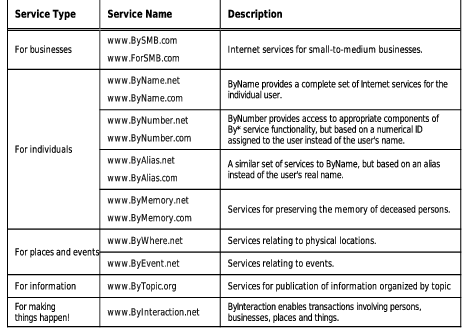
The By* services are summarized in Table 5.2. As shown in the table, each of the four services for individual users (ByName, ByNumber, ByAlias, ByMemory) is provided in the form of both a .net service and a .com service. The .com service is provided at no cost to users, without support or warranty, for demonstration and trial usage. The .net service is a paid subscription service, fully supported and advertising-free.
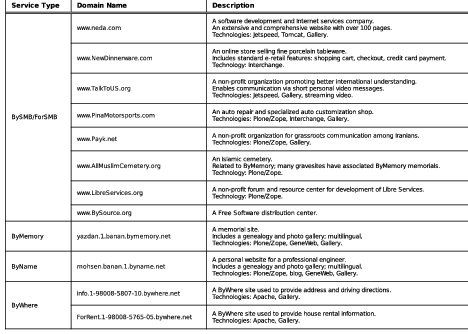
Examples of various existing By* instances are shown in Table 5.3.
4.2.2 By* Libre Engines
All By* services are Libre Services, and as such can be freely copied and reproduced by anyone.
The reproduction of any Libre Service is enabled by the existence of a corresponding Libre Service Engine. This is a complete, fully integrated package of service features and capabilities, ready for deployment and delivery by a service provider. It is part of the definition of a Libre Service that such an engine exist, ready for deployment without requiring any further software integration work. More information about the role of Libre Service Engines is provided in Libre Services: A non-proprietary model for delivery of Internet Services [3].
Each of the By* services has a corresponding By* Libre Engine, allowing the service to be reproduced in its entirety. We have established the BySource and ByBinary software distribution sites to provide the resources required to reproduce any By* service.
4.2.3 Naming principles
A consistent naming convention is essential in order to instantiate entities such as individual persons at extremely large scales. All object instantiations throughout By* are based on consistent naming principles. For example the ByName service provides each user with a personal domain based on the user’s own name, using the naming schema:
homer.simpson.1.ByName.net
This naming schema allows an unlimited number of named instances. ByName users are required to provide their real names for this purpose; pseudonyms and aliases are not permitted. This implies a certain standard of authenticity and integrity on the part of both the ByName service and the ByName user.
4.2.4 User environments
Internet services work by communication over the Internet between a client application running in the user’s computing environment, and a corresponding server application running within the service.
In the proprietary model the service is typically accessed via a web browser. It may also possibly be accessed via a dedicated client application provided by the service provider.
In the Libre Services model, however, there are no proprietary limitations placed on integration between the user’s computing environment and the service. Since the service is completely transparent, any user environment can be integrated with any Libre Service.
Furthermore, a much deeper level of integration is now possible. In particular, free user environments (i.e. user environments based on free software) can be integrated with Libre Services. And since both the client and server sides of the service are now completely transparent, this permits a highly complex level of integration between the two. This allows the development of Internet services with a power and versatility that far exceeds what exists today.
The By* services can thus be greatly enhanced by providing the user with a “matched” environment—a user environment that is closely integrated with the service. This will provide the user with features and capabilities that go far beyond what is possible using the traditional generic browser access. The role of matched user environments is described in greater detail in Libre Services: A non-proprietary model for delivery of Internet Services [3].
At the appropriate point in our continued development of By* we will develop these matched user environments to enhance the utility of the By* services. For example see the Project Document titled “Libre Emacs Office Environment (EOE)” in the article Libre Services: Projects for bootstrapping [4]. The goal of this project is to establish Emacs as a complete user environment for interaction with the initial set of starting-point Libre Service Engines. These are the Libre Engines upon which the By* services are based, therefore the resulting user environment will be immediately applicable to By*.
4.2.5 Value propositions
The By* services provide a number of critical value propositions both to end users and to service providers.
- By virtue of being Libre Services, the protection of a number of critical freedoms and civil liberties, including privacy, freedom of speech, and freedom of information.
- Greatly enhanced user functionality based on the completeness and close integration among the By* family services.
- Greatly enhanced user functionality based on the deep integration between the By* services and the By* user environments.
- Constantly increasing richness of features and functionality via the free software development model.
- The By* services are designed in every way for scaling, and to be a long-term, enduring value proposition for all users. This does not refer just to the ability to accommodate large numbers of users, it refers to the naming architecture allowing unlimited spreading of the franchise model. This gives service providers a long-term rationale for buy-in.
- The By* structure provides the basis to address certain problems currently limiting and/or degrading the Internet, resulting from the unstructured manner in which it has arisen. A good example is public key encryption. Though of enormous value, this has not yet entered mainstream usage. The reason for this is that public key encryption requires large-scale uniformity and consensus of usage. In the existing Internet landscape consisting of multiple ad hoc non-interoperating islands of functionality, this is not possible. But By* provides precisely the large-scale uniformity of usage required to address problems like this.
4.3 Growth Dynamics and Models
The growth of By* has a number of dimensions, including:
- Service features and functionality.
- Service deployment by other service providers.
- Service usage.
4.3.1 Features and functionality
The free software movement is a flourishing creative environment, constantly producing new and better functional software packages. Indeed for any particular functionality there are typically multiple alternative free software packages available. In this environment the task of developing the By* services is not one of software development, it is more a process of selection and integration. It is a matter of selecting the right software components from among the available alternatives, on the basis of fit and consistency with the existing service structure, and integrating the software correctly into the service architecture. Libre Services development becomes more a process of harvesting from the constantly growing body of free software components, than of actual new software development. We will continue to select and incorporate additional functional components into By* as these materialize within the free software environment.
This is the extraordinary magic of free software: the ability to take things and reuse them at extremely low cost. And it is this dynamic that assures constantly expanding features and functionality of the By* services. This is the fundamental engineering growth dynamic of Libre Services, and this is the powerful generative force that is lacking in the proprietary model. This is the key dynamic that causes the free/Libre model eventually to surpass the proprietary model entirely in terms of features and functionality.
4.3.2 ByName service deployment: business motivations
An important measure of the growth of By* is the number of service providers who are independently delivering the By* services, whether under the By* name or an independent brand name. It is highly desirable that not only the number of By* users grow, but that also the number of By* service providers grows.
Any company or organization can reproduce and operate any of the By* services for itself, thus becoming an independent Internet services provider. In particular, any company can reproduce the ByName service for individuals. For a company having an existing relationship with a large number of clients or users, this represents an immediate potential business opportunity.
In principle this opportunity is available to a company in any business sector, not even necessarily Internet related. But this is of greatest relevance to companies that are already operating within the Internet and telecommunications sectors. For example, this capability represents a major business opportunity for a large ISP, wireless network provider, or telephone company. Such a company already has a large number of subscribers to whom it provides basic Internet access, but under the existing proprietary services model it cannot readily deliver Internet application services. But under the Libre Services/By* model, it can almost instantly begin providing Internet Services to its entire existing subscriber base.
The business case for this is clear and compelling. The value propositions are: immediate entry into the Internet Services market as an independent service provider, greatly expanded scope of relationship with an existing customer base, and access to a much larger and growing user base. Furthermore, all this can be done extremely rapidly, and at very low cost.
And in addition, the company can deploy the ByName services based on any of several alternative business models:
- It can become its own independent Libre Service provider, with the ByName services rebranded under its own name.
- It can become its own proprietary Internet Service provider, with the ByName services rebranded under its own name, but not maintained as a Libre Service.
- It can become a franchise provider of ByName, providing and maintaining the services under the By* branding.
- It can enter into a business relationship with Neda, in which Neda provides the ByName services to the company’s subscribers, in exchange for a royalty or other payment to the company.
Each of these business models offers a different pattern of risks and benefits, and the company can thus adopt the model that best fits its positioning and broader business strategies.
The fundamental growth dynamic for ByName deployment by other service providers is the strong and clear business motivation for this.
ISP positioning
Based on the above discussion, we can see that the industry sector in the most ideal position to benefit from the free software and Libre Services models consists of the existing ISP companies. These companies have a large body of subscribers with whom they already have a service relationship. Based on the Libre Services model, an ISP can become an Internet Service provider almost overnight.1 And based on the free software development model, it can benefit continuously and at almost zero cost from the constant, on-going expansion of its services in terms of features and functionality.
The most immediate beneficiaries of the free software movement can be the ISP companies who recognize this, and simply get on board for the ride.
Non-commercial deployment
In the above discussion we have been focussed on commercial deployment of the By* services. We should also note that there is a very large non-commercial arena for deployment of By*. For example, a large corporation can provide an appropriate set of services for use by its own employees. Or a university can provide appropriate services for its faculty, staff and students. Or a government can provide a comprehensive set of services to its own citizens, as a matter of public policy.
4.3.3 Service usage
Thus there are clear growth dynamics for By* service deployment. And any participating company can readily generate user accounts for its entire customer base, ready for immediate usage. But creating accounts is one thing; account usage is another. If end users do not actually use the services, all this is meaningless.
As we have seen, there are plenty of good reasons why people should use the By* services. The most compelling benefits to end users are:
- The protection of a number of critical civil liberties, including privacy, freedom of speech, and freedom of information. These are guaranteed under the Libre Services model, but routinely violated under the proprietary services model.
- The completeness and close integration among the By* services, providing far richer and more powerful services functionality than the existing functionally isolated services.
But should do is one thing; will do is quite another. We should all eat less, exercise more, and vote Nader for President. It must be acknowledged that the By* merits, real though they are, will not be apparent to the great majority of prospective users. There will therefore be a significant latency between initial deployment of the By* services, and widespread understanding and acceptance of their benefits. So how will this understanding occur, and what will motivate people to adopt the services? The answer is that service usage will increase over time as a result of a number of factors and influences, all acting in concert. These are:
- The open and free Libre Services model, allowing unrestricted deployment and operation of By* by any company or organization.
- The clear and compelling business case for commercial deployment of By* within the Internet and telecommunications sectors.
- The large non-commercial arena for deployment of By*, such as intra-company, within universities, government institutions, and many other contexts.
- The cross-validation between deployment of the general Libre Services model in any context, and deployment of the commercial By* model. The By* services can be deployed in any of various contexts, such as commercial deployment by an ISP, non-commercial corporate deployment, or non-commercial public deployment. And in any of these contexts the services can be deployed either under the By* branding, or under an independent Libre Services branding. But any deployment of Libre Services, in any context, represents validation and growth of the general Libre Services model. And any validation of Libre Services brings validation to By* by association.
- The creation of large numbers of user accounts, thus creating the means and opportunity for service usage. (Part of our strategy for deployment of By* consists of the rapid population of the ByName service with large numbers of candidate users. Our strategy for accomplishing this is described in the Neda Business Plan [8].)
- The inherent merits of the services themselves in terms of freedom and protection of civil liberties: privacy, freedom of speech, and freedom of information.
- The inherent merits of the services themselves in terms of completeness, close integration, and powerful functionality.
- The ever-increasing richness of service features, functionality and sophistication assured by the free software and Libre Services development models.
- The moral appeal of Libre Services as a genuine communal resource, created by and for the public community itself, inherently aligned with the welfare of the user, and without any proprietary motivation or ownership.
- The slowly emerging societal awareness of these inherent merits, influencing attitudes and behavior over time. This will occur as a result of on-going discussion and analysis within all relevant constituencies: engineering, business, academia, and the media.
- Early adopters leading the way. Like all new technologies the adoption of By* will follow a pattern of adoption, driven by the differing motivations of early and late adopters. The genuine merits of By* will be understood immediately by sophisticated end users, including users among the free software community, the general engineering community, and the academic community. These will be the early adopters, and these users will lead the way.
- Later adopters following. Later adopters will be motivated more by the expanding features and capabilities of By*. But they will also be motivated by the growing societal understanding of the deeper philosophical merits of the services, and by their growing acceptance as the right model for Internet Services.
- The longer-term consequences of the By* model that will emerge over time, including unlimited global scaling and their ability to address global issues such as public key encryption.
Every one of these is a dynamic, or motivation, or linkage that leads to growing acceptance and usage of the By* services model. They are all synergistic, they are all mutually reinforcing, and they are all monotonically increasing over time. And they are all unopposed—there is nothing to stop, check, bound, or hinder any of this from happening. It is the summation of all of these factors that represents the growth model for usage of By*.
As a new model, Libre Services does not fit well into existing perceptions and expectations. It runs counter to the prevailing assumptions in all areas: engineering, business, and societal. We are dealing with a new concept for which the intellectual structures and vocabulary must be established in society at large. This is something that takes time.
At the outset the freedoms and benefits of By* will be lost on the great majority of end users, who will continue to use their proprietary services for some time to come. But these benefits are very real, and very deep. And the very depth and reality of these benefits is sufficent to ensure a monotonically increasing, organically-driven, grassroots acceptance of the services throughout society.
And in addition to the above the By* services, by virtue of being Libre Services, are a genuine communal resource, inherently aligned with the interests of the user. This creates a climate of trust between the user and the service provider that is not possible under the proprietary services model, with its inevitable dichotomy of interest between the user and the proprietary provider. The result is a long-lasting, close binding between the user and the service, based on user satisfaction, appreciation, trust, and confidence.
4.4 Development Roadmap
This is a general concept paper. The description of By* provided here represents an overarching conceptual definition and direction statement. It is clear that the intended scope of By* is extremely large—our goal is to establish By* as a new model for delivery of Internet Services, globally.
But we have said nothing about how we will develop the By* services and move towards achieving that goal. That discussion is provided in another document: the Neda Business Plan, titled The By* Family of Libre Services: The future of the Internet Services industry [8]. In that document we describe the roadmap and strategy for continued development and deployment of the By* family of services.
Though the goal is big and ambitious, the implementation is gradual and incremental. We will build the services piece by piece, and move forward a step at a time. The By* services are thus a work in progress, with the planned services in varying stages of development—some in operation, others under active development, and others at concept level only.
For the latest status on each service refer to the most recent version of the Neda Business Plan [8], or refer directly to the website for that service. All services have placeholder websites in place.
4.4.1 By* features and capabilities
As we have described, the model for implementation of By* service functionality is a process of intelligent selection and integration of functional components from the free software creative environment. Virtually all of the initial By* service functionality has been created in this way. The following are some of the basic By* features that have been included in this way:
- A named entity domain
- A public website
- A private portal for access to services
- eFax, a service for sending and receiving faxes
- WhiteBerry mobile messaging
- A photo gallery
- GeneWeb, a genealogy software program
4.5 Comparison to Existing Approaches
Some of the capabilities of the By* framework have counterparts in the Internet today, but these exist in the form of ad hoc, incomplete solutions.
Consider for example the very popular MySpace. In some ways this is not unlike the ByName and ByAlias services, in the sense that the individual person is recognized as a formal entity, and abstracted in the form of a set of attributes and conventions. But MySpace is focussed specifically on interactions between individual persons, and does not address the broader class of entities and interactions recognized in By*.
Microsoft’s less successful Passport service may also be considered in the same context, as an attempt to define an individual as a recognizable abstract entity for login purposes.
A complementary example to these is Craigslist, which enables a broad range of interactions between entities such as individuals and businesses. However Craigslist does not include any formal structures to represent the interacting entities themselves. Thus in effect Craigslist is essentially the same as ByInteraction, but without the structures defined in ByName and BySMB.
As another example Evite is essentially the same as ByEvent, but again, without the structures defined in ByName and BySMB.
These and many other existing web services have been created in a proprietary commercial context, in which the immediate focus is on short term marketability and profit. They have been created without recognition of the broader level of generality in which all such services exist. As a result these services address only part of the requirements of a unified framework for generalized interactions between people and information.
Some work is underway to create a more generalized and unified web structure. One of the better known initiatives is the Semantic Web, a project with the goal of creating a universal medium for information exchange by including semantic (computer-processable) meaning within the web content, thus allowing the web information itself to be directly processable by machines. Some Semantic Web applications have been implemented, but for the most part the Semantic Web as envisioned by its proponents remains largely theoretical.
The By* initiative addresses a much more modest set of goals than the Semantic Web. However there may be some overlap between our own work and the work of others in this field. We leave it to others to make use of the By* ideas as they see fit.
Chapter 5
Neda Open Business Plan
The By* Family of Libre Services:
The future of the Internet Services industry
An Open Business Plan
Document # LPD-601
Version 6.1
January 29, 2007
Available on-line at:
http://www.neda.com/StrategicVision/BusinessPlan
Neda Communications, Inc.
3610 164th Place SE
Bellevue, WA 98008
Phone: (425) 644-8026
Fax: (425) 644-2886
E-mail: http://www.neda.com/ContactUs
Web: http://www.neda.com
5.1 Executive Summary
Neda Communications, Inc. is an Internet Application Services company. We provide consulting and Internet services to small-to-medium businesses (SMBs) and to individuals. We are a one-stop full-service shop—we maintain our own Data Center, and we provide a full suite of services for clients requiring any sort of Internet presence. Our revenues derive from the customary sources: consulting, website development, hosting, and subscriber service fees.
So far, there is nothing unusual about any of this.
But our technological model for delivering services, and our long-term strategic vision, are very different from the mainstream. Our Internet services model is radically different in two respects, each having major consequences. First, our Internet services are based on the free software development model. And second, they are a unified services model. For these reasons our model has the potential to transform the Internet Services industry completely, and become the new model for delivery of Internet services, planet-wide.
But first, a bit of stage setting.
5.1.1 Setting the stage
Part of the debate about free software is now over, while part continues. The part that is over is any question about the viability of free software as a development model for creating large-scale, complex, relevant software systems. GNU/Linux is a fully viable free software alternative to the proprietary Microsoft Windows operating system, against which it continues to make steady inroads. Mozilla is a fully viable alternative to the proprietary Microsoft Internet Explorer, and is also experiencing steadily increasing usage. These and numerous other free software projects—Apache, Qmail, Sendmail, Bind, Plone, Snort and many others—have now become essential and widely used components throughout the software and Internet industries.
And apart from such well-known and high-profile projects, behind the scenes the free software movement has become a flourishing creative environment, generating a constant stream of new and better software packages, duplicating and surpassing the capabilities of an ever-increasing portion of proprietary software territory.
And the fundamental free software creative dynamic has now also become very well understood: the free software development model allows unrestricted creative reuse of existing assets at essentially zero cost. It is from this dynamic that the free software model derives its tremendous generative power. Free software is thus fully established as a generative engine and an industry reality, and is here to stay.
But the part of the debate that continues is whether or not this has any meaningful commercial dimension. Within the proprietary software domain a powerful revenue-generating engine exists in the form of the traditional software licensing model. But this revenue source is absent under the free software model. In its place there are a number of possible business and revenue models, but in all cases these lack the large-scale repeatability that makes things really interesting from a business perspective.
There thus remains a conceptual gap, a puzzle, about how the powerful generative forces of free software can be turned into a large-scale, repeatable, revenue stream. But this puzzle is now solved. And in this business plan we present the solution.
5.1.2 The transformation of software into services
The Internet has given rise to an enormous new industry: the Internet Services industry. And within this industry the business and revenue models are quite clear and obvious. The largest and most obvious are the subscription fee model of generalized service providers such as AOL, and the advertising model of numerous specialized no-cost service providers, demonstrated most spectacularly by Google. Both the subscription fee and advertising models are unlimitedly scalable, thus resulting in the gigantic commercial Internet of today.
But the Internet Services industry of today is a fundamentally proprietary construct. While proprietary service providers can and do make frequent use of free software components within their services, they do not espouse the free software development model itself, and their technical development process remains competitive and proprietary. Though they may incorporate free software components, AOL and Google are certainly not free software.
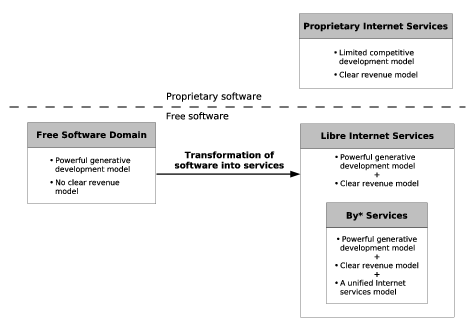
Thus as we look at the software and Internet industries of today we see two largely disjoint cultures. As illustrated in Figure 5.1 we see the free software domain, with its powerful generative and propagative development model, but lacking any clear large-scale monetization model. And separate from this we see the proprietary Internet Services domain, with enormous revenue and business consequences, but handicapped in scope and scale by its competitive development model.
But now we are witnessing a further transformational event in the evolution of the Internet: a shift of traditional software applications towards a service-based implementation, or what is sometimes called the “transformation of software into services.” And this is the critical event that now solves the free software revenue puzzle. This development unites the generative power of the free software domain with the proven revenue models of the services domain. The transformation of software into services allows the powerful generative model of free software to be invested directly into the powerful revenue model of the Internet Services industry.
5.1.3 Free and proprietary software: cultural incompatibility
But how is free software to fit into the proprietary Internet Services domain? The answer is: not very well. As we have noted, a proprietary service provider can make use of free software components. But by doing so the service provider is taking only limited advantage of free software. To take full advantage of the energy and productivity of free software, the service provider must do more than this—it must adopt the free software development model itself.
But a service provider cannot adopt the free software development model, while remaining a proprietary service. The free and proprietary software cultures are fundamentally incompatible, and a company cannot commit to both value systems at the same time. Within the free software culture, software is considered a communal public resource. Within the proprietary culture, the basic software proposition is this-is-mine-and-you-can’t-have-it. The conflicts and contradictions between these two value systems are too many and too pervasive for them to coexist within the same organization.
A successful company requires clarity of vision and unity of purpose, and must therefore define itself. So in the matter of software patents, copyright and trade secrecy, the company must take a coherent position. Either these intellectual property constructs are part of its business model, and its corporate mentality, or they are not. With a foot in both camps, the company is fundamentally conflicted.
A proprietary service provider is thus greatly limited in its ability to fully participate in and benefit from the generative power of free software. What is required instead is a new model for Internet services, one that is fully aligned and consistent with the free software development model. We call this the Libre Services model.
5.1.4 The Libre Services model
Libre Services are an extension of the principles of free software into the Internet services domain. They are Internet services that can be freely copied and reused by anyone. Any company or organization can reproduce and host any Libre Service, either for its own use, or for commercial or non-commercial delivery to others. The Libre Services model exists in relationship to the proprietary Internet services model of AOL, MSN, Yahoo, and Google, in an analogous way to how GNU/Linux exists in relation to Microsoft Windows.
Thus the Libre Services model, like the free software model, allows unrestricted reuse of assets at zero cost. In the case of Libre Services the assets in question are services constructs rather than software constructs, but the end result is the same: Libre Services reproduce the powerful generative and propagative forces of free software within the Internet Services arena.
Like free software, Libre Services are a genuine public resource, not owned by anyone, freely available for reuse by anyone. They are created by society, for society. This means that the services are inherently aligned with the interests of the user. Under the proprietary model there is an inescapable dichotomy of interest: that of the user on the one hand, and that of the proprietary service provider on the other. But under the Libre Services model, this dichotomy is dissolved. And by virtue of being free and open, Libre Services guarantee a set of critical civil liberties that are not guaranteed under the proprietary services model—indeed, that are routinely violated under that model.
To the business mentality it may seem quaint, even comical, to advance such ethical considerations within the context of a business plan. But these critical characteristics of Libre Services represent a profound motivation for acceptance and usage of the services by society. It will take some time for this motivation to become apparent, but it is there, and its effects are real.
5.1.5 The By* model
The Libre Services model is one radically different dimension of our services model. There is a second dimension, also radically different, and also having major consequences. This relates to the capabilities of Internet services in purely functional terms. Whether proprietary or Libre, what can the services actually do, and how well can they do it?
There is no question that Internet Services represent a phenomenally dynamic, thriving industry, bringing revolutionary new computing and communications capabilities to the world, and accompanied by equally phenomenal business opportunities. This much is obvious.
But the Internet Services industry of today is also a gigantic mess. It has arisen in a completely unplanned, disorganized, chaotic manner, lacking any sort of uniformity or consistency of structure, and in many ways it is wildly dysfunctional. This is not so obvious. But as software and Internet engineers, having been actively involved in the technical Internet from the beginning, we know this to be the case.
And while this may not be apparent to the everyday user, having never experienced anything different, this limits the capabilities of Internet services in many ways. The Internet Services industry of today, dynamic and thriving though it may be, is in a sense crippled. It falls far short of what it can be, and what it can do, if designed for full, consistent, uniform interoperability across all types and manners of service usage.
The By* (pronounced “by-star”) model solves this problem. By* is a unified services model, unifying and making consistent a large number of services that currently exist in functional isolation. For example there is Yahoo. And there is Craigslist. And there is MySpace. But there is no connectivity or integration among these, though such joint interoperability would greatly augment the capabilities of all these services. As with technology in general, proper integration creates a new construct, bigger and better than the sum of its parts.
Today, a user’s Internet experience is scattered across numerous disparate services. In particular, a user’s personal presence on the Internet—her individual data and self-representation—is fragmented and duplicated among a multiplicity of service providers. Today she has many usernames and many passwords. Under the By* model, she will have only one.
By* is a coherent, integrated family of services, providing the user with a comprehensive, all-encompassing Internet experience. It includes services for individuals (ByName, ByNumber, ByAlias, ByMemory), services for business entitities (BySMB/ForSMB), services relating to physical locations (ByWhere) and events (ByEvent), and services for publication of information (ByTopic). Last and most important, By* includes a set of services allowing complex interactions among persons, businesses, and things (ByInteraction).
In terms of end-user functionality the services will eventually provide a large superset of the computing and communications capabilities that exist today. Meanwhile the services are evolving and will continue to evolve towards this goal. Up-to-date details about the current and planned capabilities of each service are provided on the service websites themselves. A complete list of all service websites and their supporting documentation is provided in Section 5.1.14, “Summary of references and pointers.”
By* is the model for a new generation of Internet services, far bigger and far better than the uncoordinated mishmash of services that exist today. By* is the Internet services industry, done right.
5.1.6 Our strategic vision
As shown in Figure 5.1, the By* services embody a set of attributes that exist nowhere else in the Internet services industry. By virtue of being Libre Services, they are a proper vessel for receiving the creative productivity of the free software development model. And also by virtue of being Libre Services, they reproduce that same creative productivity within the services domain. By virtue of being Internet services, they inherit the gigantic revenue engines of the proprietary Internet services domain. And by virtue of being a unified services model, they far surpass the capabilities of the existing, functionally fragmented industry.
All this gives the By* model enormous potential. By* can become the new model for delivery of Internet services, at the scale of the entire planet. Our ambition is to lead By* forward to the full realization of this potential.
To many, this ambition will appear implausible and unrealistic. But it is based on the tremendous generative power of the free/Libre model. Though few understand this, a watershed event is currently taking place within the software industry: the proprietary software model is being overtaken by the free software model. The battles will continue for years to come, but the war is already lost: the proprietary model is marked for extinction, and the future is free software. As engineers, as software experts at the forefront of our industry, we have recognized this well ahead of the industry at large—and certainly far in advance of the business community. Though the demise of the propriety software industry may seem implausible today, this is already as much a reality as global warming.
Without a clear understanding of this reality, none of what we are saying makes sense. With this understanding, all of it does. We are a small group of engineers who fully understand the power of the free/Libre model. What will make all of this work is the extraordinary generative power of Libre, and our ability as engineers to shape and direct this power to extraordinary effect.
Not a tear-down and rebuild model
It must be emphasized that what is being presented here is not a tear-down and rebuild operation.
The Libre Services and By* models are revolutionary, and can be expected to have a revolutionary effect on Internet usage. But these models are about service development and functionality, not about technological infrastructure. We are not reinventing the Internet protocols, or any other technical aspect of Internet operation.
Libre Services and By* imply no discontinuity, in terms of either technology or service deployment. The implementation model for Libre Services and By* is wholly evolutionary—there exists a continuous migration path from the proprietary model of today to the Libre model of tomorrow.
5.1.7 This is all real
So far, everything we have said has been theoretical. Let us now turn to the practicalities of the matter. By now it will be clear to the reader that what we are proposing is rather colossally gigantic. But we have been actively working on this initiative since 2001, and our implementation is now well advanced. In terms of what we have built, this written Business Plan is just the tip of the iceberg.
Far from being empty theory, all this has substantive reality. Libre Services and By* are not just an abstract concept or a distant mirage. They are real constructs that we have built and are delivering to our clients today.
- A real conceptual foundation. We have fully defined and documented the Libre Services concept. We have also enabled this model by establishing a formal framework for industrywide participation in Libre Services development. This component of our work has been done under the auspices of the Free Protocols Foundation, a non-profit organization separate and distinct from Neda. Complete details are provided in Section 5.5.2, “Libre Services participation.”
- Real services. We have implemented the initial components of By* and established a starting point set of services. The various By* services and websites are summarized in Table 5.2. The services are in varying stages of development—some in operation, others under active development, and others at concept level only. But the initial services are in place, and the rest will follow. The current status of all By* services is summarized in Table 5.5.
- Real clients. By* services are currently in use by a number of our individual and business clients. The scale of usage is small, but nevertheless these are real, supported, working services. Examples of existing individual and BySMB users are provided in Table 5.3.
-
Real
assets.
We
have
been
actively
working
on
this
initiative
since
2001,
and
we
have
created
a
complete
conceptual
blueprint
and
a
coherent
set
of
assets
to
turn
our
ambitions
into
reality.
A
description
of
the
relevant
assets
and
their
current
status
is
provided
in
Section
5.8,
“Status
and
Assets.”
We host the By* services at our own Data Center, and this is therefore a particularly important asset. The Data Center is complete and operational in all respects, and capable of supporting all By* services up to medium operational scale.
- Real revenues. There are multiple revenue sources associated with the By* deployment. In addition to the subscription fee and advertising models already mentioned, Libre Services and By* create a number of additional revenue sources not present under the proprietary services model. All revenue sources are described in Section 5.6, “Revenue Models,” and summarized in Table 5.4.
-
A
real
company.
Neda
Communications,
Inc.
is
a
well-established
company
with
a
proven
track
record
of
technical
proficiency
and
profitability.
Neda
was
founded
in
1991,
and
between
1991
and
1997
operated
as
a
successful
data
communications
consulting
company,
with
average
revenues
from
1993
to
1997
of
over
$1
million
annually.
Since 1997 Neda has exercised active leadership in an evolving series of industry initiatives, leading up to the present By* initiative. Over the past several years our vision and focus has been the creation of the assets required to execute this Business Plan. To date Neda has received no external financing. Details are provided in Section 5.12, “The Company.”
-
A
real
team.
Neda
has
a
core
team
of
engineering
and
management
personnel
with
extensive
experience
in
the
technical
Internet
and
data
communications
fields.
Among
the
team
there
are
relationships
going
back
many
years,
reflecting
a
long
history
of
productive
cooperation.
In
particular
the
following
key
team
members
have
worked
together
closely
and
committedly
on
this
initiative
since
2001:
Mohsen Banan. Mr. Banan is the founder of Neda Communications and the team leader. He is the intellectual originator and visionary behind the Libre Services and By* concepts. His professional biography is available at his public ByName site at: http://mohsen.banan.1.byname.net/ProfessionalBio
Andrew Hammoude. Dr. Hammoude represents the written word of Neda Communications. All mission-critical exposition of the Libre Services and By* concepts has been created by him. He has been with Neda since 1999. His professional biography is available at his public ByName site at:
http://andrew.hammoude.1.byname.net/ProfessionalBio
Pinneke Tjandana. Ms. Tjandana has built a large part of the operational and developmental components of the By* services. She has been with Neda since 1998. Her professional biography is available at her public ByName site at:
http://pinneke.tjandana.1.byname.net/ProfessionalBio
Information about other Neda team members is available at:
It’s all real, and every day it gets realer.
5.1.8 Key execution strategies
We have formulated a coherent execution plan for deploying the By* services, developing the various revenue streams, and moving this initiative forward over time. Complete details are provided in Section 5.7, “Execution.” In the following sections we describe some of the key elements of our execution strategy.
Marketing strategy: Engineering vs. Business polarization
We are facing a major service uptake challenge. First, we are in a very crowded and noisy arena. The general Internet services domain includes many established services, plus a constant stream of new commercial initiatives, all competing for user attention. The domain of social networking services is a particularly intense focus of competitive activity at present, and By* asserts its own emphatic presence in this domain also.
Furthermore, we are latecomers in an increasing returns business. Many existing service providers already have a large and growing base of users, with whom they have an already established relationship.
A big part of our service uptake challenge is met by the inherent growth dynamics of the Libre and By* models themselves. These are discussed at length in the document titled, The By* Concept: A Unified Model for Internet Services [?].
But in addition to this, a strong marketing message is required to differentiate By* from other services, and pull subscribers away from existing providers. We have a coherent and powerful set of marketing messages to address this requirement. These are:
- The By* services, by virtue of being Libre Services, are inherently on the side of the user. No proprietary service can make this assertion, and this provides us with immediate differentiation from all existing Internet services.
- By* provides a total, integrated Internet services solution, delivering everything needed by the user. This is in contrast to the existing patchwork of functionally fragmented services, each delivering only a component of what is needed.
- The metaphor of a war between Engineering and Business.
In our first marketing message we position By* as inherently aligned with the interests of the user, in contrast to proprietary services which are ultimately aligned with the interests of the provider. But we will go much further than this. We will broaden this message into something much bigger: we will actively promote a militant polarization of Libre as an Engineering construct, versus proprietary as a Business construct.
Today, the Internet services industry is owned entirely by business interests. But the Libre Services and By* initiatives represent a startling challenge to this: they represent a determined reassertion of proper guardianship of the Internet by Engineering. This challenge will bring us into massive conflict with existing commercial interests, who will fight ferociously to defend the status quo.
Table 5.1 shows the many elements of contrast between the Engineering and Business value systems. As the table makes clear, these two values systems are in complete and total conflict. We will fully exploit this conflict as the metaphor of a war: a war between Engineering and Business, in which Business represents exploitation of the Internet for profit, and Engineering represents guardianship of the Internet on behalf of the public.
| Engineering Values | Business Values
|
Patent-free | Patented |
Copyleft | Copyright |
Transparency | Secrecy |
Public ownership | Private ownership |
Sharing, collaboration | this-is-mine-and-you-can’t-have-it |
Guardianship | Exploitation |
| Libre Services | Proprietary Services
|
We are thus taking an assertively militant, combative position. We have had previous experience in generating attention by this means. In 2000 we wrote and widely distributed a document titled, The WAP Trap [?]. This was a public exposé of WAP, a shoddy and exploitative business construct. The WAP Trap successfully created interest and press coverage; for details see http://www.neda.com/AboutNeda/News/WrittenAboutUs. Our highly assertive By* marketing messages will create publicity and press coverage in much the same way, though we expect on a much larger scale.
Our marketing messages are new, powerful, unique, and cannot be asserted by any other service provider. Together with the inherent growth dynamics of the By* services themselves, these marketing statements can create broad cultural acceptance of the Libre model, and can pull users away from the existing proprietary providers.
Marketing jujitsu: business based on non-business
Marketing is about perception, not reality. But it is worth noting that our marketing messages are, in fact, wholly congruent with the underlying reality. The central element of our message, that the By* Libre Services are inherently on the side of the user, is perfectly true. It is true because they are a purely engineering construct, created solely in the public interest, and not beholden to any private commercial interest. When the message is congruent with the reality, the result is a tremendously powerful marketing imperative.
Today, the public is generally oblivious to the perils of the proprietary services model, and cheerfully entrusts its personal data, its privacy, its freedoms and its civil liberties to proprietary business interests. But this will change. And as it does, as general public awareness grows, our marketing messages will resonate ever more strongly with the public, the media, and our fellow engineers.
The By* services are unique in that they are a business model based on the Libre model, which in turn is an engineering construct residing entirely in the public domain. We are thus using the inherently non-business nature of the By* services as a critical element of our business strategy. This is the unique marketing jujitsu made possible by the Libre model.
Marketing synergy: Libre Services leadership
The full scope of this initiative includes two distinct dimensions: the public side, represented by the general Libre Services concept, and the commercial side, represented by the Neda By* services and this business plan.
We have described above our By* services marketing strategy, centered around By* as a commercial offering by Neda. But in addition to this we are the visionaries and leaders of the broader Libre Services movement, and this provides us with a further unique promotional vehicle.
Libre Services are new and interesting. They are altogether unlike the existing proprietary model. They are a genuine communal resource, created by Engineering as a gift to society, inherently aligned with the interests of the users, and providing guaranteed guardianship of personal freedoms and civil liberties. This is new and different. It is interesting, puzzling, and thought-provoking. Above all, it is newsworthy. Our leadership role in the Libre Services movement will bring us a unique level of visibility and name recognition.
Our leadership of the Libre Services movement and our marketing of the By* services are strongly synergistic: attention directed towards one naturally brings attention to the other. We will therefore conduct a strategic coordination of these two activities: we will assert our leadership of the Libre Services movement in close coordination with the initiation of our By* marketing campaign. In this way we will greatly amplify the effectiveness of both.
Furthermore, both of these activities create the opportunity for revenue growth by Neda. We will therefore coordinate the above two activities with a third: the public exposure of the By* services as a revenue-generating engine.
We will execute all three activities at precisely the correct moment: the moment at which we are able to deploy and support the By* services at scale. This triply coordinated execution—of Libre leadership, of By* marketing, and of By* services exposure—will bring unique visibility to Neda. By choosing this moment correctly, we will turn that visibility directly into revenues.
(Nota bene. Throughout this Business Plan we are focussed on the success of the By* services as a commercial initiative, and in this section we have described how our promotion of the Libre Services movement contributes to this success. But it must be emphasized that this does not imply any marginalization of the Libre Services movement, or the subordination of the goals of the Free Protocols Foundation to those of Neda.
This initiative includes two major dimensions, and each is an essential requirement for the other. Just as the Libre Services movement provides the essential context for By*, so the existence of a coherent business model is essential for widespread deployment of Libre Services. These two dimensions are closely interdependent, and success of one contributes directly to the success of the other.)
Engineering development model
As we have noted, the free software movement is a flourishing creative environment, constantly producing new and better functional software components. Indeed for any particular functionality there are typically multiple alternative free software packages available.
In this environment the model for implementation of By* service functionality is not one of original software development. Rather it is a matter of selection and integration of already available software packages. Virtually all existing By* service functionality has been created this way—in building By* we have written almost no new software at all.
Thus we are not so much in the business of software development, as we are in the business of software integration. But the integration of software components to produce a coherent service is far from trivial. We have created a sophisticated technical integration environment for this purpose, called the Neda Libre Services Integration Platform (Neda-LSIP). Neda-LSIP is a comprehensive set of tools and conventions for the transformation of software into services. Neda-LSIP is the key technological component of our realization of the concept of Libre Services, allowing practical and cost-effective aggregation of free software components into coherent services. Neda-LSIP is free software itself, available under the Affero GPL version 3 license. For complete details see the document titled, Neda-LSIP Design and Implementation Notes [6].
Moving forward, we will continue to select and incorporate additional functional components into By* as these materialize within the free software environment. This is the extraordinary magic of free software: the ability to take things and reuse them at extremely low cost. This is the fundamental growth dynamic of Libre Services, and the powerful generative force that is lacking in the proprietary model. This is the key dynamic that causes the By* Libre Services eventually to surpass the proprietary model entirely in terms of features and functionality.
Engineering design for scale
By* is designed to be big. Big in every respect: in terms of functional scope, in terms of depth of integration, and in terms of numerical scale. Our goal is to establish By* as the new model for delivery of Internet Application Services for all individuals, and all businesses, everywhere. The intended scale for By* is the entire population of planet Earth.
Every aspect of our model and execution strategy is directed towards achieving this numerical scale. In particular, all our engineering design decisions have been made with scalability as a critical requirement. For example:
- Overall design of the By* services is based on a highly distributed architecture, with no inherent number limits. The services are unlimitedly expandable in terms of hardware infrastructure.
- An important design decision is the selection of the right free software components for integration into By*. All software components have been chosen with scalability as a key requirement.
- A consistent naming scheme is essential in order to create object instantiations at extremely large scales. The By* architecture incorporates a hierarchical naming model, based on consistent and extensive use of the Internet domain naming system. This allows the naming and addressing of unlimited name spaces within the By* structure.
- We built our own in-house Data Center right from the beginning, giving us the ability to scale up without requiring an initial colocation phase. With our own Data Center we can scale up operations efficiently and economically, under a wide range of operational contingencies. The Data Center can support deployment of By* up to medium operational scale.
Focus on model, scope and scale
This is a model play. This is not about a new product or service, as these are commonly defined and bounded. This is about an entirely new paradigm for Internet service deployment and usage.
Thus what we are building here is inherent model potential. We are not building limited service functionality for a limited scale of delivery. Rather we are building gigantic potential: for the creation of vast scope of functionality, and global scale of delivery.
Throughout our execution strategy we maintain proper focus on this goal. In particular our major effort has been devoted initially to defining the Libre model, designing the By* architecture, and building the machinery necessary for large scale execution. With these critical enabling components in place, only then do we attempt to deploy By* as a large-scale service.
Certainly, we could have invested our initial effort in building and deploying By* as robust services, and creating an initial user base. But this would amount to a traditional service play, not a model play. This would leave us with a service in place, but without the powerful generative model characteristics that give By* its planet-wide potential, without our unique leadership role, and without our model-based marketing messages.
Growth of user base: timing
An important consideration is the point at which we begin to accept the burden of significant numbers of users. In the case of a conventional service deployment there is typically a major emphasis placed on early and rapid growth of user base, to demonstrate demand and marketplace viability of the service, and lay claim to a particular portion of functional territory.
However we are not following this standard early proof-of-service approach. This may be appropriate for a conventional new service, where service functionality is the central and most critical issue. But for our industry model play, a different timing strategy is required.
First, as a superset of numerous existing services, proof of service for By* in functional terms is already demonstrated by the Internet Services industry as it exists today. It is far more important to prove the model itself rather than its functional manifestations, and hasty creation of user base does little to accomplish this.
Instead we have provided a coherent and complete description of the model in this and our other documents. The theoretical basis for the model is solid, and this will be clear to anyone willing to invest the time to understand it. In addition a number of working By* implementations are already in place; examples are provided in Table 5.3. Though the scale of usage remains small, these are sufficient to demonstrate the viability of the Libre model and the By* design, and the value of the resulting services to paying clients.
But a far more important consideration is that installed base is very costly in terms of maintenance and support, and premature exposure to these costs can jeopardize the more critical work of building the underlying model machinery. Therefore we will not take on the burden of user base until the time and/or context is right for this. This means either that we are fully ready to accept the associated costs of ownership, or that the user base is being taken on in an appropriate context, such as a suitable business partnership.
Under either scenario our strategy is the same: at the right time we will populate the services at large scale by mass creation of By* service accounts for large existing user bases. Our strategy for accomplishing this is described in a separate document titled, The By* Family of Libre Services for Network Service Providers: A strategy for rapid entry into the Internet Application Services market [?]. This document describes how a Layer 3 service provider can become a Layer 7 service provider virtually overnight based on the By* Libre Service model, and can begin delivering Layer 7 services directly to its entire Layer 3 user base.
Collaborative binding: an open vertical keiretsu
The Libre model creates an entirely new business environment in terms of competition, collaboration, and value chain relationships.
In the proprietary model, businesses can and do enter into technical collaboration and strategic partnership. But within such partnerships, the partnering companies remain intensely focussed on intellectual property ownership considerations. Even before any serious discussion can take place, the prospective partners implement restrictive Non-Disclosure Agreements (NDAs) to protect each other’s trade secrets. And when the partnering companies are eventually able to agree on the nature and scope of a collaborative project, technical development takes place in the context of closely negotiated agreements about who owns what, and how patents, copyrights and royalties are to be divided among the companies.
Thus proprietary technical collaboration, like porcupines mating, includes a strongly anti-collaborative component.
The Libre Services model, however, represents a complete renunciation of the existing intellectual property regime. (Indeed, we consider the very term “intellectual property” to be problematic, implying as it does an extension of the logic of physical property ownership into the non-physical realm of software and ideas.) Under the Libre model, software and services are a public resource, owned by no one. Patents and copyright are rejected entirely. With these (so-called) intellectual property constructs out of the way, there are no obstacles to collaborative services development and integration. The Libre model is thus inherently collaborative in nature.
Yet within the Libre environment, other perennial business considerations remain in full force. Competition and strategic maneuvering remain alive and well, but these take place at points of contact outside the technical development arena. Fundamental business questions remain, such as: What are the natural business alliances? How is risk to be shared among such alliances? How are revenues and profits to be divided?
The Libre business environment is new, and in time it will establish its own conventions to negotiate and settle these questions. The details of how this will occur is not our concern or responsibility. However it is our responsibility to define and maintain our own strategic positioning within this environment.
By* Libre Services creates a new, extremely large and complex value chain. Our key strategic positioning within this chain is as the top-level services aggregator, having a direct relationship with the end user. This positioning presents Neda with unique opportunities and responsibilities. Our unique opportunity is to profit from this position. Our responsibility is to promote and enlarge the value chain, while maintaining our positioning in the face of strategic actions by both competing and collaborating companies.
The elimination of proprietary competitive tensions from the technical development arena, together with the shared anti-IP mindset of collaborating companies, creates a new form of binding among value chain partners—what we call an open vertical keiretsu. We invite others to join us in expanding and profiting from By*. If you have a Libre component that fits well and that you wish to integrate into By*, or if you are interested in a longer-term business relationship for development of a particular branch of By*, please contact us. We have ample Neda equity available to promote early-stage business partnerships.
Competitive advantages
The Libre Services industry presents an entirely new competitive environment. For any provider deploying a Libre Service, it is no longer possible to maintain sustainable advantage on the basis of proprietary service ownership. Nor is it possible to create advantage on the basis of functional service differentiation from other providers.
A complete discussion of our competitive advantages within this environment is provided in Section 5.10, “Competitive Advantages.” But there are two in particular that provide us with unique advantages over any potential competitor:
- We are the originators and architects of Libre Services and By*, and we are playing a unique leadership role in their industry-wide promotion and deployment. There can be only be one leader, and we are it.
-
By*
is
a
total
services
solution,
vast
in
scope,
highly
scalable,
designed
for
the
long-term,
big
picture
future
of
the
Internet.
This
immense
scope
is
reflected
in
the
By*
design
architecture.
The
design
is
sophisticated
and
complex,
allowing
highly
generalized
interactions
among
the
many
By*
components.
This represents vision, depth of understanding, and a far-reaching intellectual investment. This cannot be easily replicated or understood by others. Yet we have a clear understanding of By* in every detail. This depth of understanding will guide our deployment and strategic maneuvering for years to come. This amounts to a major conceptual lead time over any potential competitor.
5.1.9 The Spearhead: By* Libre Texting
The scope of By* Libre Services is so vast that it is hard to believe.
We therefore need an initial point of focus to demonstrate the true reality and power of By* Libre Services. A clear value proposition and a real, concrete problem domain are required for this. We have chosen the domain of Mobile Messaging as the tactical spearhead for By* Libre Services. We call this By* Libre Texting.
By* Libre Texting is in a sense the merging of By* with our 2001 Business Plan [?] and Operation Whiteberry [?]. By adding to By* all the assets that we had previously developed in the Mobile Messaging arena (RFC-2524 [1], RFC-2188 [2], EMSD.org, ESRO.org, the LEAP Software, The LEAP Manifesto ), we now have a powerful and complete set of assets.
In contrast to Operation Whiteberry, which required the mobile phone companies to relinquish their walled garden model, By* Libre Texting is fully self-contained and complete, requiring no proprietary external assets.
We have documented and are promoting this initiative in the form of a comprehensive presentation titled, By* Libre Texting: A Reshaping of the Medium [?]. The evolution of the original Operation Whiteberry into today’s By* Libre Texting has taken about 10 years, as various components of the industry have gradually caught up with our long-term vision of Libre Mobile Messaging. In particular, the following three components were absent in 2001:
- Open Linux PDAs (e.g. Linux Nokia 810).
- Widespread availability of WiFi, for final-leg connectivity.
- Public/unlicensed spectrum (e.g. MURS), for wide-area connectivity.
But with these elements today in place, a complete Libre texting solution is now fully viable.
To provide a complete end-to-end texting alternative to SMS and BlackBerry, we use the Nokia 810 Linux PDA as our device hardware platform. The device protocol software is the native Linux EMSD-UA package. On the services side, EMSD-SA is a standard part of By*.
Details of our execution plan for By* Libre Texting are available in presentation format in By* Libre Texting: A Reshaping of the Medium [?]. A large part of the content of our 2001 Business Plan [?] also continues to apply to By* Libre Texting.
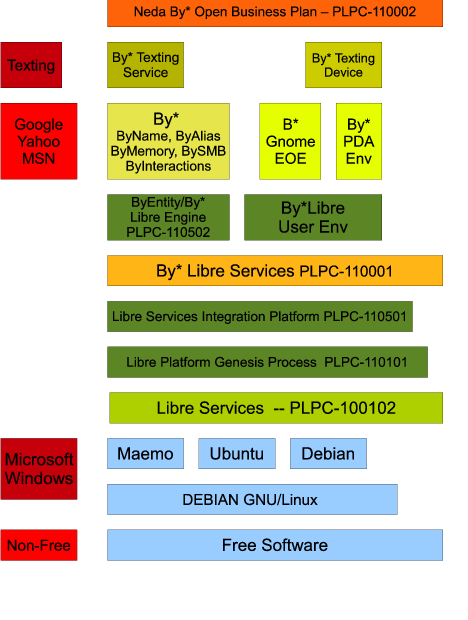
Figure 5.2 shows the technological context for By* Libre Texting. This figure shows the various conceptual and software layers that By* Libre Texting is built on. As the figure shows, the By* Libre Texting (mobile messaging) capability resides at the very top, representing a vertical slice of the highly generalized By* capabilities. This well-defined vertical application provides precisely the concrete value proposition required for initial market penetration by By*.
Each of the layers shown in Figure 5.2 represents either a conceptual definition, or an actual software/service implementation. On the business side, the value chain model has an analogous layering structure. As discussed in Section 5.1.8, “Collaborative binding: an open vertical keiretsu” our strategy of maintaining our position at the very top of the value chain is supported by our assets throughout all layers.
5.1.10 Where we are today
In broad summary this is where we are today:
- Articulation of the Libre Services conceptual model is complete and fully documented.
- We have built the assets and infrastructure necessary for widespread exposure of any part of this initiative. This includes a comprehensive website presence, and a sophisticated e-mail capability for highly efficient marketing and communications operations. See Section 5.1.14, “Summary of references and pointers,” for a summary of our very extensive website assets.
- Overarching design architecture for the By* services is complete. It is also implemented sufficiently for someone with the necessary technical skills to understand the integrity and philosophy of design, and the architectural characteristics in terms of functional scope, depth of integration, and numerical scalability.
-
Implementation
of
the
By*
services
themselves
is
in
progress.
In
terms
of
functionality,
the
initial
services
are
already
sufficiently
complete
for
deployment
and
usage.
A
number
of
example
implementations
are
in
place;
these
are
summarized
in
Table
5.3.
In addition, the By* Factories—the software machinery required for fully automated creation of new service instantiations—are also complete and in place. We thus have the ability to create unlimited numbers of new accounts in batch mode, or at any time we can “enable” the services, to permit self-service account creation by individual and business users.
However the services are not ready in terms of security, operational manageability, and scalability. Substantial work remains before we can support large numbers of users reliably and efficiently. This is the last remaining phase of work to be accomplished before we can deploy the services at large scale.
An immense construct
Over the past several years we have built something quite extraordinary. We have built a sophisticated machine, that when set into motion, can redefine the entire global Internet.
And we have done all this based entirely on our own determination, hard work, and committment. Everything we have built thus far has been driven by our own efforts, without external funding, financed entirely by our revenues as a consulting company. We are a small team, and we have foregone company revenues and personal income over an extended period. Yet despite these sacrifices we have stayed together and continued to work committedly on this since 2001.
The results, we believe, speak for themselves. This business plan is the topmost element of an immense construct. Section 5.1.14, “Summary of references and pointers,” provides a roadmap to the many interlocking elements of this construct. We invite the reader to take a look, and see for yourself.
5.1.11 Moving forward
Moving forward from this point we will execute the following items:
- We will complete the final leg of technical work required to support large numbers of users.
- At the right moment we will initiate a coordinated exposure campaign. We will make widespread exposure of the general Libre Services model and claim our leadership role; we will initiate our highly assertive By* marketing campaign; and we will make public exposure of the By* services themselves.
- We will continue to seek consulting projects and Internet services clients that are well aligned with our strategic objectives.
- We will seek out business partners with whom our strategic direction has strong resonance. An important component of this is our strategy for seeking out By* service deployment partners; this is described in a separate document titled, The By* Family of Libre Services for Network Service Providers: A strategy for rapid entry into the Internet Application Services market [?].
- We will continue to augment the framework for participation described in Section 5.5, “Framework for Participation.”
- We will continue to expand the services in terms of functionality, and we will continue to harden our deployment infrastructure in terms of security and operational manageability.
- Based on all the above, we will begin to scale up the services and develop a growing, recurring revenue stream.
Beyond the above near-term items, the large scope of this initiative permits great flexibility of execution. By* has great breadth and depth; it is the equivalent of multiple conventional business plans rolled into one. And as we discuss in Section 5.6, “Revenue Models,” it includes many opportunities and revenue streams. This multiplicity of opportunity allows our execution to be readily adapted to changing circumstances. Our overall execution plan is therefore highly reactive and responsive to events as they unfold.
In terms of By* service functionality, at this point we have established a stable functioning system, which will form the basis for ongoing engineering development. Moving forward from here we will execute an incremental implementation strategy, continuously adding new functionality and expanding the scope of this stable system.
Scaling up of the services will be contingent upon the availability of appropriate resources. The By* Factories are ready, but we will not exercise these at large scale until we are ready to accept the associated maintenance and support demands. In the meantime we will continue to populate and expand our Data Center usage at a small-scale, controlled rate.
Our general exposure campaign will likewise be contingent on circumstances. The assertion of our leadership role and other exposure activities are a matter of degree, and can be executed to greater or lesser extent. We will execute exposure in proportion to our ability to scale up the services and convert that exposure into revenues.
Other aspects of our execution plan are similarly reactive. In terms of external financing, the plan is fully adaptable to the availability of financing, addressing the full range of possible financing contingency. In particular we have a coherent execution plan for a wholly self-financed mode of operation; details are provided in Section 5.7.4, “Adaptability to financing.”
5.1.12 The need for broad participation
Based on our own efforts, we fully expect that we will complete the final phase of technical work, and we will reach the critical threshold at which the By* services begin to generate a growing, recurring revenue stream.
But there is what we can do on our own, and there is what we cannot do.
Neda now stands at an absolutely critical point in its development. Over the past several years we have built an extraordinary revenue-generating machine. But despite its phenomenal potential, this machine cannot generate any meaningful revenue until it is complete, and until it is exposed. We are now moving towards a crucial moment: the moment at which this machine begins to turn.
On our own we can and we will reach this critical threshold. But we cannot sweep up to and beyond this threshold swiftly and with certainty. We cannot exploit the many By* revenue opportunities intensively and in parallel. And we cannot deploy By* at the very large scale for which it is intended.
Though we have created a model with enormous potential, though we have a unique leadership role and unique marketing messages, our ability to convert this gigantic opportunity into revenues is desperately limited. On our own we are limited to a small-scale, incremental mode of execution. In this mode we cannot execute rapidly, intensively, and at large scale. We are simply too small, and we do not have the resources.
A small team is ideal for conceptual analysis, model articulation, and architectural design. All this we have accomplished. But now we need to bring in others. With what we now have in place, we are now ready and the time is right for us to move forward to planet-wide scale. And for this we need people, we need business partners, and we need investment.
An invitation
This initiative is not about a conventional product or service. It is about the reinvention of the global Internet Services industry, on the basis of a radical new services model. It is about leadership, and capitalization on that leadership in business terms. It promises to be exciting, and rewarding, in the execution.
We have created a gigantic opportunity, and with the right participation we can turn this opportunity into gigantic revenues. And to enable such participation we have established a comprehensive framework for participation; details are provided in Section 5.5, “Framework for Participation.” In particular we have ample equity available to motivate participation by team members, partners and investors. In the case of investment participation, our financing model is described in Section 5.13, “Financing.”
If you are interested in taking part in this venture, then please read on. And if not then please feel free to pass our Open Business Plan along to any other interested person.
5.1.13 Conceptual foundations
This business plan is built on top of, and requires understanding of, a number of important underlying concepts. Figure 5.3 shows the full conceptual foundation for the plan.
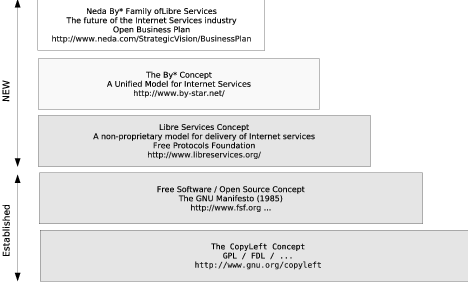
Each component in the figure represents a conceptual layer, with each layer building on those beneath. The bottommost layer represents the concept of Copyleft, a key enabling principle for the new ideas of non-material capitalism in the digital era. In the context of the software industry, Copyleft is manifested in the form of the Free Software Movement, shown as the second layer in the stack. Thus free software can be viewed as a special case of the more general idea of Copyleft. The principles of Copyleft and Free Software are well established and understood throughout the industry at this time.
But the three topmost layers are entirely new. These represent the three major conceptual components of this initiative.
As we have discussed, Libre Services are an extension of the principles of free software into the services domain. The critical concepts and ideas of Libre Services are thus built on those of free software.
Libre Services is a development and deployment model, but it says nothing about service functionality. The By* layer, built on top of the Libre layer, provides a complete functional services definition. Thus By* is a specific manifestation of the more general Libre concept.
The Libre Services and By* models say nothing about the commercial viablity of any of this, and this brings us to the topmost conceptual layer: the Neda Open Business Plan, describing the deployment of By* in a business context.
Note that each layer in this stack has well-defined public versus private ownership characteristics. The three layers at the bottom—Copyleft, Free Software, and Libre Services—represent communal public resources. These are therefore maintained by non-profit organizations, without any commercial orientation or motivation. In the case of Libre Services the responsible body is the Free Protocols Foundation, which maintains and develops Libre Services as a public resource.
The By* conceptual layer includes both public and private elements. Since the By* services are Libre Services, the entire By* implementation software is a communal public resource, freely available for reuse by anyone. But the By* services themselves, in the form of operational services for end users, are deployed and delivered in a commercial context. Further discussion of the distinction between the technical service implementation software (what we call the Libre Service Engine) and an operationally supported service is provided in Libre Services: A non-proprietary model for delivery of Internet Services [?].
Finally, Neda is a private business entity, deploying and operating the By* Libre Services in a for-profit commercial context.
Complete documentation
Libre Services and By* are radical new concepts, requiring independent thought to appreciate and understand fully. The basic premise for what we are doing—a non-proprietary, non-ownership model—runs entirely counter to the prevailing business assumptions of the day.
And like any new idea that flies in the face of existing ideas, it takes time and thought to overcome the existing entrenched assumptions, and the limitations of human intellectuality. It takes time for older, arthritic minds to exit, and younger and more adaptable ones to take their place.
But though our services model may be different, it is based on well-founded analysis. And to facilitate understanding of our model by others, we have documented the underlying analysis fully in the form of a comprehensive set of documents called the Neda Strategic Direction Statement [?]. This set of documents provides a complete description of every aspect of this initiative. In particular, this set includes the following three key documents:
- Libre Services: A non-proprietary model for delivery of Internet Services [?].
- The By* Concept: A Unified Model for Internet Services [?].
- This Business Plan.
These three documents mirror the three topmost layers of Figure 5.3. Together, this triad of documents provides a complete, big-picture view of all the critical elements of this initiative.
An Open Business Plan
These documents are available for readership by anyone. In particular, in what we believe is a first in the history of business practice, we are publishing our business model in the form of an Open Business Plan, intended for widespread distribution, analysis and criticism.
This is highly unorthodox, but essential for the realization of our goals. The deployment of By* at its intended scale cannot be accomplished by Neda or any other company acting alone. Rather this can only succeed as a general industry-wide movement, involving buy-in and participation by many others. In particular this initiative requires the participation of three major consituences: the engineering community, to build the necessary Libre Services infrastructure; the business community, to deploy and deliver Libre Services to end-users; and the investment community, to finance engineering and business development. All these prospective participants need to understand the model in its entirety, including its business dimensions.
5.1.14 Summary of references and pointers
This Business Plan is the topmost element of a very large construct. Furthermore this is a highly dynamic initiative, and will continue to evolve over time. This presents a dual challenge to the reader: to understand this sophisticated construct as it exists today, and to track its progress in the future.
But everything we do is completely transparent, open to independent examination and verification by anyone. In this section we provide a complete set of references to the many documents, websites and services that make up this construct. Anyone can determine the exact status of any part of this construct by examining these references, now or at any future time. We invite any interested person to look through these materials and verify that we have indeed built what we say we have built.
This business plan is a snapshot at a particular point in time, providing a high-level overview of things as they exist today. But as things move forward it is the websites themselves that represent the definitive point of reference.
Libre Services
- Libre Services: A non-proprietary model for delivery of Internet Services [?]. Provides a complete description of the Libre Services model.
- Libre Services: Projects for bootstrapping [?]. Describes the project-based collaborative model and current Libre Services projects.
- The Libre Forum. The central location and resource center for collaborative development of Libre Services.
- Free Protocols Foundation. An independent public forum dedicated to the promotion and support of patent-free protocols, software, and services.
By* concept
- The By* Concept: A Unified Model for Internet Services [?]. Provides a complete description of the By* model.
- By-Star.net. The central information site for By* services.
- BySource.org. The distribution center for all By* software in source form.
- ByBinary.org. The distribution center for all By* software in binary form.
By* services
Individuals
-
ByName.
A
complete
set
of
Internet
services
for
the
individual
user.
http://www.ByName.net (fully supported)
http://www.ByName.com (no-cost service)
mohsen.1.banan.byname.net (example instance)
-
ByNumber.
Provides
access
to
By*
service
functionality
based
on
a
numerical
ID
assigned
to
the
user.
http://www.ByNumber.net (fully supported)
http://www.ByNumber.com (no-cost service)
20000.ByNumber.net (example instance)
-
ByAlias.
Similar
to
ByName,
but
based
on
an
alias
instead
of
the
user’s
real
name.
http://www.ByAlias.net (fully supported)
http://www.ByAlias.com (no-cost service)
nemesis.ByAlias.com (example instance)
- ByFamily. Services for individuals in a family context.
-
ByMemory.
Services
for
preserving
the
memory
of
deceased
persons.
http://www.ByMemory.net (fully supported)
http://www.ByMemory.com (no-cost service)
yazdan.1.banan.ByMemory.net (example instance)
Small & Medium Businesses
-
BySMB/ForSMB.
Services
for
small-to-medium
businesses.
www.Neda.BySMB.com (example instance)
www.Neda.com (example instance)
Social Networks
-
ByWhere.
Services
relating
to
physical
locations.
info.1-98008-5807-10.ByWhere.net (example instance)
- ByEvent. Services relating to events.
- ByTopic. Services for publication of information organized by topic and words.
- ByLookup. Services enabling word oriented searches.
- ByInteraction. Services enabling transactions involving persons, businesses, places and things.
- ByHookup. Services enabling connections between Individuals.
Neda Communications, Inc.
- Neda: the company. Comprehensive company information is available on our website at:
- Neda: the team. Biographical information for Neda team members is available at:
-
Neda
Strategic
Direction
Statement
[?].
A
comprehensive
package
of
documents
providing
a
complete
description
of
every
aspect
of
this
initiative.
http://www.neda.com/StrategicVision/ByStarLibreServicesStrategy
- The By* Family of Libre Services for Network Service Providers: A strategy for rapid entry into the Internet Application Services market [?]. Describes our strategy for rapid population of the By* services by mass creation of user accounts for large existing user bases.
- Data Center. We maintain our own Data Center to support the By* deployment.
Investment model
- Investment Philosophy. A description of our investment philosophy is available at:
- Open Investment Model. A description of our Open Investment Model is available at:
- Due diligence. A set of resources to assist investors in conducting due diligence is available at:
Neda-developed Libre software
- Neda Libre Services Integration Platform (Neda-LSIP) Design and Implementation Notes [6]. Provides an overview and engineering description of the Neda Libre Services Integration Platform (Neda-LSIP).
- ByEntity Libre Engine Design and Implementation Notes [5]. Provides an overview and engineering description of the ByEntity Libre Service Engine—the technical service implementation software for the By* services.
WhiteBerry mobile messaging
- WhiteBerry business plan. The Q4 2001, WhiteBerry-centric Business Plan.
- Operation WhiteBerry: Creation of a Truly Open Mobile Messaging Solution [?][?]. Provides a complete description of the WhiteBerry mobile messaging solution.
- MailMeAnywhere.org. The WhiteBerry software distribution center.
- The Leap Forum. The central information and resource center for the LEAP family of protocols.
- ESRO.org. The maintenance organization and development forum for the ESRO protocol.
- EMSD.org. The maintenance organization and development forum for the EMSD protocol.
5.2 A New Model for Internet Services
The Internet has given rise to an enormous new industry: the Internet Services industry. This is an intensely dynamic industry, enabling many different types of interactions among people, businesses and information. The Internet is also giving rise to a further technological transformation: a shift of traditional software applications towards a service-based implementation, or what is sometimes called the “transformation of software into services.”
But despite its phenomenal growth, the Internet Services industry of today has two characteristics that greatly limit its capabilities and potential. First, virtually all existing Internet Services are based on the traditional proprietary software model. The solution to this is the Libre Services model, a completely non-proprietary model for delivery of Internet Services.
Second, the evolution of the Internet Services industry has taken place in a highly disorganized, unstructured way, driven by a multitude of commercial ventures and initiatives. The various industry capabilities have been created in an ad hoc manner, based on immediate business expedience, rather than by any sort of overarching engineering design. The result, not surprisingly, is chaos.
The solution to this is the By* family of Libre Services. By* (pronounced “by-star”) is a coherent, scalable, generalized Internet Services model.
Together, the Libre Services and By* models have enormous implications. These two models can transform the Internet completely, from the proprietary and ad hoc model of today, into something vastly more powerful.
We are the architects of both the Libre Services and By* models, and we intend to play a leadership role in this transformation.
5.2.1 Libre Services
Within the general software arena, the free software movement is well established as a viable alternative to proprietary software. But as yet, the free software movement has no formal presence within the services domain. The Internet Services industry of today exists almost entirely in the form of the traditional proprietary software model.
We have established a radically new, completely non-proprietary model for the delivery of Internet services. We call this the Libre Services model.
Libre Services are an extension of the principles of free software into the Internet services domain. They are Internet services that can be freely copied and reused by anyone. Any company or organization can reproduce and host any Libre Service, either for its own use, or for commercial or non-commercial delivery to others. The Libre Services model exists in relationship to the proprietary Internet services model of AOL, MSN, Yahoo, and Google, in an analogous way to how GNU/Linux exists in relation to Microsoft Windows.
This is a radical departure from the existing commercial model, with benefits that are equally radical and far-reaching. The Libre Services model provides a set of critical freedoms that are absent from the proprietary model. These freedoms have major engineering, societal and business consequences.
In the business arena the Libre Services model allows free entry into the Internet Services market, without any intellectual property barriers standing in the way. The effect of this is to transform the industry from the proprietary model of today, into a truly open model. The industry will be thrown open to an entirely different form of competition, creating major new business opportunities and growth.
For those who understand this model and how to deploy it, the business consequences are enormous.
A complete description of the Libre Services model is provided in the article titled Libre Services: A non-proprietary model for delivery of Internet Services [?].
5.2.2 The By* concept
Libre Services is a general conceptual model for delivery of Internet services. The By* family of services is an actual realization of this model.
By* is a coherent framework for enabling complex interactions among people, businesses and information. The By* framework is based on a formal engineering design approach. The architectural and design considerations are based on proper engineering discipline, rather than short-term marketing and business considerations.
This is what makes By* different from existing services. By* is a formal model for bringing structure and order to the Internet, at the scale of the entire planet.
By* is based on a set of key abstractions, representing the major real-world entities that must be represented within a generalized web structure. These entities include such things as individual persons, businesses, physical locations, and events. For each such entity we have defined the structures and conventions required to represent and instantiate that entity in a unified consistent way, and at a very large scale. We have then defined the major classes of services required to manage these entities, and to allow highly generalized interactions within and among each other.
The result of this structure and discipline is the By* family of services.
The By* family of services
The By* family includes services oriented towards each type of abstracted entity. There are four services oriented towards individual persons: ByName, ByNumber, ByAlias, ByMemory. The first three of these provide services for living persons, while the fourth is dedicated to preserving the memory of deceased persons. The By* family also includes services oriented towards business entities (BySMB/ForSMB), physical locations (ByWhere), events (ByEvent), and services for publication of information (ByTopic). Last and most important, By* includes a set of services allowing complex interactions among the various types of abstracted entity (ByInteraction).
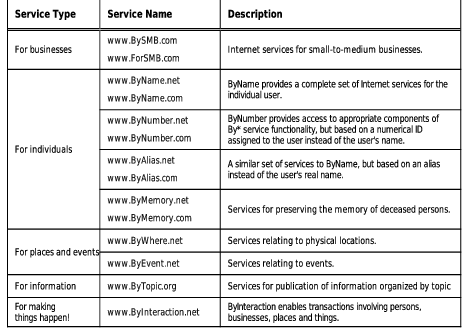
The By* family of services is described in detail in The By* Concept: A Unified Model for Internet Services [?]. A summary is provided in Table 5.2. Examples of By* instances are shown in Table 5.3.
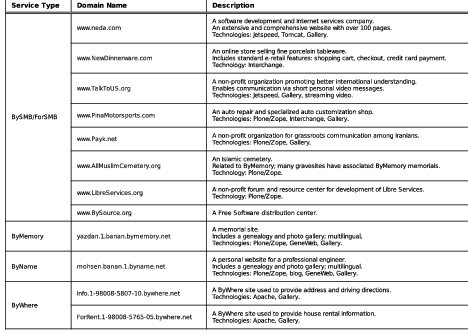
The By* services are Libre Services, and as such can be freely copied and reproduced by anyone. We have established the BySource and ByBinary software distribution sites to provide the resources required to reproduce any By* service.
For a detailed description of the By* services and how they are different to existing services, see The By* Concept: A Unified Model for Internet Services [?].
5.2.3 Growth dynamics
The Libre Services and By* models include a set of powerful inherent growth dynamics. These are discussed in detail in The By* Concept: A Unified Model for Internet Services [?]; here we present only a brief summary. By* includes growth dynamics in the following respects:
- Features and functionality. The growth dynamic in terms of functionality is the powerful generative force of the free software development model. The free software movement is a flourishing creative environment, constantly producing new and better functional software components, and thus assuring ever-expanding features, capabilities and functionality of By*. This potent dynamic will cause By* eventually to surpass all proprietary services in terms of features and functionality.
-
By*
deployment
by
other
service
providers.
Any
company
or
organization
can
reproduce
and
operate
the
By*
services
for
itself,
thus
becoming
an
independent
Internet
services
provider.
For
a
company
with
a
large
user
base
and
an
existing
service
delivery
infrastructure
(such
as
a
large
ISP,
wireless
network
provider,
or
telephone
company)
the
business
case
for
this
is
clear
and
compelling.
The
value
propositions
are:
immediate
entry
into
the
Internet
Services
market
as
an
independent
service
provider,
greatly
expanded
scope
of
relationship
with
an
existing
customer
base,
and
access
to
a
much
larger
and
growing
user
base.
Furthermore, the company can accomplish this extremely rapidly, at very low cost, and on the basis of several alternative business models to best fit the company’s positioning and broader business strategies. Thus the growth dynamic for By* deployment by other service providers is the clear business motivation for this.
-
Service
usage.
By*
service
usage
will
increase
over
time
as
a
result
of
a
number
of
motivations
and
influences
acting
in
concert.
These
include:
- The inherent merits of the services themselves in terms of protection of civil liberties: privacy, freedom of speech, and freedom of information.
- The inherent merits of the services themselves in terms of completeness, close integration, and powerful functionality.
- The ever-increasing richness of features and functional capability assured by the free software and Libre Services development models.
- The growing societal awareness of these inherent merits, occuring as a result of on-going discussion and analysis, and influencing attitudes and behavior over time.
- The open and free nature of By*, allowing unrestricted deployment and usage in any desired environment: commercial, non-commercial, government, academic.
The summation of these and other growth dynamics results in a synergistic, monotonically increasing, grassroots acceptance and usage of the By* services model.
5.3 About this Initiative
This initiative is highly unconventional in a number of respects.
5.3.1 Scope and scale
First, the scope and scale of what we are doing is extremely large. This is not about a conventional product or service, as these are commonly defined and bounded. Rather, this is about the reinvention of an entire industry.
Our goal is to establish Libre Services as a new model for the Internet Services industry, and as the eventual replacement for the existing proprietary services model. In effect, this amounts to the creation of a new industry that today does not exist.
The scope of By* is similarly large. While Libre Services can be thought of as a conceptual model and philosophy for delivery of Internet Services, By* is an actual functional implementation of Internet Services. But in terms of functional capability, the scope of By* far exceeds typical Internet services as they exist today.
By* is a unified services model, integrating together the capabilities of numerous services that presently exist in functional isolation. For example, all the functional capabilities of MySpace, Evite and Craigslist are subsumed under ByName, ByEvent and ByInteraction respectively. However, these capabilities are fully integrated with one another within the general By* framework. The result is a far more powerful, coherent and complete services model.
The scope and scale of the Libre Services and By* initatives are thus enormous. The business opportunities are likewise enormous.
5.3.2 An engineering construct
Second, the Libre Services and By* models are first and foremost engineering constructs rather than business constructs. They are constructed based on formal engineering architectural principles for the design of large-scale systems. They are built to do something, and do it well. They are intended to bring real and enduring value to society at large.
The Libre Services and By* initiatives certainly have important business dimensions. But the business dimensions are a consequence of the engineering merits, not the other way round. This is in contrast to many other recent ventures within the Internet domain, where business imperatives are the driving motivation, to which engineering considerations take a back seat. But in the case of Libre Services and By*, the overriding principle is engineering integrity. The business dimensions derive naturally from creating something of value, that people will pay for.
This is not the first time a construct of this scale and significance has arisen. The best recent example is the World Wide Web itself, conceived originally as a method for sharing electronic information, but turning out to have gigantic social and business ramifications.
But in the past the originators of such constructs have exercised vision and leadership only in the conceptual and engineering domains, while neglecting to consider the business consequences. It has been left to others to recognize and develop, or perhaps exploit and abuse, the business possibilities.
Again the Internet provides a prime example. The Internet reality was created by engineers, who apparently gave little thought to the commercial possibilities. It was left to entrepreneurs and financiers to create the enormous commercial Internet industry, and along the way, turn the true Internet into the false Internet bubble.
Here again is where this initiative is different. We have conceived Libre Services and By* as formal engineering constructs, and we are exercising conceptual and engineering leadership to move these initiatives forward. But we have also recognized the business consequences right from the outset, and we are exercising leadership in that domain too. This Business Plan is part of that leadership.
The emergence of the Internet Services industry, and the accompanying shift of traditional software applications towards a service-based implementation, represent a major transformational event in the evolution of the Internet. This event may well give rise to a second round of Internet hype and frenzy, following the initial dot-com bubble of 1997–2001. Indeed, there is already widespread recognition of the “transformation of software into services” as the next major technological event in the evolution of the Internet, and the buzz has already started.
A period of irrational exuberance based on this will have the same general characteristics as the initial dot-com bubble. It will include a fundamental engineering reality, and genuine end-user value. But as the business dimensions of this reality emerge, the underlying reality will rapidly be overtaken by a vast amount of overblown commercial hype and profiteering, just as occurred for the dot-com bubble.
Libre Services and By* fall precisely into the space where this is likely to occur. But though we may see a second Internet bubble in the “transformation of software into services” arena, Libre Services and By* are not part of the overblown hype. They are the fundamental engineering reality.
5.3.3 Open and collaborative
But the most significantly unconventional aspect of this initiative is that it is based on openness and collaboration, rather than proprietary ownership.
The free software movement as we see it today is the first manifestation of a much bigger ideological shift: a shedding of the traditional conventions of material capitalism, and the adoption of a new set of conventions based on non-material capitalism. Western capitalistic societies are rooted in the historical conventions and institutions of material products and materially-based services. In the digital domain these conventions appear in the form of the proprietary software model.
But in the digital domain there is a different and better way of doing things. The power of free software derives from a relinquishing of the traditional intellectual property conventions. Instead, free software is based on a set of principles that allow powerful generative forces to come into play. Thus traditional copyright is rewritten in the form of copyleft; ownership of software via patents is relinquished in favor of patent-free protocols and software; self-interested software hoarding via trade secrecy is relinquished in favor of openness and collaboration.
The result is a convention of engineering freedom and collaboration, based on collective pooling of resources. The essential premise is quite simple: in the digital domain there is more to be gained by collective pooling than by individual ownership.
This initiative is about the application of this premise to the domain of Internet services. The resulting open collaborative model brings the enormous generative and propagative power of free software to Internet services.
The open and collaborative nature of this initiative, and its industry-wide scope, are opposite sides of the same coin. In the case of a proprietary software product or service, based on ownership via patents, copyright and trade secrecy, the owning entity can only do what can be accomplished by its own in-house resources. Of necessity, this limits the scope of any proprietary venture to that of a traditionally bounded product or service.
But in the case of a non-proprietary construct such as free software or Libre Services, all such limitations are removed. The construct is now open to participation by anyone, and so can truly form the basis for an entire industry. It is the open and collaborative nature of Libre Services that enables its industry-wide scope.
Conversely, any industry-wide enterprise must, of necessity, be open and collaborative. It is simply not possible to achieve anything of such large scope while constrained within the ownership model of a single entity.
5.4 About this Business Plan
This Business Plan has been written for the following purposes:
- For internal clarity. The primary purpose of this plan is to establish clarity and coherence of thinking within the Neda team. This plan is the result of extensive discussion and thinking among ourselves. We have thought through and fully defined every aspect of this project and our execution strategy. This plan captures and documents the resulting team consensus.
- For public readership. The second major purpose of the plan is to make it available for general public readership. The plan is intended for anyone who is interested in what we are doing and wishes to learn more, or who wishes to participate in any way.
-
As
part
of
a
framework
for
participation.
Since
this
is
an
open
collaborative
initiative,
the
necessary
industry-wide
collaboration
must
be
properly
enabled.
To
this
end
we
have
established
a
coherent
framework
for
participation,
which
we
describe
in
the
following
section.
This
Business
Plan
is
a
component
of
that
broader
framework,
and
plays
the
role
of
describing
the
business
dimensions
of
Libre
Services
and
By*.
The success of Libre Services and By* requires participation by many constituencies, including among others the engineering community, the business community, and the investment community. This Business Plan is intended to facilitate participation by all these constituencies.
The primary purpose of a conventional Business Plan is to acquire financing, and that is one of the purposes of this plan too. To that end the plan is intended to enable investment participation. But the investment community is just one among multiple audiences for this plan.
-
To
describe
the
business
model.
The
traditional
business
model
is
based
on
a
proprietary
ownership
model.
But
Libre
Services
are
completely
non-proprietary,
and
therefore
the
critical
ownership
element
of
the
traditional
business
model
do
not
apply.
In this Business Plan we describe the key aspects of our business model, including the revenue models, competitive advantages, and end-user adoption models.
- To describe our execution strategy. In this plan we also provide details of our exection strategy, including the order in which we will develop the various revenue streams, and our marketing and recruitment plans.
- For recruiting. To execute our plans we will need the participation of talented and experienced people. The Business Plan is part of our recruiting pitch to prospective team members. For anyone interested in working with us, the plan presents the uniqueness and scope of what we are doing. And for people who then choose to join the Neda team, the Business Plan helps to create team cohesion and unity of purpose.
5.4.1 An open Business Plan
Since our engineering and business models are non-proprietary, there is no need for the close secrecy surrounding a traditional proprietary business model. On the contrary, since this initiative is based on openness and participation, it is necessary to articulate it fully to others.
This includes its business dimensions. Therefore in what we believe is a first in the history of business practice, we are documenting our business model in the form of an Open Business Plan, freely available for readership by anyone. This is completely at odds with customary business practice, but is fully consistent with the open and participatory nature of this enterprise.
This is also largely a Business Plan by reference. We have documented every aspect of this initiative in the form of a number of separate documents. Thus the plan takes the form of a roadmap and directory to these supporting materials. Here we provide a high-level overview of the major concepts, together with references and pointers as appropriate.
5.5 Framework for Participation
The Libre Services initiative is big and ambitious. Something this big is not accomplished by any single company acting alone. Instead it takes place as a distributed industry-wide enterprise, involving many participants.
In particular this enterprise requires the participation of three major consituences: the engineering community, to build the necessary Libre Services infrastructure; the business community, to deploy and deliver Libre Services to end-users; and the investment community, to finance engineering and business development. To these we may usefully add a fourth: the academic community, to provide analysis and critique of these radical new engineering and business models.
Such diverse participation does not take place in a vacuum. Instead, it is greatly facilitated if there exists an enabling framework for participation. To this end we have established a coherent framework for participation by all relevant constituencies.
5.5.1 Separation of responsibility: Neda and FPF
The overall Libre Services and By* initiatives include activities which naturally fall under different areas of responsibility.
Engineering development of Libre Services software is a communal activity, and the results of this work are communal industry resources, available for use by anyone. The body of Libre Services software is not owned by anyone, in any restrictive sense. On the other hand, deployment and delivery of supported services for end users is a business activity, and the necessary technical and business infrastructures are owned and operated by commercial entities. Throughout this initiative it is necessary to maintain a clear conceptual separation of these two sets of activities, and where responsibility for each resides.
We have established a separation of responsibility to address this issue. Responsibility for moving this initiative forward is divided between two separate entities:
-
The
Free
Protocols
Foundation
(FPF)
is
responsible
for
Libre
Services,
the
public
side
of
this
initiative.
Among
other
things
this
includes
responsibility
for
establishing
the
conceptual
definition,
creating
written
materials
to
articulate
and
promote
the
concept,
and
establishing
a
framework
for
collaborative
engineering
development
of
Libre
Services
software.
All
general
industry
enabling
work
is
the
responsibility
of
the
FPF.
At the outset, the FPF is also playing a hands-on engineering role, and taking responsibility for creating momentum in the engineering development arena. Under the FPF we are doing the necessary work to create a set of starting-point engineering resources.
- Neda Communications, Inc. is the creator and owner of By*, the private side of this initiative. We are exercising leadership in the business arena by deploying and operating a set of usable, first-generation Libre Services in the form of the By* family of services. Thus all By*-related work is associated specifically with Neda.
For complete details about the complementary roles of the FPF and Neda see Libre Services: A non-proprietary model for delivery of Internet Services [?]. Complete information about the FPF itself is available on the FPF website at: www.freeprotocols.org.
5.5.2 Libre Services participation
Under the auspices of the Free Protocols Foundation we have created a framework and set of resources for public Libre Services participation.
The first element of the framework consists of a comprehensive articulation of the concept. Participants need to understand the concept clearly. To this end we have documented the concept in the form of an industry white paper titled Libre Services: A non-proprietary model for delivery of Internet Services [?]. This paper provides a complete conceptual description of Libre Services. For anyone wishing to learn about Libre Services, this is the right place to start.
The creative model for Libre Services is collaborative software development. Such collaborative development requires a proper framework to proceed effectively. Under the FPF we have established the following framework for participation:
- LibreServices.org. LibreServices.org is the central location and forum for collaborative development of Libre Services. It provides information and resources for developers, and acts as the central repository and distribution point for Libre Services software. The software repository includes automated mechanisms to allow developers to retrieve software components from the repository, then resubmit modified software back into the repository.
- Starting-point software components. We have done the initial development work to create a set of starting-point, reference software components. These are available for immediate use as the basis for engineering development. Refer to Libre Services: A non-proprietary model for delivery of Internet Services [?] for details.
-
Project-based
collaboration
model.
We
have
defined
a
project-based
collaboration
model,
consisting
of
a
set
of
projects
required
to
move
the
Libre
Services
initiative
forward.
Each
project
is
largely
independent
and
self-contained,
and
ready
to
be
undertaken
by
an
interested
group
or
organization
immediately.
This
allows
efficient,
coordinated
collaboration
on
multiple
projects
in
parallel.
Each project is defined in the form of a Project Document, providing a complete specification for the project. The complete list of projects and Project Documents is provided in a separate article, titled Libre Services: Projects for bootstrapping [?].
5.5.3 By* participation
Libre Services is general public initiative, being driven forward under the leadership of the Free Protocols Foundation. By* is a private commercial enterprise being conducted by Neda Communications, Inc.
We have created appropriate resources to enable participation in the commercial By* enterprise by prospective business partners, investors, and employees. As in the case of Libre Services, the first and most fundamental requirement is a clear articulation of the concept. Prospective By* participants need to understand the concept clearly. To this end we have documented the By* concept in the form of two documents:
- The By* Concept: A Unified Model for Internet Services [?]. This paper describes the By* concept and family of services from a technical perspective.
- The Business Plan. The Business Plan (this document) describes deployment of By* from a commercial perspective.
We have also established a framework for investment participation. This is described later in Section 5.13, Financing.
5.6 Revenue Models
The By* deployment offers many potential sources of revenue. The major revenue sources are summarized in Table 5.4.
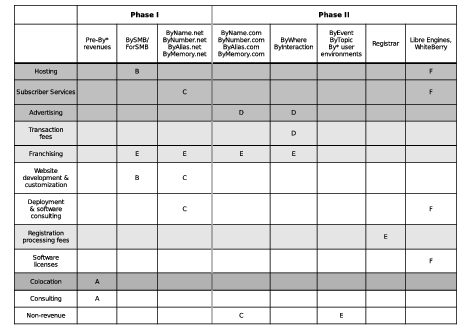
The rows of the table list the various forms of revenue by general type, such as subscriber service fees, advertising, consulting, etc. The revenue types are listed in their approximate order of magnitude, long-term. Thus the major revenue sources of web hosting, subscriber service fees and advertising appear at the top, while minor non-recurring sources such as consulting appear near the bottom.
Shaded rows indicate revenue sources that are recurring, and thus of greatest interest. Rows that are heavily shaded indicate “true” recurring revenues, meaning revenues that are repeating, calendar scheduled, contractually associated with a specific customer base, while incurring negligible direct costs. Thus web hosting, subscriber service fees and advertising are the classical Internet revenue sources of this type.
The lightly shaded rows indicate revenue categories that are not recurring in this strict technical sense, since they are not necessarily calendar scheduled, and may not be associated with a specific customer base. Nevertheless these revenue types generate a known, regular, stable revenue stream, again while incurring negligible direct cost. From a business revenue perspective therefore, they have much the same merits as the truly recurring revenue types. The two largest revenue categories of this type are transaction fees, and the service franchising model.
The columns of the table list the components of the overall By* deployment. The components are listed very roughly in their order of expected deployment, starting with BySMB/ForSMB, and ending with the indeterminately scheduled WhiteBerry deployment.
For convenience we will use the term “By<Individual>” to refer collectively to the four services for individuals. Thus By<Individual> = {ByName, ByNumber, ByAlias, ByMemory}.
As shown in the table, each of the By<Individual> services will be provided in the form of two separate deployments: By<Individual>.net and By<Individual>.com. The By<Individual>.net services will be provided to users fully supported and advertising-free. The major revenue stream for this deployment consists of subscriber service fees. The By<Individual>.com services will be provided at no cost to users and without support. The major revenue stream for this deployment consists of advertising revenues.
Each table cell with a letter entry indicates a revenue stream associated with the corresponding revenue category and By* component. Empty table cells indicate that there is no associated revenue, or the revenue source is considered to be relatively minor.
The letters themselves indicate the stage of execution at which that particular revenue stream will be developed, as we describe in detail in Section 5.7, Execution. Thus A indicates current pre-By* deployment revenues, while F indicates the indeterminate future WhiteBerry deployment.
Everything flagged in the table represents a viable and significant revenue stream. However, the various revenue sources vary widely in terms of how well-characterized they are, and at what point they will be realized. As described in Section 5.7, our execution plan consists of two broad phases. Phase I consists of the development of revenues that are well-characterized and practical within the near term. Phase II consists of the development of longer-term revenues. Some of these are new types of revenue sources deriving from the By* model, and are less well-characterized at this time.
5.6.1 Hosting and subscriber services
Hosting and subscriber services refers to the regular fees for supported BySMB/ForSMB and By<Individual>.net websites. Support for business websites is commonly referred to as “hosting,” while support for individual websites is commonly referred to as “subscriber services.” In the table these two revenue types are broken out as separate rows to indicate that one is associated with BySMB/ForSMB and the other with By<Individual>.net, but from a technical standpoint the two operations are essentially the same thing: the management of a website along with all its associated services.
Hosting and subscriber services are the major long-term revenue source for the By* deployment, based on the standard Internet service subscription fee model. The extremely large size of this revenue stream derives from the planet-wide scale of the By<Individual>.net services.
5.6.2 Advertising
Advertising is also a major long-term revenue source, and is the primary revenue stream derived from the By<Individual>.com, ByWhere and ByInteraction services. There are no regular subscription fees associated with any of these services. The revenue model is the proven Internet advertising model, as exemplified by Google and many other no-cost services.
The extremely large size of the advertising revenue stream again derives from the planet-wide scale of the By<Individual>.com and ByInteraction services.
5.6.3 Transaction fees
Transaction fees refers to usages of services for which it is usual or appropriate to charge fees, such as classified advertising, job postings, etc.
Transaction fees are a secondary revenue source from usage of the ByWhere and ByInteraction services.
5.6.4 Franchising
The Libre Services model offers a unique deployment and revenue generation model, not shared by the proprietary services model.
Note that since the By* services are all Libre Services, they can be reproduced and operated as a service by anyone. But not under the By* name. The underlying software is all free software, to be reused as a communal resource by anyone, but the By* brand name and the By* domains (ByName.net etc.) are business assets of Neda. Likewise the operational characteristics of the services, as distinct from the engineering functionality, are defined by Neda. This includes such things as the terms of use, pricing schedule, customer support policies—in fact any aspect of operation or delivery of the service that relates to the relationship between the service provider and the user. All these things are characteristic of the By* brand name, owned and operated by Neda.
One way a service provider can reproduce the By* services is to rebrand them under its own name—for example, the Acme* family of services. There will be AcmeName.net, AcmeNumber.net etc., all delivering functionally identical services to ByName etc., but now these brand names and domains are assets of the Acme Mail Order and Internet Services Company Inc., and the services are delivered under Acme delivery terms and policies. Under this arrangement Acme is wholly independent, having no relationship with Neda at all.
Alternatively, Acme can become a By* franchisee. Under this arrangement, Acme becomes a provider of the By* services, branded as such, and under exactly the same terms and conditions as the By* services provided by Neda.
The services provided by Acme will now be a true clone of the By* services, both functionally and operationally. Any user of the Acme-operated By* services will be assured of receiving services that provide an identical user experience to using the Neda-operated By* services. Just as the patron of a franchised McDonald’s in Beijing is assured of an identical fine dining experience to a McDonald’s patron in Chicago.
Under the franchise operation the entire set of By* services is packaged and provided to an independent service provider, who then provides identical services to a particular demographic or subset of users. There are many situations in which this arrangement is a logical choice for the service provider. For example, a third-world country might have only primitive and undeveloped Internet services available to its consumers. An entrepreneur wishing to provide the far superior By* services to this demographic could franchise the entire packaged set of services, then take responsibility for delivering them to this particular demographic. Note that the inherent hiearchy of the Internet and its domains provides an ideal structure for the creation and management of such franchises.
The franchise operation is a key mechanism for growth of the By* services. Clearly, this is an enormously powerful propagation mechanism. As the By* services gain ground, this will become an increasingly important propagation and revenue model. It is the franchise model that allows the By* services to become truly global. Equally clearly, the financial rewards are enormous for the company that is operating the franchise. As the owner of the By* brand and top-level domains, the franchise model provides another gigantic revenue model for Neda.
The franchise model extends across all revenue-generating members of the By* family, including BySMB/ForSMB, By<Individual>, ByWhere and ByInteraction.
5.6.5 Website development and customization
For the By* services where a website is supported for an individual person or business (i.e. BySMB/ForSMB and By<Individual>.net), there are three models for setting up the website:
- Self-service. Under the self-service model, businesses and individuals set up the website on their own on an automated basis, in the same way that user accounts are typically created under the existing proprietary services model. Getting a ByName account is a simple as getting a Yahoo or MySpace account.
- Neda-assisted. Under the Neda-assisted model, Neda provides basic flat-rate assistance to create websites for business and individual users.
- Custom development. Under the custom development model, Neda takes responsibility for creating the client’s web presence on a consulting basis. Under this model clients can direct their own specific website development and/or customization requirements.
It is expected that a large proportion of BySMB/ForSMB clients will require custom website development to meet their specific business requirements. The BySMB/ForSMB deployment thus includes a significant website development revenue stream. This is a non-recurring revenue stream and does not scale; nevertheless it plays an important role in our execution strategy as an early stage revenue source.
It is expected that a much smaller proportion of By<Individual> subscribers will require assistance or customization.
5.6.6 Deployment and software consulting
Deployment and software consulting refers to consulting work relating to deployment of By* components by other service providers. This encompasses a number of situations and scenarios, but these generally consist of two major categories:
-
By*-related
consulting.
This
includes
consulting
work
for
clients
who
are
deploying
the
By*
services
under
any
of
several
business
models,
either
under
the
By*
name,
or
rebranded
as
an
independent
service
offering
under
the
client
company’s
own
name.
This
also
includes
custom
software
development
work
for
clients
who
require
specific
enhancements
or
customizations
to
the
By*
Libre
Engine
software.
This also is a non-recurring, non-scaling revenue stream. But it also plays an important role in our execution strategy, both as an early stage revenue source, and as a mechanism for increasing general By* service deployment.
- WhiteBerry-related consulting. This consists of consulting and software development support services for clients who are deploying the WhiteBerry mobile messaging solution. This is described below in Section 5.9.1.
5.6.7 Registration processing fees
One of the unique characteristics of the By* architecture is its hierarchical naming model, based on consistent and extensive use of the Internet domain naming system. This allows the naming and addressing of very large name spaces within the By* structure.
As owners of the top-level By* domain names, this places Neda in the position of allocating subdomain names to entities within the By* structure. Thus in effect Neda is the naming authority for these entitites. This represents another revenue opportunity for Neda, similar to the existing Internet registrar function. There are various registration requirements and responsibilities within the By* structure, including allocation of domains, names, numbers, and certificates.
This is a new type of revenue source for an Internet service provider, resulting from the unique characteristics of the By* concept and architecture. Development of this revenue source is part of our long-term direction statement. A precise business model for managing this revenue source has not been established at this time.
5.6.8 Colocation
We maintain our own state-of-the-art Data Center to support the By* deployment. All By* services, and also the WhiteBerry mobile messaging services, are hosted at the Data Center. The Data Center is fully capable of supporting deployment of By* up to very large scale. Complete details about the Data Center are provided on the Neda website at:
http://www.neda.com/InternetServices/OurDataCenter/
In addition to the By* services we can also use the Data Center for general colocation services, thus generating an additional recurring revenue stream. Colocation refers to providing only physical support for client servers, including rack space, power, environmental control, security, and network connectivity. Operation and maintenance of the servers themselves remains the responsibility of the colocation client. We can provide colocation services to any company or client who requires this, whether related in any way to Libre Services or not.
The colocation revenue stream is not related to the general By* deployment. But it is recurring, and plays an important role as an on-going self-financing revenue source.
We are always interested in acquiring additional colocation clients. If you have colocation requirements that fit our general working model and philosophy, please feel free to contact us directly.
5.6.9 Consulting
Consulting refers to general data communications consulting services, not necessarily related to Libre Services and By*. This has been the primary source of company revenue since inception, and continues to support our on-going operations.
As a long-time consulting company we are always on the lookout for the right sort of consulting work. In the context of this Business Plan we are particularly interested in projects that have good synergy with Libre Services and By*. If you have a project that fits well with these strategic goals please feel free to contact us directly.
5.6.10 Non-revenue
The last row of the table indicates those elements of the By* deployment that generate no or limited direct revenues.
In their initial deployment in Stage C, the By<Individual>.com services will not generate revenues. These will be provided at no cost to users, as a free look-and-see service as an uptake mechanism for By<Individual>.net. The advertising model for By<Individual>.com will not be developed until Phase II.
The ByEvent and ByTopic services provide only limited direct revenues. There are no user service charges or transaction fees associated with these services. The primary purpose of these services is to complete and enhance the overall utility of the By* family, thus generating revenues indirectly. There are potential advertising and franchising revenue streams associated with ByEvent and ByTopic, but these are relatively minor and not shown in the table.
The By* user environments also serve to greatly increase the utility of the By* services. There are no direct revenues associated with this element of the By* deployment.
5.7 Execution
As noted in the previous section, there is a large number of potential revenue streams associated with By*. This creates a great deal of flexibility in execution. In particular, the execution is highly adaptable to the availability of external financing. With no external financing, the revenues can be developed in a gradual self-financed mode. With full funding the revenues can be developed in a highly parallel and large-scale mode.
The following execution plan describes our execution in a wholly self-financed mode, i.e. assuming no external financing at all. In Section 5.7.4 we describe how the execution can be adapted to various levels of financing.
5.7.1 By* deployment schedule
There are many ways to generate revenues from the By* deployment. There are multiple revenue streams associated with this enterprise, and at different points during the development of Libre Services and By*, Neda will generate revenue from all of them.
The multiplicity of revenue streams creates both opportunities and challenges. The challenge is to develop the revenue streams in a logical order. We have formulated a coherent plan for deploying the By* services. We will be developing the various revenue streams in a particular order, based on a number of factors including:
- Required development and deployment investment to reach revenue returns
- Magnitude of expected resultant revenues
- Controllability of deployment—the ability to deploy at a small and/or gradually increasing scale
- Service support requirements
- Synergy of functionality among the accumulating family of deployed services
The following execution plan describes the order of By* development and deployment and development of the associated revenue streams. But it should be noted that our execution strategy is highly flexible and readily adaptable to changing industry conditions, availability of external financing, and other future contingencies. The execution roadmap presented below is the order of execution based on current expectations, and assuming no external funding. In this roadmap we develop the revenue sources according to a bootstrap model, bringing the revenue streams on line in the appropriate order to deploy services and build revenues at a gradually increasing scale.
Table 5.4 shows the general stages in which we will be deploying services and building revenues. The letter in each cell indicates the stage at which that particular revenue stream will be developed. The revenues will be developed in several stages, consisting of two broad phases, as follows:
-
Phase
I:
Near-term
deployment
- Stage A. Stage A consists of on-going financing based largely on colocation and consulting revenues.
- Stage B. Stage B consists of the development of the BySMB/ForSMB revenue model, consisting largely of website development fees, and website hosting fees.
- Stage C. Stage C consists of the early development of the By<Individual>.net services. The major revenue stream is subscription service fees. There is also a website customization revenue stream at this stage.
- Phase II: Long-term direction statement
- Stage D. Stage D consists primarily of development of the advertising revenue stream from the By<Individual>.com services. ByWhere and ByInteraction will also be developed at this stage, providing both advertising revenues and transaction fee revenues.
- Stage E. Stage E consists primarily of development of the franchising model for all relevant By* family services. At this stage we will also develop the registrar process fee revenue stream. We will also deploy the ByEvent and ByTopic services, and the By* user environments.
- Stage F. Stage F consists of active development of revenues related to Libre Service Engines, and the WhiteBerry messaging model. In the case of the Libre Service Engines, these consist of software and deployment consulting revenues. In the case of WhiteBerry, these also consist of subscriber service fees, and software licensing fees. Stage F is very flexible in timing.
Phase I is very well-characterized, with a clear execution plan and schedule. The revenue streams are well understood, and the assets are all in place to execute Phase I. The primary emphasis throughout this plan is on execution of Phase I.
Phase II is much less clear. Phase II is more of a long-term direction statement, with no schedule or detailed execution plan.
5.7.2 Phase I: Near-term deployment
Phase I consists of the revenue development stages to be conducted over the next year or two. This work will take place either under the self-financed model, or based on first-stage financing of up to $2M.
Stage A: Pre-By* revenues
Stage A consists of pre-By* revenues from consulting, and from use of our Data Center for colocation. We are already fully capable of supporting colocation clients, and already have modest recurring revenues from this source. We continue to develop this revenue source by soliciting additional colocation clients.
Table 5.4 includes a column to show the primary sources of revenues prior to deployment of By*. This pre-By* financing refers to the revenue sources that have financed this initiative so far, and that continue to finance on-going operations.
Thus far the primary sources of pre-By* revenues have been general data communications consulting services, and more recently a small but growing colocation revenue stream. We expect these revenues to be quickly overtaken by the much bigger By* revenue streams. But in the short term these revenue sources continue to play a critical role within the self-financed model. In particular we continue to solicit and populate the Data Center with additional colocation clients as a recurring revenue source.
Though not shown in the table, early BySMB/ForSMB revenues have also been a component of our early self-financing revenues. We have already created BySMB/ForSMB websites for a number of clients, thus generating website development revenues, and also establishing a small but growing hosting revenue stream. We continue to solicit additional BySMB/ForSMB clients.
All the work we have done so far has been financed by the above revenue sources.
Stage B: Deployment of BySMB/ForSMB
The next stage of our execution strategy is early deployment of BySMB/ForSMB. This is the next source of revenue to be actively developed. This is because BySMB/ForSMB clients can be established with minimal additional investment from where we are today, at a small and controllable scale, requiring very little in terms of customer support infrastructure, while still generating significant revenues.
BySMB/ForSMB generates two revenue streams: website development consulting for business clients that require this (non-recurring), and hosting revenues (recurring).
We already have a number of business clients for whom we have created custom websites under the BySMB/ForSMB model. Several of these clients are shown as examples in Table 5.3. A more complete list is provided on the Neda website at http://www.Neda.com/InternetServices/ClientList. We continue to solicit additional BySMB/ForSMB clients as a source of gradually increasing consulting and hosting revenues.
In addition we are now actively developing the BySMB/ForSMB services to allow self-service (fully automated) creation of BySMB/ForSMB websites by business users. This will allow business clients who do not require custom website development to create their own “standard” website presence on a hosting fee basis.
BySMB/ForSMB revenues will be particularly important in the absence of external financing, because in the case of BySMB/ForSMB, these can be deployed at small scale in self-financed mode. These revenue sources will finance our execution plan in the absence of significant external financing.
The importance of these self-financing revenue streams diminishes depending on the amount of external financing available. With no external financing, these will be very important early revenue sources that we will develop diligently. With a large amount of external financing their importance is greatly diminished in favor of developing the bigger long-term revenue sources.
Stage C: Deployment of By<Individual>.net
Stage C consists of the deployment of the By<Individual>.net services. Under the self-financed schedule this will take place largely in parallel with Stage B. The major revenue streams are subscription fees. There are also website customization revenues for those users who require this.
ByMemory deployment
ByMemory is the first of the By<Individual> services to come on line and begin generating revenues. This is because ByMemory is already largely functional, and ready for immediate account creation and usage by anyone. Also, the support requirements for ByMemory accounts are minimal. Therefore this is an appropriate candidate for immediate revenue development. Development of the ByMemory revenue stream will take place in parallel with that of BySMB/ForSMB. We will initially develop ByMemory at small scale. Though the revenues from this are small, they are recurring revenues, and require almost no customer support.
The majority of the expected revenue stream is straightforward subscription fees. There will also be a modest non-recurring website customization revenue stream for users who require this.
Development of ByMemory revenues consists of the creation and usage of accounts by end users. Our strategy for this is similar to our strategy for populating the ByName service: it consists of identifying and targetting large batches of candidate ByMemory names. We will accomplish this by contacting businesses with access to large numbers of candidate ByMemory names, such as cemeteries and funeral directors. We will offer to create large numbers of ByMemory accounts in batch mode, and advise the surviving relatives that the ByMemory account now exists for their immediate usage. We will also propose entering into appropriate business relationships with such businesses, whereby we create ByMemory accounts for their clients on an on-going basis.
ByName deployment
The next service to undergo deployment and development is ByName. ByName is currently under active development. This is the major Phase I revenue source, and the flagship By* service. It is the most immediately visible of the By* family of services, intended to provide all essential personal computing and communications services for individual users, with extremely large revenue potential.
In contrast to BySMB/ForSMB, ByName services do not generate significant revenues at small scale, and in contrast to ByMemory, ByName services do have significant customer support requirements. Therefore an important element of our execution strategy is to deploy ByName at large scale. Therefore a key element of our execution and revenue-building strategy is rapid population of the ByName service following initial build-out and deployment. Our strategy for accomplishing this is described in the following section.
The ByNumber and ByAlias services have a high degree of functional overlap with ByName; in fact these are largely a functional subset of ByName. These services will generally track ByName in terms of development and deployment
Stage C also includes deployment of the By<Individual>.com services, but as free look-and-see service as an uptake mechanism for By<Individual>.net. The advertising model for By<Individual>.com will not be developed at this stage.
ByName service population strategy
A critical element of our execution strategy is the rapid population of the ByName service with large numbers of candidate users. The key to this is identifying and targetting locations with large batches of potential user names.
In principle, any large database of names will serve for this purpose. In practice it is most appropriate to target the user databases of companies already within the Internet and/or telecommunications sectors. Our initial targets for ByName deployment will be the large ISP companies, wired and wireless. Following that are other companies in the Internet and telecommunications sectors, such as wireless network providers and traditional telephone companies.
We will identify such companies, and present them with our very powerful business message. We will offer to create ByName accounts for all their current users, and advise the users that the account now exists for their immediate usage. By means of this strategy we will create large numbers of user accounts extremely rapidly.
By* deployment consulting
In Section 5.2.3, and in greater detail in The By* Concept: A Unified Model for Internet Services [?], we describe the very strong business motivations for companies to deploy the ByName service.
Note that regardless of which business model a company adopts for deployment of ByName, it can benefit greatly from consulting assistance from the originators and leaders of the Libre Services and By* initiatives. We have all the necessary experience and assets to assist any company in deploying any By* service quickly and efficiently under any business model.
Therefore there is a further major consulting opportunity and revenue stream available to Neda during early industry adoption of the Libre Services and By* models.
In the long run consulting revenues are rapidly eclipsed by other forms of revenue, since the consulting revenue stream is non-recurring and does not scale. But in the short term this consulting activity plays an important role for a number of reasons:
- It is a significant revenue stream, available early in Phase I execution.
- In the absence of external financing, it is a major source of self-financing revenues for continuing execution of our plans.
- It is part of our strategy for rapid population of the ByName service.
- It is part of a broader strategy for facilitating and promoting industry-wide adoption of Libre Services and By*.
- In the case of client companies requiring specific features and enhancements, this is a synergistic mechanism for advancing the capabilities and robustness of By*.
- Depending on which business model the client company adopts, additional revenues will accrue to Neda based on a business partnership or franchise relationship with the company.
- Consulting clients for deployment of By* services may in some cases choose to colocate with us, thus providing a further revenue component.
5.7.3 Phase II: Long-term direction statement
Phase II consists of revenue development stages to be conducted significantly later. Under the self-financed model these will not be developed until revenues from Phase I operations are sufficient for this. Based on a funding model, Phase II will be financed by the second-stage funding of $15M.
Stage D: Advertising and transaction fees
Stage D consists of major development of the advertising revenue model for By<Individual>.com, and other revenues commonly associated with the delivery of zero-cost services.
Stage D also includes development and deployment of the ByWhere and ByInteraction services, and development of their associated advertising and transaction fee revenues.
Stage E: Franchising
Stage E consists of major development of the franchise revenue model.
Stage E also includes development and deployment of the ByEvent and ByTopic services, and development of the By* user environment.
Stage E also includes development of the processing fee revenue stream from the Neda registrar function.
Under the self-financed model, the ByWhere, ByInteraction, ByEvent and ByTopic services will not be developed and deployed for large scale usage until revenues are available to support this. During Phase I we will continue to do conceptual development of these services, and establish basic placeholder services as appropriate. But these will not be developed as major revenue sources for some time to come.
Stage F: WhiteBerry mobile messaging
Stage F consists primarily of active develoment of the WhiteBerry mobile messaging solution. The WhiteBerry deployment is largely independent of the overall By* deployment execution strategy, so the timing of this is very flexible. This can be played as a wild card whenever industry conditions are right for this.
5.7.4 Adaptability to financing
As previously noted, because of the multiplicity of business opportunities and revenue streams available, our execution plan is very flexible. In particular the execution plan is readily adaptable and can be modified as appropriate depending on the amount of external financing available.
The above execution roadmap and schedule is a self-financed model, assuming no or modest external financing. Assuming the opposite extreme of a full funding schedule ($2M initially, followed by a $15M second round), we will modify the execution plan in the following ways:
- We will expedite and accelerate the Phase I execution plan.
- Rather than executing in a generally serial mode, we will execute in an increased parallel mode, conducting all planned Phase I execution in parallel.
- We will initiate long-term planning for engineering development of the Phase II technical components.
-
We
will
also
subject
the
execution
plan
to
a
major
shift
of
emphasis,
shifting
emphasis
away
from
the
smaller
early-stage
revenue
sources
such
as
consulting,
and
instead
placing
immediate
major
emphasis
on
the
key
Phase
I
revenue
stream
of
subscriber
services
fees
from
large-scale
usage
of
By<Individual>.
However, emphasis will continue to remain on Phase I. Even under a full-funding scenario, Phase II will remain a long-term direction statement, and no major Phase II activity will take place under the first round of financing. A key goal and milestone to be reached is positive cash-flow status on the basis of the Phase I deployment. This will remain the initial focus even under full financing.
- We will execute at large scale immediately, rather than building scale over time. In the case of ByName, for example, we will begin to build the technical and business infrastructure to support planet-wide deployment immediately.
In the case of less than full financing, we will expedite the execution plan as appropriate to the amount of financing available. Any funding we receive during Phase I will be used to accelerate the recruiting process and Phase I schedule, and start on Phase II sooner.
Self-financed scenario
Under the self-financed scenario, execution of Phase I will be gradual and controlled. The scale and features of the services deployment will be defined and reevaluated on an on-going basis, and will be reactive and responsive to market conditions and experiences.
The key goal of Phase I under self-financing is to have the Stage B and C deployments become meaningfully operational and generate meaningful revenues. The number of users and the magnitude of revenues required to achieve this goal remain undefined.
In terms of schedule, it is expected that major execution of Phase I will take place throughout 2008 and 2009. As Phase I progresses we expect to see a gradual shift in the revenue balance from Stage A to Stage B, then from Stage B to Stage C.
Under the self-financed scenario there will be no scheduled Phase II activity; the focus will remain on solidification and consolidation of the Phase I deployments. Phase II remains a direction statement, to be revisited later. Without external financing, it is not expected that any Phase II activity will take place until 2009 at the earliest.
All these schedule statements are based on current projections and estimations, and are subject to change based on future contingency.
Fully-financed scenario
Under a fully financed scenario, the focus will remain on Phase I execution. However, all consulting activities will be sharply restricted and highly selective, and will be limited only to consulting projects relating directly to By* uptake.
In the case of the Stage B and Stage C deployments, we will execute in a proactive rather than a reactive mode, defining explicit targets in terms of number of users and revenues, and staffing up accordingly.
With the initial round of financing we will still not conduct any execution of Phase II; the emphasis will remain on Phase I. However we will place some emphasis on scaling up By<Individual>.com usage to large numbers, in preparation for the Phase II advertising model.
The key goal of Phase I under the financed model is to become cash flow positive within the first round of financing. The major use of proceeds is to expedite and accelerate Phase I execution.
The schedule for this remains undefined at this time.
5.7.5 Engineering and operations
Deployment and support of the By* services at their intended scale represents a major engineering and operations challenge. The services must be up and running constantly, and must provide a very high degree of functional reliability. At the same time the services must expand continuously in terms of features and functionality, and must be able to grow continuously in terms of scale of usage.
The Libre Services model is a complete, not partial, free software development model. Conducting engineering and operations activities within this model demands a set of cultural, structural, management and procedural processes that are not well established within the industry at this time.
While many engineering and business environments make extensive use of free software components, they remain ”mixed” environments, in which free software components are used alongside proprietary. In the commmercial world engineering environments based on total, as opposed to partial, free software usage are non-existent, and in most commercial engineering and business environments of today the total cost of ownership of free software remains very high.
We are long-time developers, integrators and users of free software, and though this is rare in the commercial domain, we have developed great expertise in its deployment in a commercial context. Based on this expertise, we have established an initial broad-based starting point for all By* services.
Our initial deployment of By* is of limited scope and scale. But our engineering architecture and design is evolutionary and scalable both in terms of number of users, and in terms of features and capabilities. Though the initial implementations are relatively small in scale at this time, the overall architecture is highly scalable, and the services can be expanded up to extremely large scale.
Our Data Center has been architected to scale up to well over 10exp5 (hundreds of thousands) of users. The engineering and operations processes and disciplines we have established can grow and scale to meet the intended scale of the By* services.
Though Libre Services and By* are revolutionary models for delivery of Internet services, their engineering implementation is evolutionary in nature. In particular, deployment of these models involves no disruptive technology. The adoption of By* requires no fundamental technological change on either the user side or the server side.
The overall architecture of the By* Libre Services is discussed in Section 3.1, ”Technological context,” in the article titled Libre Services: A non-proprietary model for delivery of Internet Services [?].
Our engineering and operations methodology for meeting these challenges includes three major components:
- A coherent framework for services integration: the Libre Services Integration Platform (LSIP).
- A consistent and disciplined free software selection process.
- Discipline and processes for Data Center operations.
These are discussed briefly below, with pointers to additional information provided where appropriate.
Libre Services Integration Platform (LSIP)
The Libre Services Integration Platform (LSIP) is a generalized framework for developing Libre Services. All our initial implementations are based on LSIP.
LSIP is a set of tools, policies and conventions for services development and deployment. It provides a uniform, disciplined environment for transformation of software into services, integration, and service aggregation. It allows efficient integration of free software components into coherent services.
LSIP is the key technological component of By* Libre Services. It is the component that makes generalized, large-scale services development practical and efficient. The manageability and scalability of the By* services is largely a result of LSIP. For more information see the LSIP project document in the article titled Libre Services: Projects for bootstrapping [?].
The By* software selection process
The free software movement is a thriving creative environment, and will continue to produce new and better software components that can be incorporated into By* as additional features and functionality. An important engineering challenge is to select the right free software components for integration into By*. Some of our key software selections, and the rationale for these selections, are provided below.
- Base Operating System: Debian GNU/Linux:
-
Our initial Libre Services implementations are based on the Debian distribution of GNU/Linux [?]. Debian was founded in 1993, and has emerged as the most practical and reliable distribution for software engineering development. Equally important, Debian fully conforms to the philosophy of the free software movement. The Debian project is guided by the Debian Social Contract [?], an explicit statement of the philosophy and guiding principles of Debian.
Our selection of Debian GNU/Linux over other available distributions, for example Redhat, is based primarily on its greater degree of freedom, and on the explicit Debian Social Contract.
- Mail Transfer Service: Qmail:
-
Our selection of Qmail over alternative packages such as Sendmail, exim etc. is based on the superior scalability, flexibility and robustness of Qmail.
- Domain Name System: djbdns:
-
Our selection of djbdns over Bind is based on the superior flexibility of djbdns.
- Content Management System (CMS): ZOPE/Plone:
-
Our selection of Plone is based primarily on its completeness and already widespread usage.
Data Center operations
All Data Center operations are based entirely and exclusively on free software. All Data Center infrastructure, including all routers, are Linux based. This uniformity in culture and skillsets allows for a large overlap between engineering integration and Data Center operations.
5.7.6 Promotion
Marketing in the traditional sense is not an explicit part of our plan for promotion of the Libre Services and By* concepts. Note that these are not proprietary products or services, being launched into a traditional competitive industry environment. Rather these are fundamentally different ways of doing things, without peer or precedent.
In particular, these constructs have a set of inherent growth characteristics, as described in Section 5.2.3. These growth characteristics are based on a set of forces and dynamics including the inherent merits of the services themselves, a growing societal awareness of the merits over time, and the generative and propagative forces of the free software and Libre Services models. These are not unlike the growth characteristics of the World Wide Web, which grew rapidly without any formal marketing at all. Libre Services and By* will grow for similar reasons.
What this means is that marketing in the conventional sense, based on a persuasion dynamic, is neither appropriate nor necessary. Instead what is required is a process of exposure and articulation of the concept across multiple constituencies and communities. Our promotion plan thus consists of three major components aligned with this:
- Public exposure via widespread distribution of our written materials among all relevant communities
- Talks and presentations at selected industry forums, user groups, conferences, and academic settings
- Active participation on the relevant industry mailing lists
We have a comprehensive set of written assets for the promotion of Libre Services and By*. We intend to distribute our articles and use these assets in a variety of creative ways to communicate our message widely within every relevant industry segment and consituency, including the software engineering community, the Internet engineering community, the business community, the investment community, the academic community, our own users, potential business clients and strategic partners, and the media.
These articles and our other written materials will enable us to conduct a strong, coordinated and sustained campaign to promote the Libre Services and By* models at grass-roots level.
In particular we will subject the two key defining documents—Libre Services: A non-proprietary model for delivery of Internet Services [?], and The By* Concept: A Unified Model for Internet Services [?]—to widespread distribution within the technical engineering community. We will do this by distributing these documents on all the relevant mailing lists. We will also target these same documents to key decision makers within the industry.
We expect all of this to generate widespread interest and discussion. The very unconventionality and scale of what we are doing can be expected to generate significant media interest.
Key promotional message
An important consideration is the principal message to be used to promote Libre Services and By*. The principal promotional message will be the ethical superiority of Libre Services as open and free, a communal societal resource, created by society for society. The message to the end user will be the genuine freedoms, privacy, and protection of civil liberties guaranteed by Libre Services. This will be contrasted with the proprietary model, with its fundamental inherent divergence of interests between the providers and the users of the services. This idea will be presented and emphasized consistently in our messages to users and the media.
It should be noted that this is another important respect in which the open and free nature of Libre Services and By* are an asset rather than a liability. The fundamental raisons d’etre for the openness of Libre Services is that this provides a tremendously powerful propagation and growth mechanism, and that this provides a set of critically important engineering, business and societal freedoms and benefits.
But it also provides a unique promotional opportunity. The Libre Services story is genuinely different and unlike anything the industry has seen before, providing a ready-make marketing and promotion engine. People will be interested, people will write about it, and people will discuss it. What this amounts to is free press—the best kind of publicity.
5.7.7 Recruiting
Execution of this business plan requires the participation of talented and experienced people. We can offer a number of incentives to induce the right people to make a commitment to Neda.
Part of the incentive comes from the inherent uniqueness and interest of what we are doing: we are reinventing the Internet Services industry on the basis of a radically new conceptual model. This is a compelling story, and we expect it to be dramatic and dynamic in the execution.
In addition, we have ample equity available to motivate the participation of potential employees, business partners and investors.
Also, Neda is well-connected within the data communications and Internet community. We have maintained contact with a large pool of talented people who have interacted with Neda throughout our history, either as employees, clients, or business partners. These people have first-hand knowledge of Neda and we of them, so a strong basis for a working relationship exists already.
For these reasons we expect little difficulty in securing the enthusiastic and committed participation of talented personnel. A number of candidates for various technical and management roles have already been identified, and are expected to join Neda when appropriate revenues and/or financing are available.
5.8 Status and Assets
We have created a complete and coherent set of assets required to move this initiative forward. In this section we describe these assets and the current status of each.
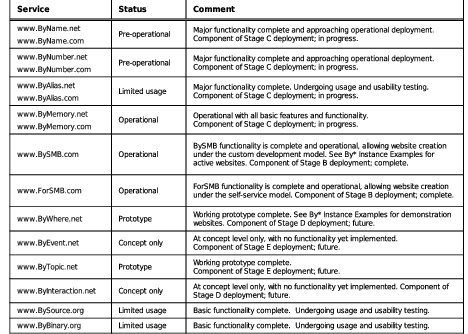
5.8.1 Conceptual definition
We have done all the necessary intellectual work to create a complete conceptual blueprint for this initiative. We have created the following written assets to articulate the concept and enable participation by others:
- Libre Services: A non-proprietary model for delivery of Internet Services [?]. This paper provides a complete description of the Libre Services concept.
- The By* Concept: A Unified Model for Internet Services [?]. This paper provides a complete description of the By* concept and family of services.
- An Open Business Plan: The By* Family of Libre Services. The Business Plan (this document) provides a complete description of the By* business opportunity.
Together these three documents provide a complete description of all critical elements of this initiative. They are all complete and available in multiple file formats.
5.8.2 By* services
The following is the current status of all By* services at the time of writing. For the latest status on each service refer directly to the website for that service. All services have placeholder websites in place.
- Much of the conceptual and architectural design work for the By* family is complete.
- ByMemory is largely complete, including basic general functionality, and ready for immediate account creation and usage by anyone. It is already populated with a number of active accounts, providing tangible demonstration of the capabilities of the Libre Services and By* concepts.
-
BySMB/ForSMB
is
sufficiently
complete
in
terms
of
features
and
capabilities
to
support
the
custom
development
model
of
service
creation
(see
Section
5.6.5,
and
under
this
model
we
have
already
created
BySMB/ForSMB
services
for
a
number
of
clients.
Creation of the facilities and features to enable the fully automated self-service model is under active development. This is slated for completion next, and is expected to become available in 2008.
- A complete set of basic ByName features and capabilities have been implemented. These are already adequate for initial deployment of ByName as a live service. The remaining work is the creation of facilities to enable automated account generation. This is under active development, and the ByName service is expected to be deployed in late 2008.
- ByNumber and ByAlias are largely a functional subset of ByName, and their status generally tracks that of ByName. These are also under active development, and slated for deployment in late 2008.
- ByWhere, ByEvent, ByTopic remain at concept level only, with no actual functionality implemented.
- ByInteraction remains at concept level only, with no actual functionality implemented. This will be the last of the By* family to undergo development and become available.
- The By* user environments remain at concept level only, with no actual functionality implemented.
- Placeholder websites. All By* services have placeholder websites in place, populated with basic service information.
- By-Star.net. In addition to the individual By* service websites we have also established a general informational website at:
The status of all By* services is summarized in Table 5.5. The Status column indicates the following status conditions, listed in order of development progression:
- Concept only. The service remains at concept level only, with no functionality implemented.
- Prototype. Initial design and development is complete, and a prototype services exists for demonstration and proof-of-concept.
- Limited usage. The prototype service is in limited usage for validation and testing purposes.
- Pre-operational. The service is undergoing active development in readiness for operational deployment.
- Operational. The service is fully operational. This means the service is always running, available for immediate usage by anyone, has an installed base of real users, and is generating revenues.
5.8.3 Software distribution centers
We have established the following software distribution sites to provide the resources required to reproduce the By* services:
- BySource.org. The distribution center for By* software in source form.
- ByBinary.org . The distribution center for By* software in binary form.
Both of these websites provide initial basic functionality, and are currently undergoing validation and testing.
5.8.4 Business infrastructure
The following business assets are in place to support execution of this Business Plan:
- Processes and discipline. We have established a complete set of engineering and business methodologies, processes and discipline to support our operations. These are more than adequate to support on-going operations and revenue generation.
- Data Center. The Data Center is state-of-the-art, complete and fully functional.
- www.neda.com. We have created a very extensive and comprehensive website to support every aspect of our company operations.
- Equity. Thus far Neda is entirely self-financed and almost entirely employee-owned. Ample equity is available as a vehicle for collaboration, partnership, and employee incentive.
5.8.5 Execution and revenue status
We have created a complete conceptual blueprint, framework for participation, and execution plan. We have also created sufficient technical and business assets to move forward with Phase I of our execution plan. The initial stages of Phase I have begun, and we are already generating early Phase I revenues. These revenues are small, but they are recurring revenues and growing.
We are now at a point where we are ready to subject this initiative to wide exposure, accommodate participation by others, and begin building increased revenues. From here the next major steps are continued services deployment, widespread promotion of the concept, and revenue-building.
All the basic structures and assets required to execute our plans are in place. We are now ready for immediate, rapid implementation and revenue-building.
5.9 The Wireless Component
Libre Services and By* include two important wireless components: WhiteBerry mobile messaging, and Libre Community WiFi.
5.9.1 WhiteBerry mobile messaging
WhiteBerry is an open mobile messaging solution. We initially completed development of the WhiteBerry model in 2001, and documented it fully in the form of a white paper titled Operation WhiteBerry: Creation of a Truly Open Mobile Messaging Solution [?][?].
Though we created a complete conceptual blueprint for deployment and promotion of the WhiteBerry model, we did not subject this article to wide distribution, nor did we execute our implementation plan.
This is because widespread industry implementation of the WhiteBerry solution requires open access to the wireless networks, and in 2001 the wireless network landscape remained very much a walled garden, in which the network providers control and limit network access. Five years later the wireless landscape continues to be a walled garden. It will not be possible for large-scale industry-wide deployment of WhiteBerry to take place until the wireless network access model shifts to an open paradigm.
But WhiteBerry remains fully viable as an open model for mobile messaging, and we believe represents the eventual future of the mobile messaging industry. Sooner or later the closed and fragmented industry of today will give way to an open model allowing general industry-wide interoperability. Whenever the wireless network industry evolves sufficiently to allow this to happen, WhiteBerry is ready to step immediately into its intended role.
In the meantime our own strategic vision has continued to evolve. In 2001 we viewed WhiteBerry as a tactical entry point into the Internet Services market. In 2006 we are now targetting the Internet Services industry directly, and WhiteBerry has been subsumed as just a single functional capability within the By* family.
The Business Plan we wrote in Q4 2001 was WhiteBerry-centric, as an entry point into the Libre Services industry. The current version of the Business Plan is Libre Services-centric, now including WhiteBerry as a single component.
At this point WhiteBerry is a dormant asset, subsumed under the broader By* deployment, and we have no explicit execution plan or schedule for deployment of WhiteBerry. WhiteBerry will be executed as a business opportunity only if this is occasioned by appropriate industry conditions, and the availability of appropriate external financing. Under the self-financed scenario, we do not expect to promote WhiteBerry as a general industry-wide solution.
But it should be noted that WhiteBerry continues to represent a gigantic business opportunity in its own right. For complete details, and for insight into how the 2001 WhiteBerry initiative has evolved into the current Libre Services initiative, refer to the Q4 2001 Business Plan, available at:
http://www.neda.com/StrategicVision/BusinessPlan
WhiteBerry revenues
The final column of Table 5.4 includes two additional components of the overall By* deployment: deployment of services in non-By* settings (Libre Engines), and deployment of the WhiteBerry mobile messaging solution.
In the context of the By* deployment, WhiteBerry is something of a wild card. It is largely independent of the other By* components, and can be executed at any time, whenever industry conditions are right for this. It also represents a gigantic business opportunity in its own right.
The WhiteBerry business model and revenue streams remain fully valid and viable within the more general By* context. The WhiteBerry revenue streams are discussed in detail in the Q4 2001, WhiteBerry-centric business plan [?]. Here we present a brief summary only. As shown in Table 5.4, the major revenue opportunities are:
-
Software
licensing.
We
have
created
a
comprehensive
set
of
WhiteBerry
software
products
for
all
major
segments
of
the
mobile
messaging
industry.
All
these
software
products
are
dual-licensed:
they
are
available
as
free,
open-source
software
under
the
GPL
(General
Public
License),
and
they
are
also
available
under
Neda
commercial
licenses
for
usage
in
commercial
contexts.
The software licensing revenue stream consists of sales of these commercial licenses into the extremely large mobile messaging market, including ISPs and wireless data carriers, intranet messaging system operators, end-user device manufacturers, systems integrators, and personal desktop messaging users.
-
Software
and
deployment
consulting.
There
is
also
a
very
significant
consulting
revenue
stream
associated
with
WhiteBerry.
This
consists
of
providing
consulting
services
to
clients
who
are
deploying
WhiteBerry
throughout
the
mobile
messaging
industry.
Such
clients
include
device
manufacturers,
wireless
modem
manufacturers,
wireless
network
operators,
message
center
operators,
and
systems
integrators.
Consulting
revenues
also
include
custom
software
development
work
for
clients
who
require
specific
software
portations,
enhancements
or
customizations.
As the architects and developers of the WhiteBerry solution, we are uniquely qualified to provided these services.
-
Value-added
service
fees.
WhiteBerry
mobile
messaging
is
provided
as
a
functional
component
of
the
BySMB/ForSMB
and
By<Individual>
(except
ByMemory)
services.
This
can
readily
be
provided
to
users
as
a
value-added
feature
for
an
additional
monthly
service
charge,
thus
creating
a
recurring
hosting/subscriber
service
fee
revenue
stream.
In the case of By<Individual>.com, WhiteBerry can be provided as a feature carrying additional advertising exposure, thus creating a recurring advertising revenue stream.
WhiteBerry assets
All resources required to support the WhiteBerry mobile messaging solution are complete and available. These include:
- Operation WhiteBerry: Creation of a Truly Open Mobile Messaging Solution [?]. This industry white paper provides a complete description of the WhiteBerry solution.
- MailMeAnywhere.org. MailMeAnywhere is the WhiteBerry software distribution center. MailMeAnywhere also hosts a public forum for the collective development and enhancement of the LEAP protocol engines and integration tools.
- LeapForum.org. The Leap Forum is the central information and resource center for the LEAP family of protocols.
- ESRO.org. ESRO.org is a maintenance organization and development forum for the ESRO protocol.
- EMSD.org. EMSD.org is a maintenance organization and development forum for the EMSD protocol.
All the above websites are fully operational. For complete details see the Q4 2001, WhiteBerry-centric business plan [?].
5.9.2 Libre Community WiFi
A second wireless component of Libre Services is Libre Community WiFi.
For details about Libre Community WiFi refer to the related project document in the article titled Libre Services: Projects for bootstrapping [?].
5.10 Competitive Advantages
In the traditional proprietary business model, a key component of sustainable advantage is ownership of assets via intellectual property mechanisms such as patents and copyright. But our business model is entirely non-proprietary, without these formal components of asset ownership. Instead, our competitive advantages are these:
- Unique leadership role. We are the originators and architects of Libre Services and By*, and we are playing a unique leadership role in their industry-wide promotion and deployment. This leadership role provides Neda with incomparable name recognition status and mindshare within the industry. At the outset, this mindshare will far exceed that of any other Libre Services provider.
- Conceptual lead time. This initiative is complex and conceptually challenging, but we have a clear and complete big-picture understanding of it in every respect. This amounts to a major conceptual lead time over any potential competitor.
- Fitness to execute. We are technically and strategically fit to execute this plan. On the technical side we have all the necessary skills, knowledge and experience, and we are fully in tune with the free software culture. On the strategic side we are a small team, internally coherent and fully gelled, with the agility to respond rapidly to changing circumstances and opportunities.
- Execution synergy. Based on our big-picture understanding we are executing on all fronts necessary to drive this forward. We have thought through every aspect of this initiative, and created a fully coordinated execution blueprint. This creates a powerful synergy among the mutually reinforcing components of our execution plans. Anyone else will at best be doing only a portion of what we are doing.
- First mover advantage. We have a decisive first mover advantage within what is essentially a new industry.
- Infrastructure in place. We have built a sophisticated technical and business infrastructure, and have done so with near zero debt. This infrastructure is large, scalable and complete enough to support on-going execution of our plans and rapid increase in revenues. We are already generating small but growing revenues based on this infrastructure.
For all these reasons Neda is uniquely positioned to profit from the By* initiative.
5.11 Risks and Competition
Despite its large upside, this venture is not without risk. The following is a discussion of the possible associated risk factors.
5.11.1 Non-risk: engineering execution
On the engineering side, we are fully equipped and capable to execute this plan. We know exactly what to do and how to do it. We have all the understanding and expertise necessary to build all the required engineering components. We also have a complete engineering infrastructure and toolset necessary to move forward with this.
The remaining requirement to move forward rapidly with this is the right engineering personnel to do the engineering work. We are confident we can recruit the right people when revenues and/or financing permit. We are well connected, have many existing professional relationships, and understand the staffing requirements very well. Thus recruiting and execution on the engineering side is extremely well characterized, and a very low risk element of our execution plan.
Note that the technical and infrastructure requirements to becoming an Internet service provider are very demanding. This requires a number of highly specialized skillsets, discipline, and a major initial investment. It requires building major physical assets in the form of a Data Center, and major intellectual assets in the form of processes and discipline. But we have accomplished all of this entirely on the basis of our own in-house abilities, and with near zero debt. We are now fully capable of operating and delivering all By* services at very large scale.
5.11.2 Major risk: business execution
The fundamental risk associated with this enterprise is inability to execute on the business operations side. The major recruiting and execution risks reside in the areas of management, business development, sales, and operations. Here recruiting and team-building will be significantly more challenging.
The scope of the plan is very large. In the case of a fully-financed scenario, this calls for a rapid growth rate on several fronts. This in turn calls for the creation of a highly sophisticated business structure, and for the management of a rapid and sustained scaling up of operations.
These are standard challenges in the high tech arena, and the business tools and methodologies exist to address them. However, success in this depends upon having the right people for the task. To accomplish our goals, we will need a well-coordinated team of experienced management and business operations personnel.
We have stated that we do not anticipate difficulty in recruiting talented people. But another question is whether we will be able to recruit the necessary people sufficiently quickly to meet our goals. Even with full financing and a skilled core management team, it may not be possible to do the necessary recruiting and team-building fast enough to sustain our growth rate.
However, the severity of this risk is greatly mitigated by the fact that, as the initial proponents of a radical new engineering and business model, time is inherently on our side. Industry conditions are right for the execution of this initiative today, and will remain so for some considerable time. The prevailing industry ideology remains fully rooted in the proprietary services model, and despite anything we might do this will not change for many years.
Thus the window of opportunity for this initiative will remain open for some time to come, and competitive pressure will not come on Neda because of changing industry conditions. Rather, pressure will come on Neda because of competition resulting from our own success. However, this pressure will not arise until our own execution plans are well under way. Therefore we expect to have an ample window of opportunity to do the necessary recruiting and scale up the necessary business structures before serious competitive pressures arise.
5.11.3 Competing Internet services
There is nothing to prevent another company from competing directly with Neda on the basis of Libre Internet Services. Indeed, it is a defining characteristic of Libre Services that such competition must inevitably arise.
Our sustainable advantages in the face of this competition are those described previously: our leadership role, name recognition, conceptual lead time, execution synergy, first mover advantage, and fitness to move faster and with greater certainty than the competition.
In the long term, it is the first mover advantage that is the most decisive. Since Internet Services is an increasing returns business, the company that first begins to dominate this business will become increasingly dominant as time goes on. But the benefit of the first mover advantage depends on the ability of the first mover to capitalize on it quickly. If the first mover is unable to execute smoothly and rapidly, or otherwise blunders, this advantage can be lost. And there is no other advantage that Neda currently enjoys, that cannot eventually be eroded away by a competing company.
Therefore an inability to execute, coupled with swift, intelligent, aggressive and well-executed competition, can prove fatal to Neda.
5.11.4 Timing
We have created a blueprint for a transformation of the Internet Services industry into something much more powerful than its incarnation of today. We believe our thinking and vision are well ahead of the industry at large, and it will take time for the prevailing ideas and attitudes of the industry to catch up with us.
This is why we claim that time is on our side, and this is why we believe that we can continue to move forward with our plans on a self-financed basis.
But it must be acknowledged that we could be quite wrong about this, and we could somehow be acting too soon or too late. One could argue that the proprietary services model is too entrenched for any alternative services model to gain any credibility and traction, so for this reason the Libre Services/By* initiative is too late.
On the other hand one could argue that the Libre Services and By* concepts are too far ahead of their time, and societal thinking remains rooted in the mindset and conventions of ownership-based material constructs. From this point of view the Libre Services/By* initiative is too early.
Our response to these conjectures is that we stand by our current assessment. We have a deep understanding of the Internet Services industry, and we continue to pay close attention to its trends and voices. On this basis, we maintain that our assessment of the current status of the industry, and our predictions for its future development, are correct.
While we understand the basis for these conjectures, we believe they are without merit. While the proprietary services model is the prevailing reality today, it is not sacrosanct. It is no more permanent than any other institution, and no less vulnerable to displacement by a more powerful set of ideas.
And while our ideas are radically new and groundbreaking, the necessary precedents and intellectual preparedness exists for them to be understood and taken seriously.
5.12 The Company
Neda Communications, Inc. is a well-established company with a proven track record of technical proficiency and profitability. Neda was founded in 1991, and between 1991 and 1997 operated as a successful data communications consulting company, with an average income from 1993 to 1997 of over $1 million annually. To date Neda has received no external financing.
Neda has been actively involved in the wireless data industry since 1992. From 1992 through 1994 Neda acted as the lead designer and primary architect of the Cellular Digital Packet Data (CDPD) System Specifications. From 1994 through early 1997, Neda designed and implemented much of AT&T Wireless Services mobile messaging prototype software and systems, for use over Narrowband PCS and CDPD wireless networks.
In 1997, Neda substantially curtailed its consulting activities, and began actively developing the WhiteBerry mobile messaging solution. Between 1997 and 2001, Neda developed a complete set of WhiteBerry assets, as described in the Q4 2001, WhiteBerry-centric business plan.
In 1999 Neda was re-incorporated as a new legal entity, appropriately structured to undergo external financing.
In 2001, Neda made a significant change in strategic focus, shifting from WhiteBerry as a tactical entry point into the Internet Services industry, to a direct strategic targetting of this industry based on the Libre Services and By* initiatives. From 2001 until the present, Neda has created the assets needed to launch these initiatives and profit from their success.
For the past five years our vision and focus has been the creation of the assets required to execute this Business Plan.
We have been involved in the Internet since the very beginning, and consider ourselves long-time students of the medium. As an example of our early vision, note that our Neda domain was registered before that of Microsoft:
Registrant: Registrant:
Neda Communications, Inc. Microsoft Corporation
(NEDA-DOM) (MICROSOFT-DOM)
3610 164th Place S.E. One Microsoft Way
Bellevue, WA 98008, US Redmond, WA 98052, US
Domain Name: NEDA.COM Domain Name: MICROSOFT.COM
Record Created On 20-Mar-91 Record Created On 02-May-91
We also established the ByName and other By* domains as far back as 1998, long before any of the recent proprietary offerings in this space:
Registrant:
By Name Services
C/O Neda Communications, Inc.
3610 164th Place SE
Bellevue, WA 98008, US
Domain Name: BYNAME.NET
Record created on 21-Aug-1998
We also established our ARIN registration as far back as 1993:
OrgName: NEDA COMMUNICATIONS, INC.
OrgID: NEDAC
Address: 3610 164th Place SE
City: BELLEVUE
StateProv: WA
PostalCode: 98008
Country: US
NetRange: 198.62.92.0 - 198.62.92.255
RegDate: 1993-02-23
For complete details about Neda see our website at: www.neda.com
5.12.1 The people
Neda has a core team of technical and management personnel with extensive experience in the wireless data communications field, and a track record of technical accomplishment and business success. Among the team there are relationships going back almost twenty years, reflecting a long history of productive cooperation. Every member of the team fully understands and is committed to the execution of this business plan.
The team is led by Mohsen Banan, who has been running Neda since 1991. Mohsen was the primary architect of the network structure of the CDPD specification. He is also the intellectual originator and primary architect of the WhiteBerry mobile messaging solution, the Libre Services model, and the By* family of Internet services.
Other team members have a similarly high level of technical and business expertise. Complete biographical data for each team member is available on the Neda website at:
http://www.neda.com/AboutNeda/CompanyProfile/
5.13 Financing
We have built all this and reached this point on our own, without any external participation or financing. With or without external financing, we will continue to execute our plans. Everything we have built thus far has been accomplished on the basis of on-going consulting and colocation revenues, and we will continue to move forward on this basis. We will continue to develop and deploy the By* services and build the various revenue streams, according to the execution plan described in Section 5.7.
But this enterprise can benefit tremendously from investment participation. We have created an enormous profit-making opportunity. With the right level of financing we can greatly expedite and accelerate our execution schedule, and take full and immediate advantage of this opportunity.
Our optimal financing schedule for this purpose is $2M initially, followed nine months later by a second financing round of $15M. Under this financing schedule the initial $2M will be used to expedite execution of Phase I. The second round of $15M will be used to execute Phase II immediately on conclusion of Phase I.
But our execution strategy is by nature very flexible. We are currently operating in a self-financed mode, and can continue in this mode indefinitely. However, we can readily expedite our execution schedule according to a wide range of financing amounts and timing. We have all the necessary technical expertise, managerial experience, and business infrastructure required to execute Phase I. But a relatively small amount of financing can accelerate Phase I significantly. Thus we can currently accommodate external financing in any amount from $500k to $2M.
This is an unconventional financing model, but is an appropriate one for this plan. To accommodate this model, we have established a flexible framework for investment participation. This framework allows investors to participate to the extent and timing of their choosing.
The above financing figures and schedule will remain valid until we next update this business plan.
5.13.1 An open investment model
The By* initiative can benefit greatly from investment, and we have established an appropriate framework for this purpose.
However, we are not following the conventional model for early-stage private investment. The conventional model permits excessive control and exploitation by the venture capital community, to the frequent detriment of the company being invested in. A detailed discussion of the deficiencies of the conventional model, and our reasons for rejecting it, is provided in our Investment Philosophy at:
http://www.neda.com/StrategicVision/Participating/
Instead, we are taking an approach which is open, egalitarian, and permits participation by any interested and qualified investor. Under this open model we are publishing on our website everything necessary for a potential investor to make an initial evaluation of Neda as an investment opportunity. This includes our Open Business Plan and all its supporting documents. Anyone can review these materials and decide for themselves whether to participate or not. A complete description of our Open Investment Model is provided at:
http://www.neda.com/StrategicVision/Participating/
As part of our Open Investment Model we have assembled some resources to assist potential investors in conducting due diligence. These are available on the Neda website at:
http://www.neda.com/StrategicVision/Participating/
5.13.2 Use of proceeds
Financing proceeds will be used to:
- Execute a significantly accelerated ramping up of personnel.
- As described in Section 5.7.4, expedite and accelerate our execution strategy.
- Accelerate the execution plan by carrying out development of the various Phase I technical components and revenue streams in parallel, rather than in sequence.
- Significantly shift emphasis away from the early-stage, lower revenue sources, and towards the later-stage high-revenue sources. For example, development of the advertising revenue model is not something we will do for some time under the boostrap model. If fully funded, however, we will target this for rapid development following the second financing round.
- Execute a focussed and orchestrated promotion of the By* services.
- Put in place a highly scalable business structure.
5.13.3 Financial projections
A conventional Business Plan, based on a bounded product or service, traditionally includes a set of pro forma financial projections. Also traditionally, the projections take the form of a wildly inventive exponential, to be taken seriously by no one.
But these traditions are not right for this Business Plan. First, we are not talking about a product or a service, we are talking about an entire industry. And not just any industry: the Internet Services industry. It’s big, and with or without fictional pro formas, we all know it. Thus the creation of fanciful projections to confirm that, indeed, the By* services have extremely large profit potential is an empty exercise.
And in any case, the actual numerical projections have limited meaning. With or without projections, it is clear that the Internet Services industry and the By* business opportunity are huge, and quantitative projections based on a set of arbitrary assumptions do little to clarify this—they merely present an illusion of clarification.
Also, this entire initiative is about genuine reality, value and integrity. Imaginative financial projections are a form of persuasion. But in this initiative no persuasion, and no spin, is required, and is at odds with the basic spirit of this thing.
Finally, our primary reasons for writing this plan are for the sake of internal clarity and discipline, and to articulate the plan to a broad audience. The standard pro formas are written for a narrow VC (Venture Capital) audience, who expect and demand the jumping of this particular hoop. But the institutional VC audience is just a single constituency among many that form the true audience for this plan. Thus the narrow VC community, along with their expectations, are here marginalized.
When it comes to investment, we are looking for the right kind of investor. Among other things, this means an investor who can quickly grasp what matters and what doesn’t. It means an investor who understands the potential of By* without needing a fictional spreadsheet. In particular, it means an investor who understands that there is a time when financial projections really do matter, and there is a time when they do not. And when they do matter, it means an investor who demands real projections, based on meaningful and defensible assumptions.
When the time is right, we will produce proper financial projections for the right audience. In the meantime, we refer readers to the Q4 2001 Business Plan, which does include a set of projections for the Internet Services industry.
And in the meantime, we can offer this projection: the profit potential is big.
5.13.4 ROI and exit
The ROI is expected to be extremely large.
Exit is by any of the conventional mechanisms.
5.14 An Invitation to Participate
We are doing something big and ambitious: we are reinventing the Internet. In many ways we consider the Internet of today, dramatic though its arrival has been, to have been a false start. Based on what we now know, we are proposing to do the job properly.
But there is what we can do on our own, and there is what we cannot. What we can do is establish a conceptual blueprint for this initiative, and create a starting-point set of assets and services for participation and growth. This we have done. What we can also do is continue to build and deploy the By* services as described in our execution plan. This we will do.
But what we cannot do is make this big. And unless it’s big, it’s not very interesting. But if it is big, then it gets very interesting indeed. But By* can only get big as a result of buy-in and participation by others. Without this, Libre Services and By* will remain no more than interesting historical footnotes in the evolution of the Internet.
Our work so far has been largely conceptual and infrastructural. The next major phase of work consists of growing the By* services into something big and real. And for this we need people, we need business partners, and we need investment.
In creating this opportunity, in building the necessary assets, in establishing a framework for participation, and in documenting everything fully, we have fulfilled our initial responsibilities. We now invite others to join us. We invite and encourage active participation throughout the engineering, business and investment communities.
This is an exciting enterprise, requiring hard work and risk. But the rewards for those who participate, tangible and intangible, will be very great.
Chapter 6
By* for Network Service Providers – A Proposal
The By* Family of Libre Services
for Network Service Providers
A strategy for rapid entry
into the Internet Application Services market
A proposal
Document # LPD-602
Version 1.0
February 2, 2007
Available on-line at:
http://www.libreservices.org/libreManifesto/byStarGenericProposal
Mohsen Banan
htmladdnormallinkhttp://mohsen.banan.1.byname.net/ContactMehttp://mohsen.banan.1.byname.net/ContactMe
Andrew Hammoude
htmladdnormallinkhttp://andrew.hammoude.1.byname.net/ContactMehttp://andrew.hammoude.1.byname.net/ContactMe
Neda Communications, Inc.
3610 164th Place SE
Bellevue, WA 98008-5807
Phone: (425) 644-8026
Fax: (425) 644-2886
Web: http://www.neda.com
6.1 Executive Summary
This proposal is directed towards any provider of network-oriented services. This includes companies such as ISPs, wireless network providers, and telephone companies. Throughout this document we will refer to such companies as “Network Service Providers,” or “you,” or “the Client.”
Such a company has a large network infrastructure and a large subscriber base, to whom it typically provides Layer 3 services, either wired or wireless. It may also provide some limited Layer 7 services directly, and other services in partnership with specialist Layer 7 companies.
This proposal presents a strategy for a Network Service Provider to rapidly extend its service offering to include comprehensive Layer 7 capabilities. The result will be a complete, fully integrated communications and computing service for your subscribers.
This proposal is not about a conventional strategic partnership with a Layer 7 company. How this proposal is different is that the Network Service Provider itself will become an independent Layer 7 operator. It will provide Layer 7 services to its subscribers directly, without needing a strategic partnership with anyone.
Nor is this proposal about a narrow set of niche Layer 7 services, catering to a specific mode of usage such as wireless. It is about the Network Service Provider becoming a complete, full-fledged Internet Application Services provider, in the same market arena as AOL, MSN, Yahoo and Google. And it is about doing so in a highly cost-effective manner.
The proposal is based on the following key premises:
- For any Layer 3 service provider with a large subscriber base, entry into the Layer 7 service market represents a major potential business opportunity.
- In the general software domain, free software is fully proven as a viable alternative to the proprietary software model.
- In the network services domain, an analogous model to the free software model exists in the form of the Libre Services model.
- Based on the Libre Services model, a Layer 3 service provider (wired or wireless) can move decisively into the network-based services arena.
- All the necessary assets exist to enable any Network Service Provider to do this, in the form of the By* (“by-star”) family of Libre Services.
We propose to work with you as consultants to deploy By* as a Layer 7 service operated by you, the Network Service Provider, and under your full control. The opportunity presented here is large, complex and ambitious. It is based on a radically new model for delivery of Internet Services, demanding sophisticated domain-specific understanding, and an entrepreneurial spirit.
The benefits to you are: immediate entry into the Internet Services arena as an independent service provider, greatly expanded scope of relationship with your existing subscribers, and access to a much larger and growing user base.
6.1.1 Part of a bigger picture
The proposal presented here is part of something much bigger.
The Libre Services and By* models described in this proposal have enormous implications. The Libre Services development model, and the By* unified services model, can transform the entire global Internet completely. They can transform it from its limited, proprietary, ad hoc incarnation of today into something far more powerful. The proposal we are presenting is an early manifestation of the next major stage of evolutionary growth of the Internet.
But ambitious though it may be, this initiative is fully thought out and fully documented. The complete picture is drawn in a triad of documents that together describe every aspect of the Libre Services and By* concepts. These are:
- Libre Services: A non-proprietary model for delivery of Internet Services [3].
- The By* Concept: A unified model for Internet Services [7].
- The By* Family of Libre Services: The future of the Internet Services industry [8]—the Neda Open Business Plan.
These three documents describe everything necessary to understand the complete big-picture context for this proposal.
6.1.2 If not now, then prepare
What we are proposing here represents a significant shift in Layer 7 strategy for your company. But clearly, there are a number of barriers to immediate implementation of this. Specifically:
- You may already have a Layer 7 strategy in place, including existing services and partnerships. These cannot be abandoned overnight.
- The generative and propagative power of free software is not yet widely understood within the industry at large. Your organization may not be ready to accept this as a viable technological model.
- The non-proprietary nature of the Libre Services model may conflict with your current business models.
- Making the strategic shift from your current Layer 7 approach to this new approach is a non-trivial thing. This requires thought, analysis and buy-in from multiple constituencies within your organization.
Realistically, therefore, we do not seriously expect you to make an abrupt change of direction based on this written proposal.
On the other hand, it is now abundantly and incontrovertibly clear that free software is the way of the future. This may not be well understood among the industry at large, but for those of us who really know what’s going on, this is as conclusive a factual reality as global warming. Furthermore, the opportunity presented by the By* Libre Services is completely real. There is nothing theoretical or speculative about the ability of your company to deploy By*, exactly as we describe.
This proposal therefore warrants some degree of internal thought and analysis. Realistically, acceptance of this proposal is not an all-or-nothing thing. Rather, it is a matter of degree and timing. What we present here is our vision of the future. To the extent that you agree with this vision, you may wish to begin preparing for it.
At the end of this proposal we present our suggested next steps for how to begin this preparation. What we suggest is a positive, proactive approach. But the approach you take will, of course, be the one that is right in your own company context.
If this proposal interests you at any level, either as something to begin active preparation for in the near term, or as something to take a long-term wait-and-see approach, we are available as consultants to assist you in your process.
6.2 Background
The Internet has given rise to an enormous new industry: the Internet Services industry. And in addition the large new class of network-based services represented by this industry, a fundamental change is occurring in the way traditional software applications are being provided to the user. Increasingly, software applications are migrating towards a service-based implementation, rather than being run locally on the user’s own PC. This trend is taking place for both individual and business end users.
The network-based service model is thus emerging as the dominant computing and communications paradigm for the end user. All usage modalities must become fully integrated and unified components of the network-based model. This includes in particular the wireless and mobile aspects of personal computing.
The corresponding business opportunities, both in the general Internet services arena and in the wireless domain, are gigantic.
6.2.1 Libre Services: A non-proprietary services model
Within the general software domain, free software is a proven alternative to the proprietary software model.
But as yet there is no equivalent to the free software model within the services domain. Virtually all existing Internet Services are based on the traditional proprietary software model. This greatly limits the growth potential of the Internet Services industry.
The solution to this is the Libre Services model, a completely non-proprietary model for delivery of Internet Services. Libre Services are an extension of the principles of free software into the Internet Services domain. They are Internet Services that can be freely copied and reused by anyone. Any company can reproduce and host any Libre Service, either for its own use, or for commercial or non-commercial delivery to others. The Libre Services model exists in relationship to the proprietary Internet Services model of AOL, MSN, Yahoo and Google, in an analogous way to how GNU/Linux exists in relation to Microsoft Windows.
The Libre Services model is described in detail in the paper titled Libre Services: A non-proprietary model for delivery of Internet services [3], available online at:
http://www.freeprotocols.org/libreConcept/accessPage.html
The Libre Services development work was done under the auspices of the Free Protocols Foundation. For information about the Free Protocols Foundation see:
6.2.2 By*: A unified services model
The Internet Services industry has arisen in a completely unplanned, disorganized, ad hoc manner, driven by a multitude of independent commercial initiatives. The various industry capabilities have been built based on immediate business expedience, rather than by any sort of coherent engineering design. The result is the Internet Services industry as it exists today: chaotic, uncoordinated, and lacking any sort of uniformity or consistency of structure. The services industry falls far short of what it can be, and what it can do, if designed for full, consistent, uniform interoperability across all types and manners of service usage.
The solution to this is the By* model. By* (pronounced “by-star”) is a unified services model, unifying and making consistent a large number of services that currently exist in functional isolation. The By* model is based on formal engineering design, rather than short-term marketing considerations. In creating By* we have addressed the following sorts of design issues:
- What are the key types of entity (individuals, businesses, etc.) that must be represented within a generalized web structure?
- For each type of entity, what is required to represent that entity in a highly generalized abstract form?
- What structures and conventions are required so that these entities can be instantiated and named consistently, at a scale of 6 billion?
- What general classes of services are required to enable complex interactions among these entities?
None of these questions was considered during the uncontrolled organic growth of the Internet that brought us to where we are today. And this is what makes By* different. By* is a formal model for bringing structure and order to the Internet, at the scale of the entire planet.
By* is based on a set of key abstractions, representing the major real-world entities that must be represented within a generalized web structure. These entities include such things as individual persons, businesses, physical locations, and events. For each such entity we have defined the structures and conventions required to represent, instantiate and name that entity in a unified consistent way, and at a very large scale. We have then defined the major classes of services required to manage these entities, and to allow highly generalized interactions within and among each other.
The result is a coherent, integrated family of services, enabling complex interactions among people, businesses and information.
6.2.3 The By* family of services
The By* family includes services oriented towards each type of abstracted entity. In particular, By* includes a group of three services specifically oriented towards the needs of individual persons. It is this group that is of most immediate relevance to Network Service Providers. This group consists of:
-
ByName.
ByName
provides
a
complete
set
of
Internet
services
for
the
individual
user,
including
a
personal
domain,
personal
website,
e-mail,
integrated
support
for
mobility,
WhiteBerry
mobile
messaging,
and
various
other
capabilities.
Example named ByName instance: mohsen.1.banan.byname.net
-
ByNumber.
ByNumber
provides
access
to
appropriate
components
of
By*
service
functionality,
but
based
on
a
numerical
ID
assigned
to
the
user
instead
of
the
user’s
name.
ByNumber
provides
an
alternative
means
of
access
to
services
using
numeric
devices
such
as
telephone
keypads.
Example named ByNumber instance: 20000.ByNumber.net
-
ByAlias.
A
similar
set
of
services
to
ByName,
but
based
on
an
alias
instead
of
the
user’s
real
name.
All
user-specific
elements
of
a
user’s
ByName
account
(domains,
websites,
e-mail
accounts,
etc.)
are
based
on
the
user’s
real
name.
But
there
are
circumstances
where
a
user
may
wish
to
protect
his
or
her
true
identity
behind
an
alias.
The
ByAlias
service
supports
this
requirement.
It
is
a
companion
service
to
ByName,
providing
appropriate
services
while
protecting
the
user’s
identity.
Example named ByAlias instance: nemesis.ByAlias.net
The By* family also includes services oriented towards business entities (BySMB/ForSMB), physical locations (ByWhere), events (ByEvent), deceased persons (ByMemory), and services for publication of information (ByTopic). Last and most important, By* includes a set of services allowing complex interactions among the various types of abstracted entity (ByInteraction).
All By* services are Libre Services, and as such can be freely copied and reproduced by anyone. We have established the BySource and ByBinary software distribution sites to provide the resources required to reproduce any By* service.
Complete details about the By* model are provided in the paper titled The By* Concept: A Unified Model for Internet Services [7], available online at:
http://www.By-Star.net/docs/ByStarConcept
6.2.4 The By* development model
The free software movement is a flourishing creative environment, generating a constant stream of new and better software packages, duplicating and surpassing the capabilities of an ever-increasing portion of proprietary software territory. Indeed for any particular item of functionality, there are typically multiple alternative free software packages available.
In this environment the model for implementation of By* service functionality is not one of original software development. Rather it is a process of intelligent selection and integration of functional components from the free software creative environment.
So in creating By* our task has not been to write functional software components—in fact we have written almost none. Our main task has been to make careful engineering choices among the available free software components, and integrate these properly into the By* framework. In making these choices we consider not just the features and capabilities of each software component, but also the compatibility of the component within the overall By* architecture.
Virtually all the initial By* service functionality has been created this way. The following are some of the basic By* features that have been included by this process:
- A named entity domain
- A public website
- A private portal for access to services
- eFax, a service for sending and receiving faxes
- WhiteBerry mobile messaging
- A photo gallery
- GeneWeb, a genealogy software program
We will continue to select and incorporate additional software packages as these materialize within the free software environment. We will not create, so much as we will harvest. Or to paraphrase the common industry dictum: Good programmers write good software; great programmers reuse and integrate.
This is the extraordinary power, and magic, of free software: the ability to take things and reuse them at extremely low cost. This is what has allowed a small consulting company in Bellevue to create the beginnings of something that can eventually displace MSN and Google.
6.2.5 Development status and roadmap
The description of By* provided here and in The By* Concept paper represents an overarching conceptual definition and direction statement. The By* family services themselves are a work in progress, with the planned services in varying stages of development. The following is the current status of the By* services, and the roadmap for future development:
- ByMemory is complete and fully functioning, ready for immediate account creation and usage by anyone. It is already populated with a number of active accounts, providing tangible demonstration of the Libre Services and By* development models.
- ByName, ByNumber, ByAlias are under active and continuing development. These are the services that are most immediately relevant to individual subscribers. Though lacking their eventual richness of functionality, a complete set of basic features and capabilities has been implemented, and they are ready for immediate deployment as live services.
- BySMB/ForSMB are under active development. These are slated for completion next, and are expected to become available in early 2007.
- ByWhere, ByEvent, ByTopic remain at concept level only, with no user functionality implemented.
- ByInteraction remains at concept level only, with no user functionality implemented. This will be the last of the By* family to undergo development and become available.
A more complete description of the status of each service is provided in the Neda Business Plan, The By* Family of Libre Services: The future of the Internet Services industry [8], available online at: http://www.neda.com/StrategicVision/BusinessPlan
The intended scope of By* is extremely large—our goal is to establish By* as a new model for delivery of Internet Services, globally. The Neda Business Plan provides a complete description of our strategy for moving towards this goal, including details of our roadmap for continued development and deployment of the By* services.
As the full suite of By* family services becomes complete and available, these additional services can also be deployed by your company, if this fits in with your broader technical and business strategies.
6.3 The Opportunity for Network Service Providers
Network Service Providers typically provide Layer 3 services to their subscribers. In the case of ISPs this is their primary service model; in the case of wireless network providers and telephone companies this is a secondary service model. But in either case the Network Service Provider has a direct relationship with a large subscriber base.
For any Layer 3 service provider with a large subscriber base, entry into the Layer 7 service market represents an obvious business opportunity. But under the proprietary services model the Network Service Provider cannot provide Layer 7 services to its subscribers directly. Instead, it must enter into appropriate partnerships with proprietary Internet Service providers.
But an alternative approach is for the Network Service Provider to deliver Layer 7 services directly to its own subscribers using the Libre Services model. Under this approach the Network Service Provider itself becomes the Internet Application Service provider, and a relationship with a proprietary provider such as AOL is no longer needed.
The By* family of services provides precisely what is needed to accomplish this. The combination of your existing Layer 3 services and the By* Layer 7 services provides a complete computing and communications environment, both fixed and mobile, for your subscribers. This is the future of the Internet Services industry, available today.
The business benefits are clear and obvious. They are:
- Immediate entry into the Layer 7 services market as an independent service provider.
- A far more comprehensive and committed relationship with your existing subscriber base.
- Access to a much larger and growing user base.
And this can be done extremely rapidly, and at very low cost.
In the longer term the benefit is early entry into the Libre Services arena, which we regard as the ultimate future of the Internet Services industry.
6.3.1 Business models
A Network Service Provider can deploy the By* services based on any of several different business models:
- It can become its own independent Libre Service provider, with the By* services rebranded under its own name.
- It can become its own proprietary Internet Service provider, with the By* services rebranded under its own name, but not maintained as a Libre Service.
- It can enter into a business partnership with Neda, in which Neda delivers the By* services to the Network Service Provider’s subscribers.
- It can become a franchise provider of the By* services, providing and maintaining the services under the By* branding.
Each of these business models offers a different pattern of risks and benefits. Your own company can adopt the model that best fits its overall business strategies.
6.3.2 Corporate financing
The proposal presented here represents a limited consulting relationship with Neda.
But as we have indicated, the Libre Services and By* initiatives have a much bigger future. If your company wishes to participate in the Libre Services and By* initiatives in a broader context, a more formal partnership and corporate financing are available options.
The Neda Business Plan provides complete details of the opportunity open to potential business partners, including the availability of equity as a vehicle for corporate partnership and investment. If this is something that may be of interest, please include your corporate development team as participants in further discussions with us.
6.4 About Neda
We propose to work with you as consultants to deploy By* as your own service offering. We have all the necessary experience and assets for this.
Neda Communications, Inc. is a provider of consulting, web hosting, and software engineering services to the data communications industry. We are a privately held company, founded in 1991, and with a proven track record of technical and business expertise.
In addition to our consulting and engineering services, we have a long history of leadership and innovation within the data communications industry. We are the authors of numerous articles and white papers relating to the data communications and Internet industries. Most recently we are the originators of the Libre Services concept, and the developers of the By* family of services. For complete details visit our company website at: http://www.neda.com
We maintain our own state-of-the-art Data Center to support our web hosting and colocation clients. If necessary this asset can be used to support Phase 1 of the proposed project, as described below. Details about the Data Center are available on our website at:
http://www.neda.com/InternetServices/OurDataCenter
6.5 Project Outline
In the remainder of this document we present an outline of how we propose to work with you. Given the large scope of the intended project, we propose that the project be approached in two phases.
Phase 1 will consist of business and technical analysis, and deployment of an initial small-scale pilot service. Phase 1 will have the following goals:
- Conduct a business and technical analysis of the addition of Layer 7 services to your existing Layer 3 services. Establish the appropriate technical and business models, and other initial deployment parameters.
- Deploy By* at a scale of 1000 within your own network.
- Develop a comprehensive implementation plan for Phase 2.
Phase 2 will consist of large-scale development and deployment. The details of Phase 2 will be established during Phase 1.
6.5.1 Scope of work and deliverables
We anticipate the following tasks and deliverables for Phase 1:
- Assist you in conducting a business analysis of By* within your own context. Establish the appropriate business model for deployment of By* services.
- Assist you in conducting a technical analysis of By* within your own context. Establish which By* services and functionality are most relevant and appropriate for deployment.
- Define the scope and scale of the initial pilot service.
- Deploy the pilot service at a scale of 1000. If necessary the Neda Data Center can be used for this purpose.
- Formulate a detailed implementation plan for Phase 2.
6.5.2 Schedule
We estimate it will take approximately 3 months to complete all Phase 1 tasks and deliverables.
If you are interested in pursuing this proposal, we will initially work with you to establish a formal Statement of Work for Phase 1. We will provide a more accurate schedule once the Statement of Work is in place.
6.5.3 Commercial terms
The commercial terms for this project will be governed by our Rates and Policies for Contracts and Consulting, available on request.
We propose that Phase 1 of this project be undertaken under a consulting (time and materials) contract. For Phase 1 we can offer our Long-Term consulting rates, as described in our Rates and Policies.
We estimate that Phase 1 can be accomplished by two Senior Consultants contributing 30 hours per week for 12 weeks, and one Staff Consultant contributing 25 hours per week for 12 weeks.
Actual times and costs will depend on a number of factors to be determined, such as the precise scope of work and the availability of Client staff to provide technical liaison. Our estimates are based on reasonable assumptions and our experience with other projects of a similar nature.
We will provide a more precise estimate once a Statement of Work is in place. We will then work with you to establish firm schedules and budgets.
6.5.4 Project management
On the Neda side, Mohsen Banan will take responsibility for overall project management. He will also take top-level responsibility for all technical analysis and engineering work.
Other Neda personnel who may be involved in the creation of deliverables for this project include: Andrew Hammoude, Pean Lim, Pinneke Tjandana, and Mark McWiggins. Professional biographies for all Neda personnel are available on our website at:
http://www.neda.com/AboutNeda/CompanyProfile/People
On your (“the Client”) side, we will require that you assign a single person to be responsible for project administration. This will be the primary contact person from whom Neda can receive direction, and to whom inquiries can be made.
As per customary practice, such matters as project coordination, periodic reporting and inquiries will be conducted by means of telephone, facsimile, e-mail and in-person meetings. We will provide periodic progress reports to allow monitoring and on-going review of the project by the Client.
6.6 Next Steps
For any Client wishing to proceed with this project we are ready to provide assistance as consultants in whatever manner you see fit. However we suggest the following as appropriate next steps to move things forward:
- (Client action.) The Client to review this proposal, and external documents and websites as necessary. The following references are particularly relevant:
- (Neda/Client action.) If you are interested in pursuing this further, an initial meeting to be scheduled for a first round of discussion and Q & A.
- (Neda/Client action.) Neda and the Client to work together to establish a formal Statement of Work for Phase 1.
- (Neda action.) Based on the Statement of Work, Neda to create a formal project proposal for review and consideration by the Client.
Finally, it is worth noting that if you were to attempt to become a proprietary Internet Services provider, the required development costs would be on the order of hundreds of millions of dollars. Instead, the equivalent capability is being offered to you at no cost. The price quoted under Commercial Terms represents only the cost of delivery.
Part III
Engineering and Developmental Dimmensions of Libre Services
Chapter 7
Overview of Engineering Dimmensions of Libre Services
7.1 Introduction
This is a placeholder document. This document is intended to provide a description the engineering and developmental models for Libre Services. For the moment the document consists only of section headings and brief placeholder text to indicate the intended content. We will provide complete information at some future time.
7.1.1 Audience
Engineering and development of Libre Services software is based on a collaborative work model. The primary audience for this document consists of engineering developers of Libre Services software. It is intended to provide the information necessary to facilate collaborative engineering development.
7.2 FPF Development Resources
This section will provide a description of the engineering development resources maintained by the Free Protocols Foundation (FPF).
7.2.1 Libre Services Projects
The FPF has established a project-based model for collaborative participation in Libre Services. A description of this model and the currently defined projects are provided in the document titled Libre Services: Projects for Bootstrapping [?, LS-Projs]
7.3 Neda Development Resources
Neda Communications, Inc. also maintains various engineering development resources. These include the Libre Services Integration Platform (LSIP), BySource.org, and ByBinary.org.
7.3.1 Libre Services Integration Platform (LSIP)
LSIP is the basis for efficient services development, and a key component of the Libre Services model. It consists of a uniform set of tools, policies and conventions for integration of software into services. Developers can obtain LSIP by using the following cvs command:
7.3.2 BySource.org
Visit http://www.bysource.org for information about BySource.org.
7.3.3 ByBinary.org
Visit http://www.bybinary.org for information about ByBinary.org.
Chapter 8
By* Libre Engines Release Notes
8.1 Introduction
This is a placeholder document. This document is intended to provide the engineering release notes necessary to recreate By*-equivalent services based on the By* Libre Engines. For the moment the document consists only of section headings and brief placeholder text to indicate the intended content. We will provide complete information at some future time.
In the meantime additional further information is available at the By* website at http://www.by-star.net
8.2 About the By* Libre Engines
The By* Libre Engines comprise the entire body of software required to recreate any By*-equivalent service. It is part of the definition of a Libre Service that such an engine exist, ready for deployment without requiring any further integration work.
The information provided in this document applies to Release 0.1, dated February 07, 2007.
8.3 Platform Assumptions
These release notes assume that GNU/Debian 3.1 (Sarge) has already been installed.
8.4 Obtaining the Software
The software can be obtained from the BySource and ByBinary software distribution websites. For more information visit:
8.5 Libre Platform Genesis Process
Detailed information to be provided later.
8.6 Site Name Assignment
You will need to create a directory representing your site’s configuration in /opt/public/osmt/siteControl.
8.7 Server Configuration and Domain Bindings
You will need to create the necessary items files representing your server configurations and domain bindings in /opt/public/osmt/siteControl/yourSite.
Part IV
Deployment and Operational Dimmensions of Libre Services
Chapter 9
Overview of Operational Dimmensions of Libre Services
9.1 Introduction
This is a placeholder document. This document is intended to provide a description of the general operational requirements for deployed Libre Services. For the moment the document consists only of section headings and brief placeholder text to indicate the intended content. We will provide complete information at some future time.
9.2 Libre Services Social Contract
Operators of Libre Services provide the services to end-user clients, and therefore their actions and practices affect those clients. The developers of Libre Services software create software for use by Libre Services operators, end users, and other software developers. Their actions and practices therefore affect all these constituencies.
To guide the practices of persons and organizations involved in the development and deployment of Libre Services, and to maintain the integrity of the resulting deployed services, Libre Services are based on a written social contract. In the same spirit as the Debian Social Contract, this consists of a set of ethical commitments made by Libre Services developers and operators towards the free software community and the public.
Continued definition of the Libre Services Social Contract is a Libre Services project maintained by the FPF.
9.3 General Libre Services SLA
The formal business relationship between operators and users of Internet services is typically defined in the form of a Service Level Agreement (SLA).
The General Libre Services SLA defines a general template that can be used by all Libre Services operators.
9.4 General Libre Services AUP
The usage guidelines and limitations imposed upon users of Internet services are typically specified in the form of an Acceptable Use Policy (AUP).
The General Libre Services AUP defines a general template that can be used by all Libre Services operators.
Bibliography
[1] M. Banan. Neda’s Efficient Mail Submission and Delivery (EMSD) Protocol Specification Version 1.3. RFC 2524 (Informational), February 1999.
[2] M. Banan, M. Taylor, and J. Cheng. AT&T/Neda’s Efficient Short Remote Operations (ESRO) Protocol Specification Version 1.2. RFC 2188 (Informational), September 1997.
[3] Mohsen Banan. Libre Services: A non-proprietary model for delivery of Internet Services. Neda published document, Neda Communications Inc, January 2006. Online document is available at http://www.libreservices.org/docs/.
[4] Mohsen Banan. Libre Services: Projects for bootstrapping. Neda published document, Neda Communications Inc, January 2006. Online document is available at http://www.libreservices.org/docs/.
[5] Neda Communications Inc. ByEntity Libre Engine Design and Implementation Notes. Neda Published Document PLPC-110502, Neda Communications Inc, Bellevue, WA, February 2007. Online document is available at http://www.neda.com/PLPC/110502.
[6] Neda Communications Inc. Libre Services Integration Platform (LSIP) Design and Implementation Notes. Neda Published Document PLPC-110501, Neda Communications Inc, Bellevue, WA, February 2007. Online document is available at http://www.neda.com/PLPC/110501.
[7] Neda Communications, Inc. The By* Concept: A Unified Model for Internet Services. Neda published document, Neda Communications Inc, January 2007. Online document is available at http://web.by-star.net/docs/ByStarConcept.
[8] Neda Communications, Inc. The By* Family of Libre Services: The future of the Internet Services industry – An Open Business Plan. Neda published document, Neda Communications Inc, January 2007. Online document is available at http://www.neda.com/StrategicVision/BusinessPlan.


