
The By* Concept:
A Unified Model for Internet Services
Document # LCNT-110001
Version 1.1
January 18, 2007
Available on-line at:
http://www.neda.com/PLPC/110001
Neda Communications, Inc.
3610 164th Place SE
Bellevue, WA 98008
Phone: (425) 644-8026
E-mail: http://www.neda.com/ContactUs
Web: http://www.neda.com
Copyright © 2007, Neda Communications, Inc.
Permission is granted to make and distribute complete (not partial)
verbatim copies of this document provided that the copyright notice
and this permission notice are preserved on all copies.
About this document
This document is available in multiple file formats, including PDF, HTML, and PostScript. You can access the document in any of these formats at:
Contents
1.1 About this document
2 The By* Concept
2.1 The By* family of services
2.2 By* Libre Engines
2.3 Naming principles
2.4 User environments
2.5 Value propositions
3 Growth Dynamics and Models
3.1 Features and functionality
3.2 ByName service deployment: business motivations
3.2.1 ISP positioning
3.2.2 Non-commercial deployment
3.3 Service usage
4 Development Roadmap
4.1 By* features and capabilities
5 Comparison to Existing Approaches
List of Tables
1 Introduction
The Internet has given rise to an enormous new industry: the Internet Services industry. This is an intensely dynamic industry, enabling many different types of interactions among people, businesses and information. But despite its phenomenal growth, the Internet Services industry of today has two characteristics that greatly limit its capabilities.
First, virtually all existing Internet Services are based on the traditional proprietary software model. As yet the free software movement has no formal presence within the services domain. The solution to this is the Libre Services model, a completely non-proprietary model for delivery of Internet Services. For more information see the article titled Libre Services: A non-proprietary model for delivery of Internet Services [1], or visit the Libre Services information center at: http://www.LibreServices.org
Second, the Internet Services industry has arisen in a highly disorganized, unstructured way, driven by a multitude of uncoordinated commercial initiatives. The various industry capabilities have been built in an ad hoc manner, based on immediate business expedience, rather than by any sort of overarching engineering design. The result is the Internet Services industry as it exists today: chaotic, uncoordinated, and falling far short of its true potential. The solution to this is the By* family of Libre Services. By* (pronounced “by-star”) is a coherent, scalable, generalized Internet Services model.
Together, the Libre Services and By* models have enormous implications. The Libre Services development model, and the By* unified services model, can transform the Internet completely, from the proprietary and ad hoc model of today into something far more powerful.
The realization of this potential is large, complex and ambitious. It is far too large in scope to be accomplished by any one company acting alone, but instead can only be accomplished as a coordinated industry-wide effort. But the Libre Services model enables precisely the necessary large-scale, distributed, cooperative effort. Libre Services brings the tremendous collaborative power of free software to the Internet Services domain.
1.1 About this document
This document is one of a triad of documents that together describe every aspect of the Libre Services and By* concepts. These are:
- Libre Services: A non-proprietary model for delivery of Internet Services [1]. Provides a complete description of the Libre Services model.
- The By* Concept: A Unified Model for Internet Services (this document). Provides a complete description of the By* unified services model.
- The By* Family of Libre Services: The future of the Internet Services industry [3]. Neda’s Open Business Plan. Describes the business dimensions of the By* Libre Services.
A critically important characteristic of the By* services is that they are Libre Services. Many important elements of By* derive from the general Libre Services model, including their development model, value propositions, and growth dynamics. An understanding of the general Libre Services model is an essential prerequisite to understanding the By* services model. It is recommended that the Libre Services concept paper [1] be read and understood fully before reading this one.
2 The By* Concept
By* is a unified services model. It is a coherent framework for enabling complex interactions among people, businesses and information. The By* framework is based on a formal engineering design approach. The architectural and design considerations are based on proper engineering discipline, rather than short-term marketing and business considerations. In creating By* we have considered the following sorts of questions:
- In creating such a framework, what are the key types of entity (individuals, businesses, etc.) that must be represented?
- For each type of entity, what is required to represent the entity in a highly generalized, abstract form?
- What structures and conventions are required so that these entities can be instantiated and named consistently, at a scale of 6 billion?
- What general classes of services are required to enable complex interactions among these entities?
None of these questions was asked during the explosive, organic growth of the Internet that brought us to where we are today. And this is what makes By* different. By* is a formal model for bringing structure and order to the Internet, at the scale of the entire planet.
By* is based on a set of key abstractions, representing the major real-world entities that must be represented within a generalized web structure. These entities include such things as individual persons, businesses, physical locations, and events. For each such entity we have defined the structures and conventions required to represent, instantiate and name that entity in a unified consistent way, and at a very large scale. We have then defined the major classes of services required to manage these entities, and to allow highly generalized interactions within and among each other.
2.1 The By* family of services
The By* family includes services oriented towards each type of abstracted entity. There are four services oriented towards individual persons: ByName, ByNumber, ByAlias, ByMemory. The first three of these provide services for living persons, while the fourth is dedicated to preserving the memory of deceased persons. The By* family also includes services oriented towards business entities (BySMB/ForSMB), physical locations (ByWhere), events (ByEvent), and services for publication of information (ByTopic). Last and most important, By* includes a set of services allowing complex interactions among the various types of abstracted entity (ByInteraction).
-
ByName.
ByName
provides
a
complete
set
of
Internet
services
for
the
individual
user,
including
a
personal
domain,
personal
website,
e-mail,
integrated
support
for
mobility,
WhiteBerry
mobile
messaging,
and
various
other
capabilities.
Example named ByName instance: mohsen.1.banan.byname.net
-
ByNumber.
ByNumber
provides
access
to
appropriate
components
of
By*
service
functionality,
but
based
on
a
numerical
ID
assigned
to
the
user
instead
of
the
user’s
name.
ByNumber
provides
an
alternative
means
of
access
to
services
using
numeric
devices
such
as
telephone
keypads.
Example named ByNumber instance: 20000.ByNumber.net
-
ByAlias.
A
similar
set
of
services
to
ByName,
but
based
on
an
alias
instead
of
the
user’s
real
name.
All
user-specific
elements
of
a
user’s
ByName
account
(domains,
websites,
e-mail
accounts,
etc.)
are
based
on
the
user’s
real
name.
But
there
are
circumstances
where
a
user
may
wish
to
protect
his
or
her
true
identity
behind
an
alias.
The
ByAlias
service
supports
this
requirement.
It
is
a
companion
service
to
ByName,
providing
appropriate
services
while
protecting
the
user’s
identity.
Example named ByAlias instance: nemesis.ByAlias.com
-
ByMemory.
ByMemory
is
a
set
of
services
for
preserving
the
memory
of
deceased
persons.
ByMemory
has
a
complete
set
of
features
for
this
purpose,
including
features
for
creating
memorials
and
biographies,
for
creating
and
maintaining
shared
genealogies,
and
for
maintaining
a
photo
gallery
and
guest
book.
When an individual person dies, the person’s ByName and ByNumber accounts are transitioned into a ByMemory account. Responsibility and authority for maintaining the deceased person’s ByMemory account is assigned to another ByName account, designated by the deceased before his or her death.
Example named ByMemory instance: yazdan.1.banan.ByMemory.net
-
BySMB/ForSMB.
A
set
of
services
based
on
the
generalized
abstraction
of
a
business
entity.
The
BySMB
services
are
somewhat
analogous
to
ByName,
but
oriented
specifically
to
the
needs
of
the
Small-to-Medium
Business
(SMB)
segment.
Example named BySMB instances:
-
ByWhere.
A
set
of
services
based
on
the
generalized
abstraction
of
a
physical
location.
Such
services
are
useful
to
individual
users,
who
can
use
the
ByWhere
services
for
their
personal
residence,
or
to
corporate
users,
who
can
use
the
services
for
their
business
address.
Example named ByWhere instance: info.1-98008-5807-10.ByWhere.net
- ByEvent. A set of services based on the generalized abstraction of an event. An event is anything that is scheduled to occur at a particular time, such as a meeting, conference, party, or any other type of time-delineated occurrence. ByEvent provides a complete set of features for creating and managing events. ByEvent is a fully integrated component of the By* family, allowing proper coordination of events with persons, businesses and locations.
- ByTopic. A set of services for publication of information organized by topic.
-
ByInteraction.
ByInteraction
enables
transactions
involving
persons,
businesses,
places
and
things.
A
transaction
is
any
sort
of
interaction
between
two
or
more
persons
or
businesses.
ByInteraction
provides
a
comprehensive
set
of
capabilities
for
enabling
transactions,
including
such
things
as
classified
advertising,
auctions,
job
listings,
resume
posting,
housing
listings,
dating,
ridesharing,
and
many
others.
ByInteraction is a fully integrated component of the By* family, allowing proper coordination and linkage with the persons, places and things involved in the transaction.
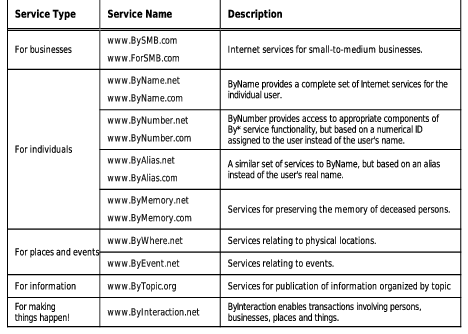
The By* services are summarized in Table 1. As shown in the table, each of the four services for individual users (ByName, ByNumber, ByAlias, ByMemory) is provided in the form of both a .net service and a .com service. The .com service is provided at no cost to users, without support or warranty, for demonstration and trial usage. The .net service is a paid subscription service, fully supported and advertising-free.
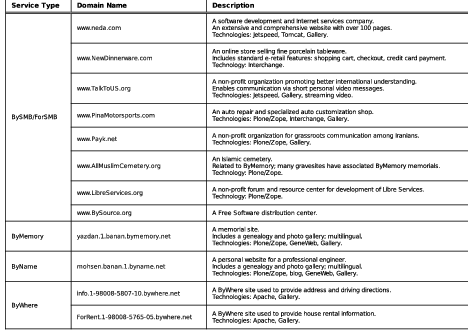
Examples of various existing By* instances are shown in Table 2.
2.2 By* Libre Engines
All By* services are Libre Services, and as such can be freely copied and reproduced by anyone.
The reproduction of any Libre Service is enabled by the existence of a corresponding Libre Service Engine. This is a complete, fully integrated package of service features and capabilities, ready for deployment and delivery by a service provider. It is part of the definition of a Libre Service that such an engine exist, ready for deployment without requiring any further software integration work. More information about the role of Libre Service Engines is provided in Libre Services: A non-proprietary model for delivery of Internet Services [1].
Each of the By* services has a corresponding By* Libre Engine, allowing the service to be reproduced in its entirety. We have established the BySource and ByBinary software distribution sites to provide the resources required to reproduce any By* service.
2.3 Naming principles
A consistent naming convention is essential in order to instantiate entities such as individual persons at extremely large scales. All object instantiations throughout By* are based on consistent naming principles. For example the ByName service provides each user with a personal domain based on the user’s own name, using the naming schema:
homer.simpson.1.ByName.net
This naming schema allows an unlimited number of named instances. ByName users are required to provide their real names for this purpose; pseudonyms and aliases are not permitted. This implies a certain standard of authenticity and integrity on the part of both the ByName service and the ByName user.
2.4 User environments
Internet services work by communication over the Internet between a client application running in the user’s computing environment, and a corresponding server application running within the service.
In the proprietary model the service is typically accessed via a web browser. It may also possibly be accessed via a dedicated client application provided by the service provider.
In the Libre Services model, however, there are no proprietary limitations placed on integration between the user’s computing environment and the service. Since the service is completely transparent, any user environment can be integrated with any Libre Service.
Furthermore, a much deeper level of integration is now possible. In particular, free user environments (i.e. user environments based on free software) can be integrated with Libre Services. And since both the client and server sides of the service are now completely transparent, this permits a highly complex level of integration between the two. This allows the development of Internet services with a power and versatility that far exceeds what exists today.
The By* services can thus be greatly enhanced by providing the user with a “matched” environment—a user environment that is closely integrated with the service. This will provide the user with features and capabilities that go far beyond what is possible using the traditional generic browser access. The role of matched user environments is described in greater detail in Libre Services: A non-proprietary model for delivery of Internet Services [1].
At the appropriate point in our continued development of By* we will develop these matched user environments to enhance the utility of the By* services. For example see the Project Document titled “Libre Emacs Office Environment (EOE)” in the article Libre Services: Projects for bootstrapping [2]. The goal of this project is to establish Emacs as a complete user environment for interaction with the initial set of starting-point Libre Service Engines. These are the Libre Engines upon which the By* services are based, therefore the resulting user environment will be immediately applicable to By*.
2.5 Value propositions
The By* services provide a number of critical value propositions both to end users and to service providers.
- By virtue of being Libre Services, the protection of a number of critical freedoms and civil liberties, including privacy, freedom of speech, and freedom of information.
- Greatly enhanced user functionality based on the completeness and close integration among the By* family services.
- Greatly enhanced user functionality based on the deep integration between the By* services and the By* user environments.
- Constantly increasing richness of features and functionality via the free software development model.
- The By* services are designed in every way for scaling, and to be a long-term, enduring value proposition for all users. This does not refer just to the ability to accommodate large numbers of users, it refers to the naming architecture allowing unlimited spreading of the franchise model. This gives service providers a long-term rationale for buy-in.
- The By* structure provides the basis to address certain problems currently limiting and/or degrading the Internet, resulting from the unstructured manner in which it has arisen. A good example is public key encryption. Though of enormous value, this has not yet entered mainstream usage. The reason for this is that public key encryption requires large-scale uniformity and consensus of usage. In the existing Internet landscape consisting of multiple ad hoc non-interoperating islands of functionality, this is not possible. But By* provides precisely the large-scale uniformity of usage required to address problems like this.
3 Growth Dynamics and Models
The growth of By* has a number of dimensions, including:
- Service features and functionality.
- Service deployment by other service providers.
- Service usage.
3.1 Features and functionality
The free software movement is a flourishing creative environment, constantly producing new and better functional software packages. Indeed for any particular functionality there are typically multiple alternative free software packages available. In this environment the task of developing the By* services is not one of software development, it is more a process of selection and integration. It is a matter of selecting the right software components from among the available alternatives, on the basis of fit and consistency with the existing service structure, and integrating the software correctly into the service architecture. Libre Services development becomes more a process of harvesting from the constantly growing body of free software components, than of actual new software development. We will continue to select and incorporate additional functional components into By* as these materialize within the free software environment.
This is the extraordinary magic of free software: the ability to take things and reuse them at extremely low cost. And it is this dynamic that assures constantly expanding features and functionality of the By* services. This is the fundamental engineering growth dynamic of Libre Services, and this is the powerful generative force that is lacking in the proprietary model. This is the key dynamic that causes the free/Libre model eventually to surpass the proprietary model entirely in terms of features and functionality.
3.2 ByName service deployment: business motivations
An important measure of the growth of By* is the number of service providers who are independently delivering the By* services, whether under the By* name or an independent brand name. It is highly desirable that not only the number of By* users grow, but that also the number of By* service providers grows.
Any company or organization can reproduce and operate any of the By* services for itself, thus becoming an independent Internet services provider. In particular, any company can reproduce the ByName service for individuals. For a company having an existing relationship with a large number of clients or users, this represents an immediate potential business opportunity.
In principle this opportunity is available to a company in any business sector, not even necessarily Internet related. But this is of greatest relevance to companies that are already operating within the Internet and telecommunications sectors. For example, this capability represents a major business opportunity for a large ISP, wireless network provider, or telephone company. Such a company already has a large number of subscribers to whom it provides basic Internet access, but under the existing proprietary services model it cannot readily deliver Internet application services. But under the Libre Services/By* model, it can almost instantly begin providing Internet Services to its entire existing subscriber base.
The business case for this is clear and compelling. The value propositions are: immediate entry into the Internet Services market as an independent service provider, greatly expanded scope of relationship with an existing customer base, and access to a much larger and growing user base. Furthermore, all this can be done extremely rapidly, and at very low cost.
And in addition, the company can deploy the ByName services based on any of several alternative business models:
- It can become its own independent Libre Service provider, with the ByName services rebranded under its own name.
- It can become its own proprietary Internet Service provider, with the ByName services rebranded under its own name, but not maintained as a Libre Service.
- It can become a franchise provider of ByName, providing and maintaining the services under the By* branding.
- It can enter into a business relationship with Neda, in which Neda provides the ByName services to the company’s subscribers, in exchange for a royalty or other payment to the company.
Each of these business models offers a different pattern of risks and benefits, and the company can thus adopt the model that best fits its positioning and broader business strategies.
The fundamental growth dynamic for ByName deployment by other service providers is the strong and clear business motivation for this.
3.2.1 ISP positioning
Based on the above discussion, we can see that the industry sector in the most ideal position to benefit from the free software and Libre Services models consists of the existing ISP companies. These companies have a large body of subscribers with whom they already have a service relationship. Based on the Libre Services model, an ISP can become an Internet Service provider almost overnight.1 And based on the free software development model, it can benefit continuously and at almost zero cost from the constant, on-going expansion of its services in terms of features and functionality.
The most immediate beneficiaries of the free software movement can be the ISP companies who recognize this, and simply get on board for the ride.
3.2.2 Non-commercial deployment
In the above discussion we have been focussed on commercial deployment of the By* services. We should also note that there is a very large non-commercial arena for deployment of By*. For example, a large corporation can provide an appropriate set of services for use by its own employees. Or a university can provide appropriate services for its faculty, staff and students. Or a government can provide a comprehensive set of services to its own citizens, as a matter of public policy.
3.3 Service usage
Thus there are clear growth dynamics for By* service deployment. And any participating company can readily generate user accounts for its entire customer base, ready for immediate usage. But creating accounts is one thing; account usage is another. If end users do not actually use the services, all this is meaningless.
As we have seen, there are plenty of good reasons why people should use the By* services. The most compelling benefits to end users are:
- The protection of a number of critical civil liberties, including privacy, freedom of speech, and freedom of information. These are guaranteed under the Libre Services model, but routinely violated under the proprietary services model.
- The completeness and close integration among the By* services, providing far richer and more powerful services functionality than the existing functionally isolated services.
But should do is one thing; will do is quite another. We should all eat less, exercise more, and vote Nader for President. It must be acknowledged that the By* merits, real though they are, will not be apparent to the great majority of prospective users. There will therefore be a significant latency between initial deployment of the By* services, and widespread understanding and acceptance of their benefits. So how will this understanding occur, and what will motivate people to adopt the services? The answer is that service usage will increase over time as a result of a number of factors and influences, all acting in concert. These are:
- The open and free Libre Services model, allowing unrestricted deployment and operation of By* by any company or organization.
- The clear and compelling business case for commercial deployment of By* within the Internet and telecommunications sectors.
- The large non-commercial arena for deployment of By*, such as intra-company, within universities, government institutions, and many other contexts.
- The cross-validation between deployment of the general Libre Services model in any context, and deployment of the commercial By* model. The By* services can be deployed in any of various contexts, such as commercial deployment by an ISP, non-commercial corporate deployment, or non-commercial public deployment. And in any of these contexts the services can be deployed either under the By* branding, or under an independent Libre Services branding. But any deployment of Libre Services, in any context, represents validation and growth of the general Libre Services model. And any validation of Libre Services brings validation to By* by association.
- The creation of large numbers of user accounts, thus creating the means and opportunity for service usage. (Part of our strategy for deployment of By* consists of the rapid population of the ByName service with large numbers of candidate users. Our strategy for accomplishing this is described in the Neda Business Plan [3].)
- The inherent merits of the services themselves in terms of freedom and protection of civil liberties: privacy, freedom of speech, and freedom of information.
- The inherent merits of the services themselves in terms of completeness, close integration, and powerful functionality.
- The ever-increasing richness of service features, functionality and sophistication assured by the free software and Libre Services development models.
- The moral appeal of Libre Services as a genuine communal resource, created by and for the public community itself, inherently aligned with the welfare of the user, and without any proprietary motivation or ownership.
- The slowly emerging societal awareness of these inherent merits, influencing attitudes and behavior over time. This will occur as a result of on-going discussion and analysis within all relevant constituencies: engineering, business, academia, and the media.
- Early adopters leading the way. Like all new technologies the adoption of By* will follow a pattern of adoption, driven by the differing motivations of early and late adopters. The genuine merits of By* will be understood immediately by sophisticated end users, including users among the free software community, the general engineering community, and the academic community. These will be the early adopters, and these users will lead the way.
- Later adopters following. Later adopters will be motivated more by the expanding features and capabilities of By*. But they will also be motivated by the growing societal understanding of the deeper philosophical merits of the services, and by their growing acceptance as the right model for Internet Services.
- The longer-term consequences of the By* model that will emerge over time, including unlimited global scaling and their ability to address global issues such as public key encryption.
Every one of these is a dynamic, or motivation, or linkage that leads to growing acceptance and usage of the By* services model. They are all synergistic, they are all mutually reinforcing, and they are all monotonically increasing over time. And they are all unopposed—there is nothing to stop, check, bound, or hinder any of this from happening. It is the summation of all of these factors that represents the growth model for usage of By*.
As a new model, Libre Services does not fit well into existing perceptions and expectations. It runs counter to the prevailing assumptions in all areas: engineering, business, and societal. We are dealing with a new concept for which the intellectual structures and vocabulary must be established in society at large. This is something that takes time.
At the outset the freedoms and benefits of By* will be lost on the great majority of end users, who will continue to use their proprietary services for some time to come. But these benefits are very real, and very deep. And the very depth and reality of these benefits is sufficent to ensure a monotonically increasing, organically-driven, grassroots acceptance of the services throughout society.
And in addition to the above the By* services, by virtue of being Libre Services, are a genuine communal resource, inherently aligned with the interests of the user. This creates a climate of trust between the user and the service provider that is not possible under the proprietary services model, with its inevitable dichotomy of interest between the user and the proprietary provider. The result is a long-lasting, close binding between the user and the service, based on user satisfaction, appreciation, trust, and confidence.
4 Development Roadmap
This is a general concept paper. The description of By* provided here represents an overarching conceptual definition and direction statement. It is clear that the intended scope of By* is extremely large—our goal is to establish By* as a new model for delivery of Internet Services, globally.
But we have said nothing about how we will develop the By* services and move towards achieving that goal. That discussion is provided in another document: the Neda Business Plan, titled The By* Family of Libre Services: The future of the Internet Services industry [3]. In that document we describe the roadmap and strategy for continued development and deployment of the By* family of services.
Though the goal is big and ambitious, the implementation is gradual and incremental. We will build the services piece by piece, and move forward a step at a time. The By* services are thus a work in progress, with the planned services in varying stages of development—some in operation, others under active development, and others at concept level only.
For the latest status on each service refer to the most recent version of the Neda Business Plan [3], or refer directly to the website for that service. All services have placeholder websites in place.
4.1 By* features and capabilities
As we have described, the model for implementation of By* service functionality is a process of intelligent selection and integration of functional components from the free software creative environment. Virtually all of the initial By* service functionality has been created in this way. The following are some of the basic By* features that have been included in this way:
- A named entity domain
- A public website
- A private portal for access to services
- eFax, a service for sending and receiving faxes
- WhiteBerry mobile messaging
- A photo gallery
- GeneWeb, a genealogy software program
5 Comparison to Existing Approaches
Some of the capabilities of the By* framework have counterparts in the Internet today, but these exist in the form of ad hoc, incomplete solutions.
Consider for example the very popular MySpace. In some ways this is not unlike the ByName and ByAlias services, in the sense that the individual person is recognized as a formal entity, and abstracted in the form of a set of attributes and conventions. But MySpace is focussed specifically on interactions between individual persons, and does not address the broader class of entities and interactions recognized in By*.
Microsoft’s less successful Passport service may also be considered in the same context, as an attempt to define an individual as a recognizable abstract entity for login purposes.
A complementary example to these is Craigslist, which enables a broad range of interactions between entities such as individuals and businesses. However Craigslist does not include any formal structures to represent the interacting entities themselves. Thus in effect Craigslist is essentially the same as ByInteraction, but without the structures defined in ByName and BySMB.
As another example Evite is essentially the same as ByEvent, but again, without the structures defined in ByName and BySMB.
These and many other existing web services have been created in a proprietary commercial context, in which the immediate focus is on short term marketability and profit. They have been created without recognition of the broader level of generality in which all such services exist. As a result these services address only part of the requirements of a unified framework for generalized interactions between people and information.
Some work is underway to create a more generalized and unified web structure. One of the better known initiatives is the Semantic Web, a project with the goal of creating a universal medium for information exchange by including semantic (computer-processable) meaning within the web content, thus allowing the web information itself to be directly processable by machines. Some Semantic Web applications have been implemented, but for the most part the Semantic Web as envisioned by its proponents remains largely theoretical.
The By* initiative addresses a much more modest set of goals than the Semantic Web. However there may be some overlap between our own work and the work of others in this field. We leave it to others to make use of the By* ideas as they see fit.
References
[1] Mohsen Banan. Libre Services: A non-proprietary model for delivery of Internet Services. Neda published document, Neda Communications Inc, January 2006. Online document is available at http://www.libreservices.org/docs/.
[2] Mohsen Banan. Libre Services: Projects for bootstrapping. Neda published document, Neda Communications Inc, January 2006. Online document is available at http://www.libreservices.org/docs/.
[3] Neda Communications, Inc. The By* Family of Libre Services: The future of the Internet Services industry – An Open Business Plan. Neda published document, Neda Communications Inc, January 2007. Online document is available at http://www.neda.com/StrategicVision/BusinessPlan.


